
The pharmaceutical industry has traditionally been product-centric with a focus on developing and marketing new OTC drugs to treat various diseases and conditions. However, the narrow focus on mere clinical value can lead to the inadequate identification market and patient needs which serve as key drivers for successful drug launches and their revenue trajectories thereon.
Companies that create superior customer experiences witness higher levels of brand loyalty, lower levels of churn and higher levels of revenues in the long term. One simple yet effective way to track customer experience is the use of Net Promoter Score (NPS) as a tool to measure customer satisfaction and loyalty. NPS is a metric that asks customers to rate their likelihood of recommending a company's products or services to a friend or colleague on a scale of 0 to 10. Customers who score 9 or 10 are considered promoters, while those who score 7 or 8 are considered passives, and those who score 0 to 6 are considered detractors.
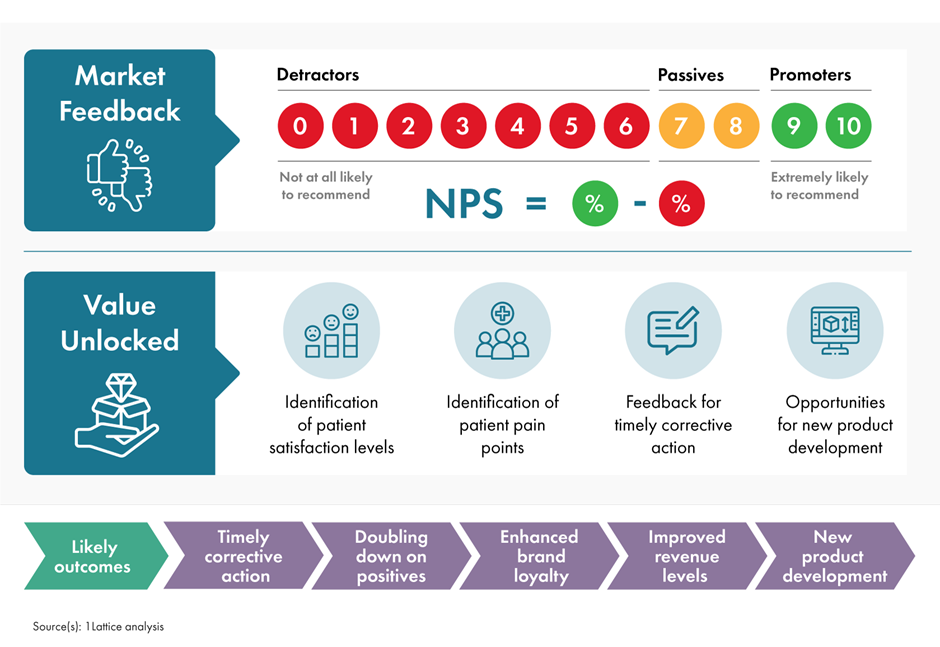 Using
NPS as a feedback mechanism allows pharmaceutical companies to get a better
understanding of how their customers feel about their products in the OTC
category. This can help them identify areas where they can improve and make
changes to better meet the needs of their customers. For example, if a company
receives a high number of low scores from detractors, it may indicate a problem
with the product, the service, or the customer experience. By addressing these
issues, the company can improve its NPS and increase customer satisfaction and
loyalty adding up to a long-term competitive advantage.
Using
NPS as a feedback mechanism allows pharmaceutical companies to get a better
understanding of how their customers feel about their products in the OTC
category. This can help them identify areas where they can improve and make
changes to better meet the needs of their customers. For example, if a company
receives a high number of low scores from detractors, it may indicate a problem
with the product, the service, or the customer experience. By addressing these
issues, the company can improve its NPS and increase customer satisfaction and
loyalty adding up to a long-term competitive advantage.
In addition to improving customer satisfaction and loyalty, a customer-centric approach can also help pharmaceutical companies better understand the needs of their target market and develop products and services that meet those needs. By gathering customer feedback through NPS and other feedback mechanisms, companies can gain valuable insights into what customers may want and what they may be willing to pay for. This can help companies develop more targeted and effective marketing campaigns, as well as drive innovation and new product development.
At
1lattice, we deliver on Physician’s NPS across patient demographics, Channel
partner NPS across channel type, margin size, geography, etc to enable better
decision making for our pharma clients.