
CPCB IV+ is usually read as a cost shock for genset makers. A closer look suggests something different. The norm raised revenue per kVA, concentrated market share among larger players, and quietly gave Indian manufacturers an export asset. For OEM strategists and investors, the real question isn’t whether compliance was expensive. It’s who came out ahead.
Key takeaways
- CPCB IV+ brought India’s generator sets from 19 kW to 800 kW broadly in line with international Tier 4 standards, faster and more completely than most industrial equipment categories.
- Compliance raised content per unit, and on our reading it was largely recoverable in price: margin-accretive for the organized tier, and dilutive only for those who couldn’t fund the engineering.
- Three consequences deserve more attention: a certification-gated retrofit market, the 800 kW band boundary, and a new export market-access advantage.
What are CPCB IV+ emission norms for gensets?
India moved to CPCB IV+ emission standards for generator sets up to 800 kW in July 2023. The standards cover the 19 kW to 800 kW range and broadly match international Tier 4. They tighten limits on oxides of nitrogen, particulate matter, carbon monoxide, and hydrocarbons.
What’s easy to miss is where this places India. Few industrial equipment categories in the country have reached the global regulatory frontier as completely or as quickly. For an OEM strategist or an investor, the interesting question is not whether compliance was expensive. It is who ended up better off.
Why does CPCB IV+ favor larger genset manufacturers?
Meeting the standard took serious engineering: selective catalytic reduction (SCR), diesel particulate filtration (DPF), electronic engine management, and the certification and conformity-of-production infrastructure behind it all. Programs with that cost profile favour scale every time.
The top five participants, Cummins India, Kirloskar Oil Engines, Caterpillar, Mahindra Powerol and Greaves Cotton, already held approximately 55–60% of organized revenue in 2024 (IMARC). We expect further concentration, but not evenly across kVA bands. It should be sharpest where compliance content costs the most relative to unit value, which points to the lower and middle bands more than the top.
What is the genset “barbell” effect?
That uneven pressure creates a barbell. At the top of the range, demand is growing fastest, and compliance content is a small share of a large ticket. At the bottom, the same content is a large share of a small one. A product strategy that treats the range as one continuum risks losing ground at both ends to participants who have chosen a side.
Did CPCB IV+ raise or cut genset margins?
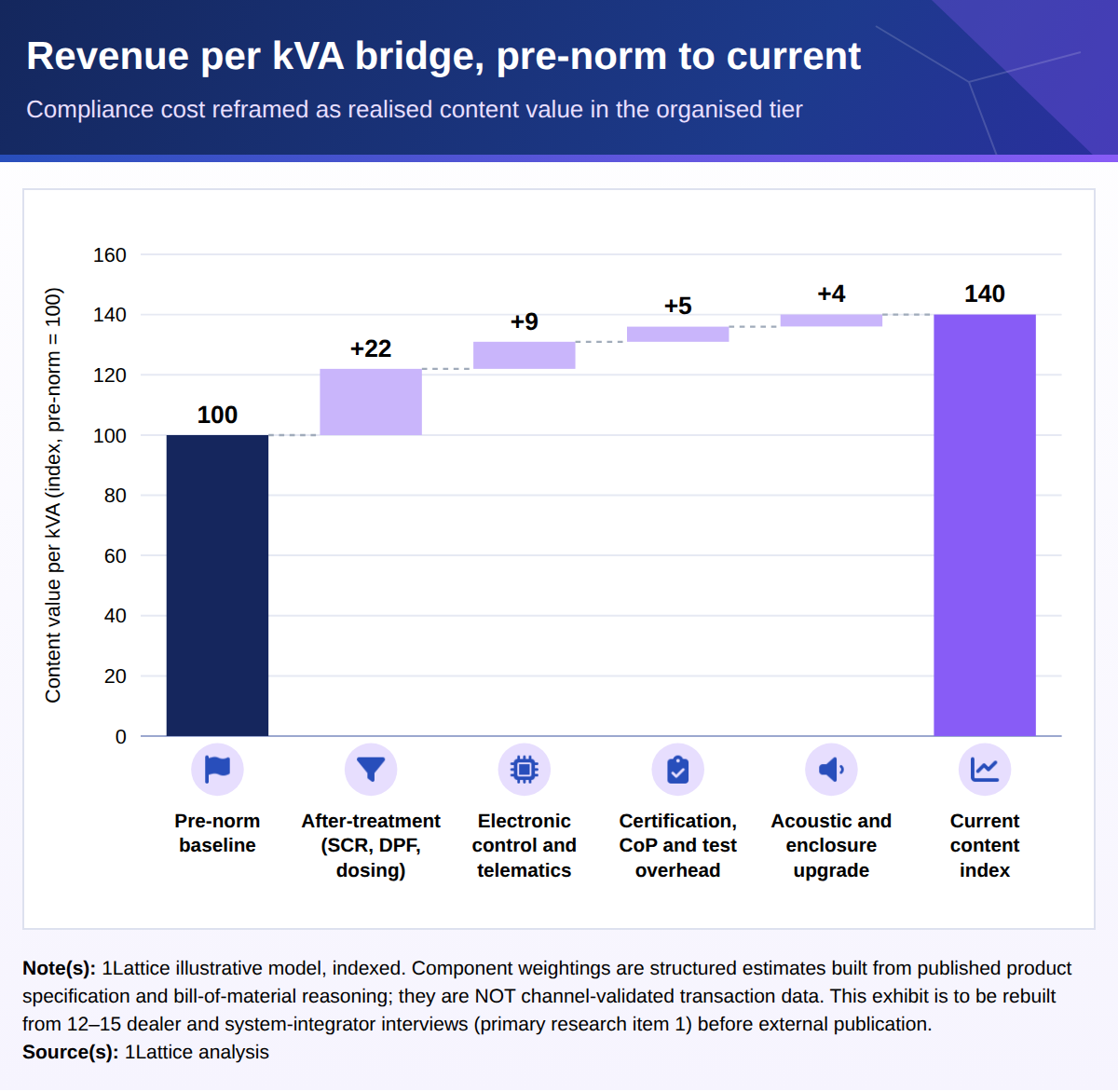
Here’s the finding that matters most to investors. Compliance raised content per unit, and content per unit is revenue per unit.
The usual framing treats after-treatment, control, and certification content as a cost imposed on manufacturers. But the entire organized tier faced the same requirement at the same moment, and the standard is legally mandatory for new installations. In those conditions, the added content was substantially recoverable in price. On our reading, the norm was margin-accretive for the organized tier, and dilutive only for participants who couldn’t fund the engineering.
It’s worth being clear about the basis for this view. This analysis is a structured model built from published product specifications and bill-of-materials reasoning, not from channel-validated transaction data. The weightings are defensible, but they aren’t measured. Realized price per kVA before and after the transition isn’t published anywhere. Rebuilding it through dealer and system-integrator interviews would settle the question outright, and it is the single highest-value piece of primary research in this area.
How did genset manufacturers respond to CPCB IV+?
The industry moved quickly:
- Greaves Cotton launched a compliant 5–2,250 kVA range with SCR and DPF in July 2024, backed by a 450-point service network and a five-year warranty.
- Cummins India introduced compliant units up to 800 kVA the same month with OptiNAS+ filtration and reported 30.8% revenue growth in Q2 FY25 on data center demand.
- Ashok Leyland showcased its SAATHI platform in January 2025, pairing CPCB IV+ gensets with predictive maintenance software.
What consequences of CPCB IV+ get less attention?
Two consequences get far less attention than they deserve.
The retrofit market. Emission control devices for the pre-transition installed base form a separate market, with its own certified-supplier dynamics. The Central Pollution Control Board publishes lists of manufacturers certified for retrofit devices on diesel genset engines up to 800 kW. For a component supplier, that’s a defined, certification-gated market attached to an installed base of known size. That combination is rare, and it’s largely missing from published market sizing.
The 800 kW band boundary. The standard applies up to 800 kW, while data center and prime-power demand concentrates above it. We raise this purely as a planning consideration. Standards evolve alongside the markets they govern, and anyone building a high-kVA product strategy on a five-year horizon should plan for the possibility that the band widens. After-treatment engineering for large platforms takes long enough that the decision can’t wait for certainty.
Can CPCB IV+ help Indian genset makers export?
This may be the consequence that matters most. Indian manufacturers absorbed the cost of Tier 4-equivalent engineering for the domestic market and built working relationships with domestic certification and test-house infrastructure along the way. Meanwhile, import certification is tightening across several of India’s natural export markets. A cost already paid at home is turning into a market-access advantage abroad.
How 1Lattice can help
1Frontier market intelligence helps OEMs, component suppliers, and investors read regulatory shifts like CPCB IV+ through competitive landscape analysis, capacity and supply intelligence, and market entry planning. And the dealer and system-integrator interviews that would settle the pricing question are exactly the kind of primary research 1Lattice runs. As Asia’s leading market intelligence platform, 1Lattice helps decision-makers see who gains when the rules change.