
The B30 surge
How India’s smaller towns are quietly reshaping the mutual fund story, and what the shift means for asset managers, distributors, and the wider BFSI industry.
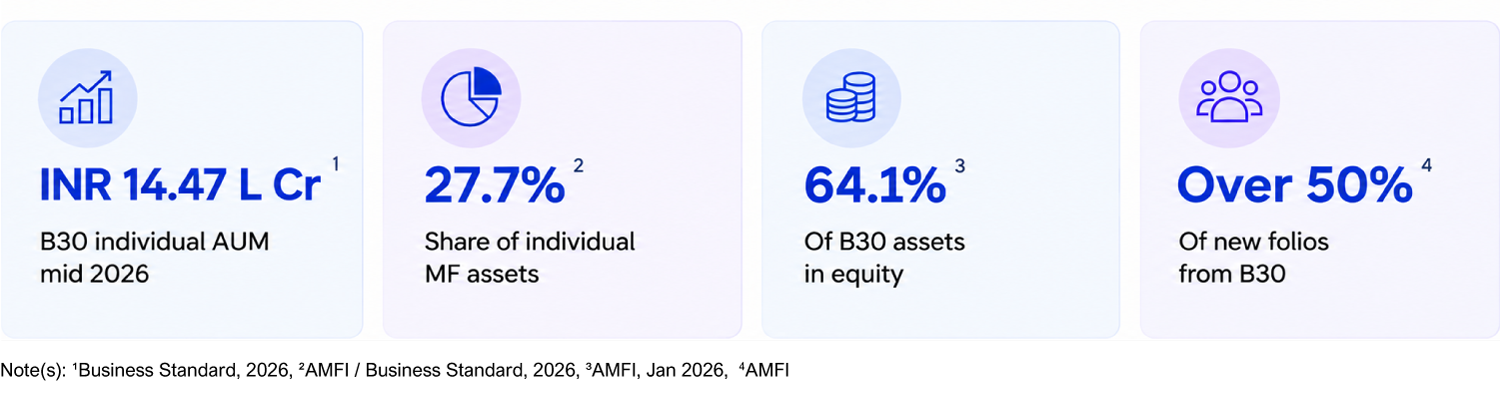
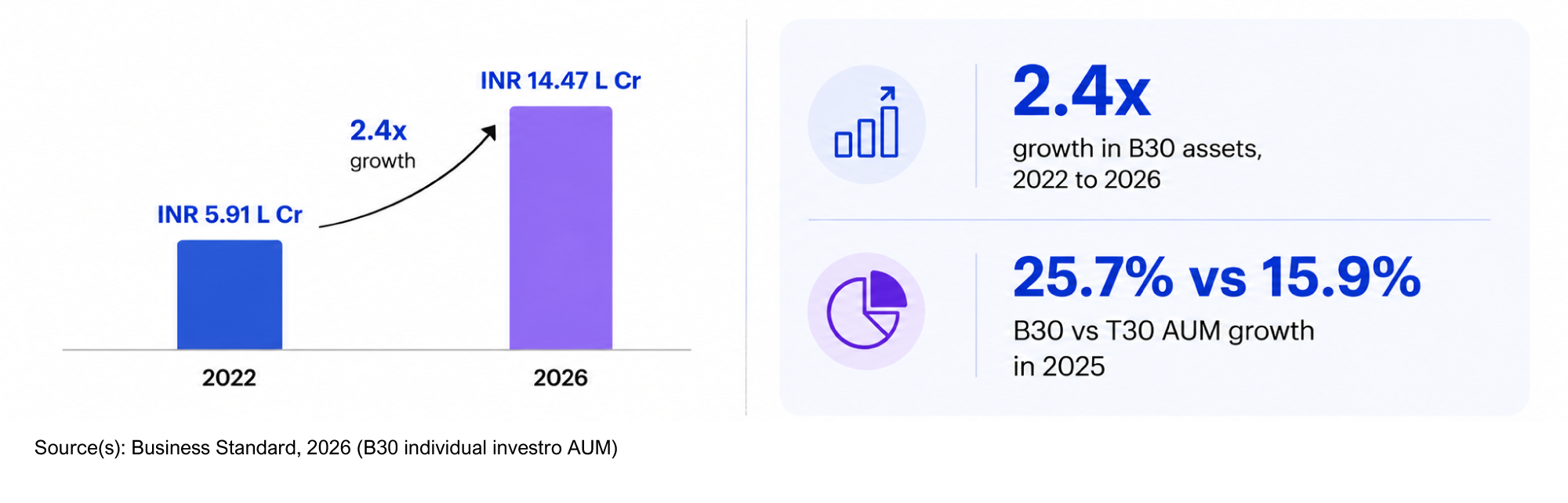
For most of its history, India’s mutual fund industry was a big-city story. That is no longer true. The fastest growth today is coming from beyond the top 30 cities, the markets that AMFI classifies as B30. Assets held by individual investors from these smaller towns have more than doubled in four years, from INR 5.91 L Cr in 2022 to INR 14.47 L Cr in the first half of 2026. B30 now accounts for 27.7% of all individual investor assets in the industry, and the momentum looks structural rather than a passing market phase.
Growth that outpaces the metros
The gap in growth rates tells the story. In 2025, individual assets in B30 markets expanded 25.7%, well ahead of the 15.9% recorded in the top 30 (T30) cities. Over five years, B30 assets have compounded at roughly 24% a year, against about 20% for T30.
The B30 share of total industry AUM has risen to about 19% in Jan '26, from 16% at the end of 2020. The wider base is expanding in step: the industry now counts more than 6 Cr unique investors, and monthly systematic investment plan inflows crossed INR 31,000 Cr in Jan '26.
B30 individual AUM has more than doubled in four years
A different kind of investor
What makes the B30 investor interesting is not only the pace of growth but also the profile. Households in these markets are markedly more equity-oriented. As of Jan '26, equity schemes made up 64.1% of B30 assets, against 38.2% in the metros.
They invest in smaller amounts, with an average retail ticket size of about INR 1.13 L in B30, against roughly INR 2.04 L across all India, yet they participate in large numbers. More than half of the industry’s live SIP accounts, and over half of all new investor folios, now originate in B30 cities.
And they are staying, with the share of B30 SIP assets held in accounts older than five years rising from 11% in Mar’20 to 29% in Mar’25.
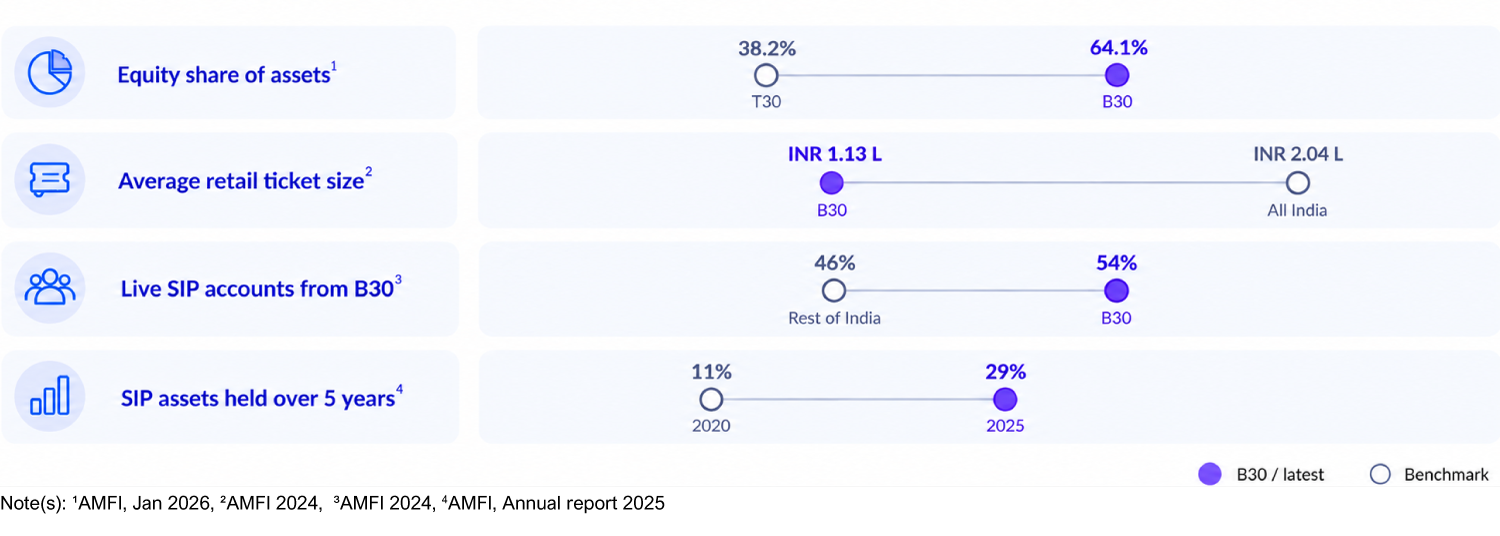
In short, the B30 investor tends to arrive through a monthly SIP, favor equity, commit smaller sums, and hold for longer. That combination of small tickets, high discipline, and rising persistence is exactly what builds a durable retail franchise.
What is driving the surge?
Several forces are converging. Digital rails have removed the friction that once kept smaller towns out. App-based onboarding, UPI autopay mandates, and vernacular interfaces have made starting a SIP a few taps away.
Distribution has widened, helped by SEBI’s structural nudge of an extra 30 bps commission on incremental B30 flows, which has encouraged fund houses to look beyond the metros.
Underlying all of it is a broader financialization of household savings, as families that once defaulted to fixed deposits and gold now route a share of their surplus into markets through the discipline of an SIP.
The fragility beneath the surge
The momentum is real, but it is not yet fully tested. The market correction in early 2026 showed the first strain, with direct-plan SIP accounts in B30 falling by over 3.5 L during March and April. The impact was most pronounced among do-it-yourself investors in smaller towns, even as other segments held steady.
Newer investors, investing without an advisor and through their first market cycle, are the most likely to pause when returns turn negative. The surge has depth, but its youngest cohort has not yet lived through a prolonged downturn.
Why it matters across BFSI
For asset managers, B30 is now the primary axis of retail growth, and the contest is shifting from product to reach, trust, and service in markets where brand familiarity cannot be assumed.
For distributors, the opportunity is wide open. The industry has roughly 2 L distributors for more than 6 Cr investors, close to one for every 7,350 people, leaving much of the country underserved.
And for banks and insurers, the same B30 household is deciding where its savings and premiums go, which makes understanding this investor a shared BFSI priority rather than an asset management one.
The questions worth answering
The headline numbers are clear; the consumer questions behind them are not.
Who exactly is the B30 investor, and how does that differ between a busy Tier 2 hub and a genuinely rural market?
What do these households understand about risk, and what will they do when a SIP is under water?
Which brands do they trust, and how does that trust travel through a distributor rather than a branch?
These are questions that aggregate industry data cannot answer; they call for primary research on the ground.
How we look at it
At 1Lattice, we track shifts like this through primary consumer research across BFSI, segmentation that separates the many faces of the B30 investor, driver and switching studies that explain what starts and stops a SIP, and brand and trust tracking in exactly the markets where the next crore of investors will come from.
The bottom line
The B30 surge is one of the more consequential shifts in Indian financial services, and it is still early.
The households opening their first SIP in a Tier 2 town today are the retail core of the industry tomorrow. Across BFSI, the advantage will sit with the institutions that understand this investor, market by market, well before the competition treats these towns as more than a line in an industry report.