
A Net Promoter Score (NPS) tells you where you stand, not what to do next. Two companies with the same NPS can have very different businesses behind the number and need very different decisions. NPS driver analysis closes that gap by showing where the score comes from, why customers feel the way they do, and which actions will move it.
Key takeaways
- Net Promoter Score (NPS) is a valuable summary of customer advocacy, but on its own it doesn’t explain who feels that way or why.
- Five questions turn a score into decisions: where it comes from, whose voice is missing, why customers feel that way, how it compares, and which way it is heading.
- Passives (scores of 7–8) are easy to overlook, but they can be an important pool of customers with the potential to strengthen loyalty.
What is NPS, and what can’t it tell you?
NPS is the share of promoters (scores of 9–10) minus the share of detractors (scores of 0–6). It is a valuable summary of customer advocacy. But a summary is all it is. It does not tell you who feels that way, why, or what would change their mind. These are exactly the questions that decide where to invest, what to fix, and where the next phase of growth will come from.
Same score, different businesses
Imagine two companies in the same category, each reporting an NPS of +40. The first owes its score to a loyal base in two metros, while customers in newer markets are quietly drifting away. The second scores consistently everywhere, but its promoters are loyal mainly on price, the one advantage a competitor can match overnight. Same number. Very different businesses, and very different decisions.
What five questions should your NPS answer?
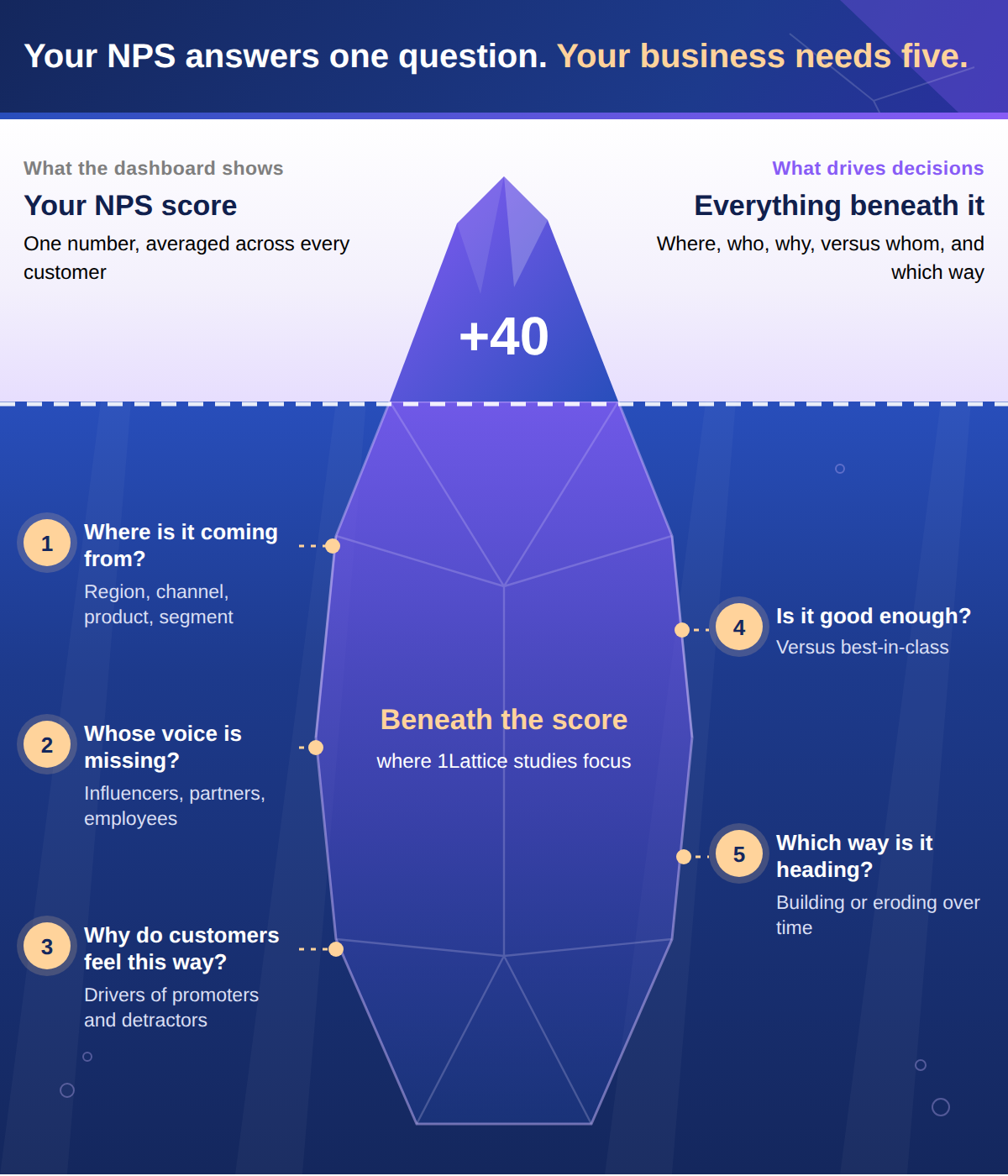
- Where is it coming from? Which regions, channels, products, or customer segments are driving the score, and which are holding it back?
- Whose voice is missing? What are influencers such as architects, contractors and installers, channel partners and employees saying?
- Why do customers feel this way? Which experiences are actually driving advocacy or dissatisfaction? A detractor lost over delivery delays needs a very different fix from one lost over price.
- Is it good enough? How does your NPS compare with competitors and with the best-in-class player in your category?
- Which way is it heading? Is loyalty strengthening, stagnating or eroding over time?
Why do NPS passives matter?
Passives, those scoring 7 or 8, rarely complain or recommend, which makes them easy to overlook. Yet understanding what holds them back can reveal an important pool of customers with the potential to strengthen loyalty.

How does NPS driver analysis work?
At 1Lattice, we don’t just ask what score customers gave; we establish what is driving it. Through 1Sense, our face-to-face and telephone studies follow three steps:
- Establish the baseline: measure overall advocacy before diagnosing individual touchpoints.
- Identify the drivers: link scores to the experiences actually influencing them.
- Prioritize the action: turn findings into interventions and validate their impact over time.
NPS and CSAT research in consumer and retail
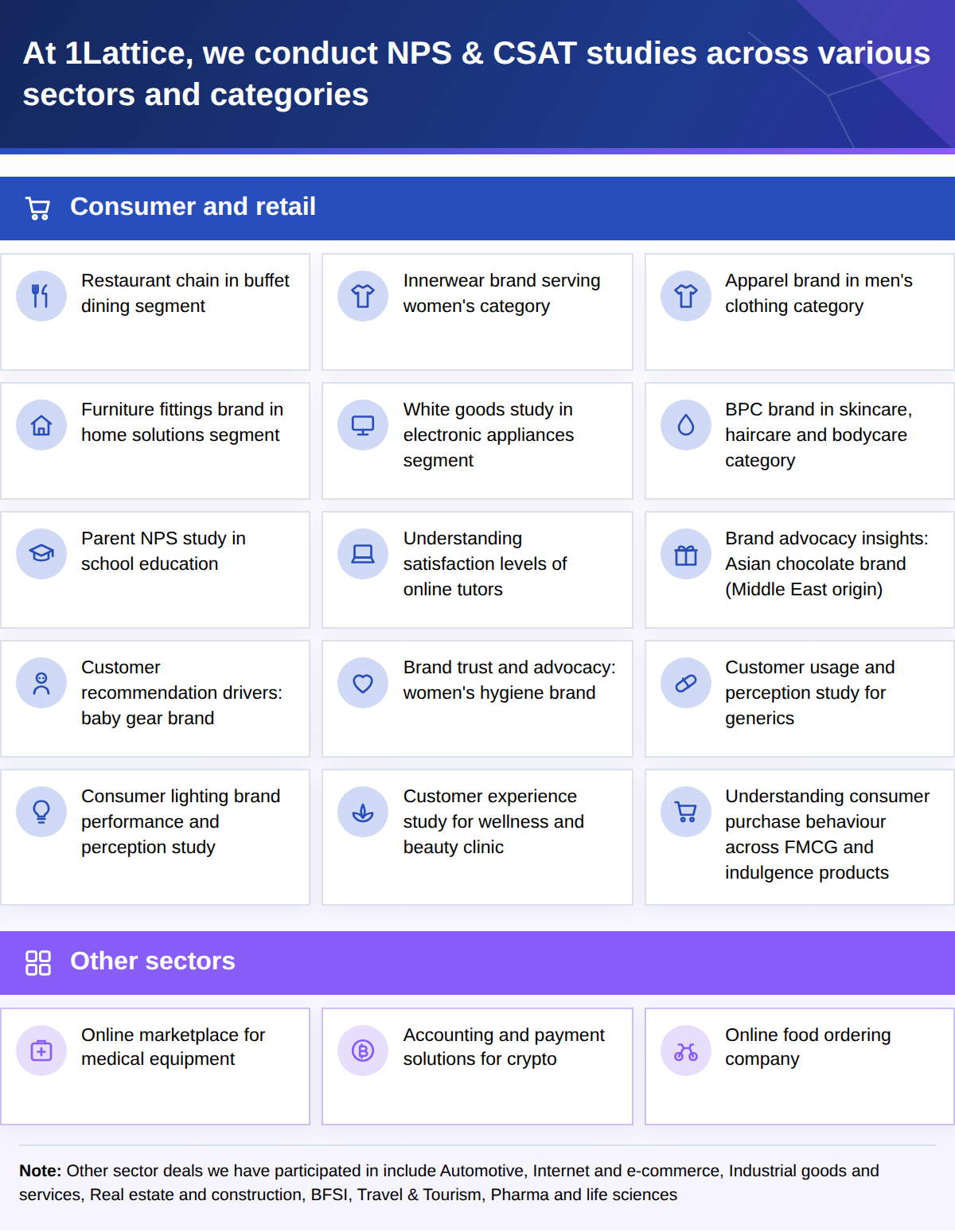
Consumer and retail is a core area of 1Lattice’s NPS and CSAT work, spanning apparel, beauty and personal care, food and indulgence, home and appliances, and education. These studies have looked beyond the headline score at recommendation drivers, brand trust and advocacy, perception, and the wider customer experience.
When should you look beyond your NPS?
It may be time to look beyond your score if:
- Your NPS has stayed flat despite investments in customer experience
- Scores vary widely across regions, channels or products, and the reasons are unclear
- You track NPS internally but have never benchmarked it against competitors
- Feedback is collected regularly but rarely translates into specific actions
How 1Sense can help
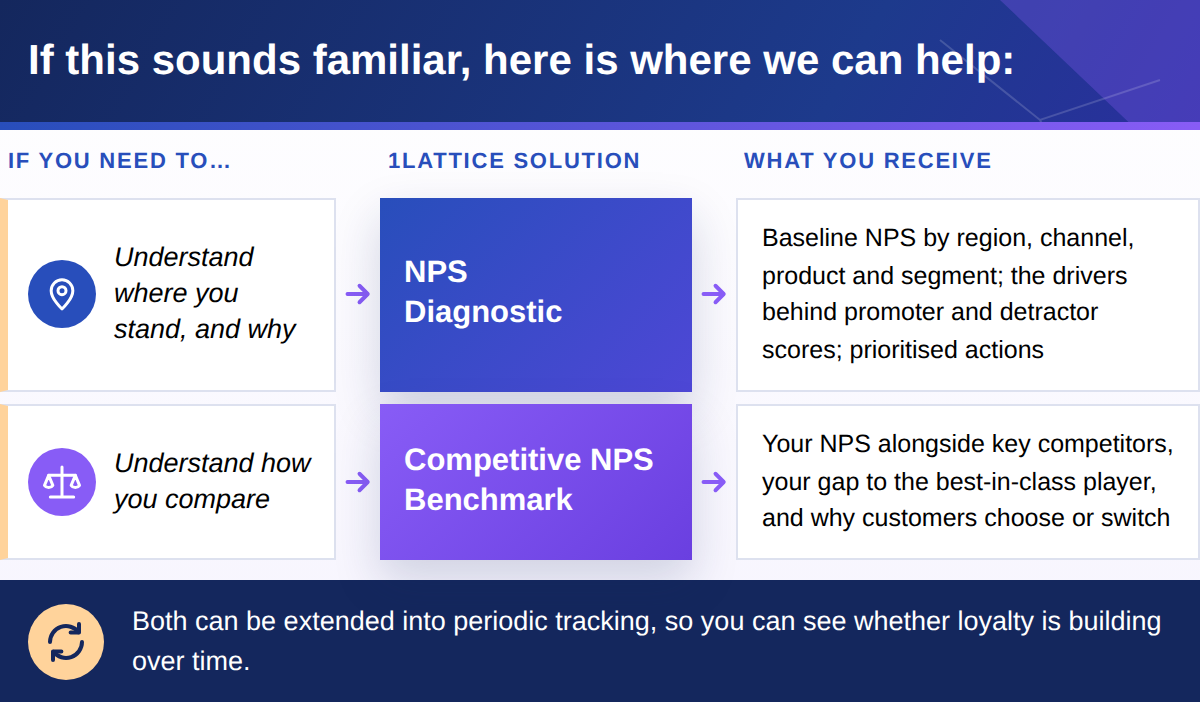
Both can be extended into periodic tracking, so you can see whether loyalty is building over time.