
A new chapter in India's e-commerce history is about to begin. For many years, the metro area served as the focal point of the expansion strategy, which called for acquiring tech-savvy customers, building scale, and then branching out. But the direction of incremental growth is increasingly reversing that logic. The next wave of online consumption is being built beyond the metros.
Around two-thirds of incremental D2C orders in FY26 came from Tier 2 and 3 cities, contributing close to 60% of incremental GMV. At the same time, there are more than 950 million active internet users in India, most of whom live in rural areas.
The opportunity is therefore no longer simply about taking e-commerce to smaller cities. It is about co when consumers who were previously constrained by physical access enter a much wider digital marketplace.
From limited choice to unlimited discovery
For consumers in India’s smaller cities, e-commerce solves a problem that is fundamentally different from the one it solves in metros.
In large cities, online shopping often competes with an established ecosystem of malls, organized retailers, and extensive brand availability. The proposition is frequently convenience, speed, and price comparison.
Beyond the metros, the proposition can be much more fundamental: access to brands and products that may simply not exist in the local retail environment.
More than 60% of online shoppers prefer apps over websites, while online order volumes in Tier 2 and 3 cities have increased by more than 60%. Limited brand availability, stock-outs, and a narrower offline assortment are among the reasons consumers outside major urban centers increasingly turn online.
This changes the role of e-commerce.
It is not merely replacing an offline purchase. In many cases, it is enabling the purchase in the first place.
That distinction creates a larger opportunity for categories that have historically depended on physical distribution.
The next opportunity may be categories, not cities
The instinctive response to the rise of Tier 2 and 3 markets is to ask:
“How do we distribute our existing products there?”
The more useful question is:
“Which categories could grow once distribution is no longer the constraint?”
Consumers outside the largest cities are showing increasing engagement with categories such as home and kitchen, sports and fitness, health and wellness, alongside established online categories such as fashion and beauty.
For categories with fragmented offline distribution, this can be transformative.
A consumer in a Tier 3 city does not need a premium home store nearby to discover a new home décor brand. They do not need a specialist sports retailer to access a niche fitness product. They do not need a large beauty chain to experiment with a new personal-care brand.
The digital shelf can be dramatically larger than the physical shelf.
This creates room for brands that were previously too niche, too geographically concentrated, or too difficult to distribute through conventional retail.
The emerging consumer is aspirational but value conscious.
The Tier 2/3/4 consumer should not be viewed simply as a lower-income version of the metro consumer. Consumers outside the metros place greater importance on deals and offers, while urban consumers place relatively greater value on speed and convenience.
In fashion and accessories, price remains a particularly important reason for continuing to use an online platform. At the same time, premium brands and products are increasingly becoming accessible through digital channels.
The whitespace sits between mass and premium: products that deliver a visible upgrade without becoming financially inaccessible.
Discovery is becoming the new distribution advantage
The expansion of e-commerce is also changing how brands get discovered.
Social media is increasingly influencing product trials. Around six in ten consumers have tried products after seeing them on platforms such as Facebook and Instagram.
For consumers beyond the metros, this is particularly powerful because digital content can introduce products that physical retail may not stock.
The journey increasingly looks like:
Content → discovery → consideration → trust → purchase
rather than:
Store → shelf → purchase
This creates an important strategic shift.
A brand’s challenge is no longer simply to be available in a city. It is to become relevant enough to be discovered by consumers in that city.
This is especially important for D2C and emerging brands, where social content, creators, reviews, and community can substitute for some of the physical visibility traditionally provided by stores.
One India does not mean one consumer
There is, however, a danger in treating Tier 2, 3, and 4 India as one homogeneous opportunity.
India changes every few hundred kilometers. Language, culture, purchasing power, category maturity, trust drivers, and consumption occasions can vary substantially across markets.
The implication is that distribution can be national, but the consumer proposition may need to be local.
The brands that win beyond the metros may therefore be those that understand the difference between being present and being locally relevant.
Where the next e-commerce whitespace is emerging
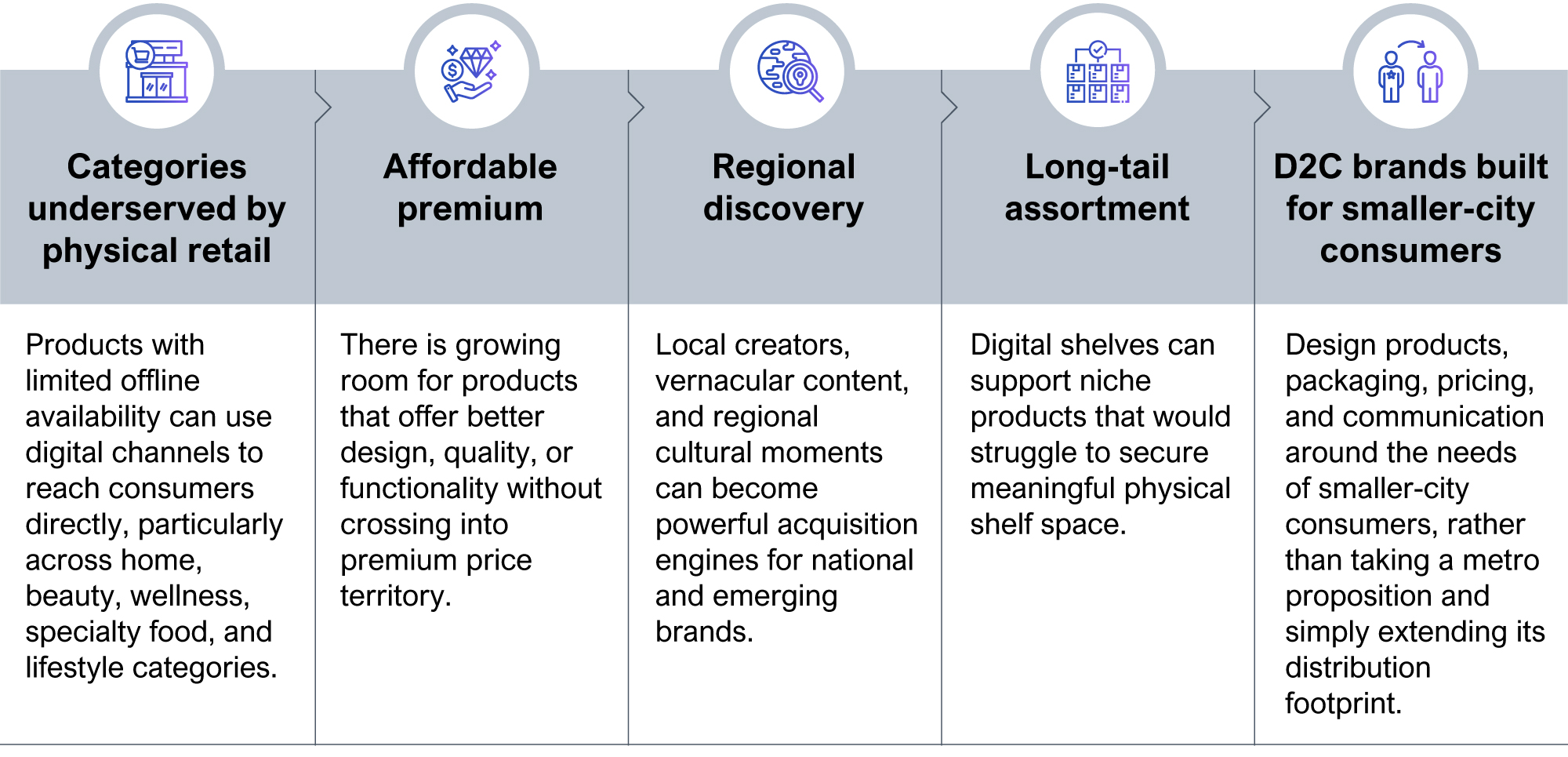
The convergence of digital access, expanding D2C adoption and broader product availability is creating sevral opportunities
The bigger shift
The first phase of Indian e-commerce was about bringing consumers online.
The next phase is about expanding what those consumers can access once they are online.
That makes Tier 2, 3, and 4 India more than a geographic expansion story. It is a consumption whitespace story.
The question for brands is no longer:
“How do we sell more in smaller cities?”
It is:
"When geography no longer restricts what consumers can find, what will they purchase?"
The answer could reshape the next generation of growth across fashion, beauty, home, food, wellness, and lifestyle.
India’s next consumer is not waiting to come online. They are already shopping.
Where is your next consumer opportunity?
1Insight helps businesses understand market potential, consumer needs, category dynamics, competitive landscapes, and emerging growth opportunities.