
Enhancing the customer's shopping journey and
delivering tailored experiences at every touchpoint is at the core of retail
personalization. By leveraging real-time intent, browsing and purchasing
history, and insights from analytics technologies, this process ensures that
each consumer receives a unique and personalized experience.
In the past, retail personalization was considered
a “good to have” addition to marketing strategies. However, in today's
landscape, it has become an expectation among customers. When personalization
falls short, a significant majority (71%) of consumers feel frustrated with the
overall shopping experience. Personalization has now evolved into a hygiene
factor—a standard that customers take for granted. Yet, if a retailer fails to
meet this expectation, customers may easily switch to a competitor.
Successful personalization provides a distinct
advantage that is difficult to imitate, enabling businesses to differentiate
themselves and gain a lasting competitive edge.
Increasing importance of personalization in retail
A significant majority, more than 4 out of 5
consumers are willing to share their personal data for a personalized
experience. Customers value brands that show genuine interest in their needs,
preferences, and make shopping easy and enjoyable.
An industry report reveals that scaled personalization can boost sales
by up to 2%, even for essential businesses like grocery stores. Other
industries can expect even more substantial revenue growth by customizing
interactions with most or all customers. Additionally, these personalized
programs can reduce marketing and sales costs by approximately 10 to 20%. While influencer marketing holds great potential as an advertising strategy, businesses must tread carefully and consider several crucial factors before embarking on a collaboration. Without a well-thought-out influencer marketing strategy, achieving a satisfactory return on investment (ROI) from the partnership might prove challenging. Prior to diving into the world of influencers, businesses should take the time to address the following key challenges:
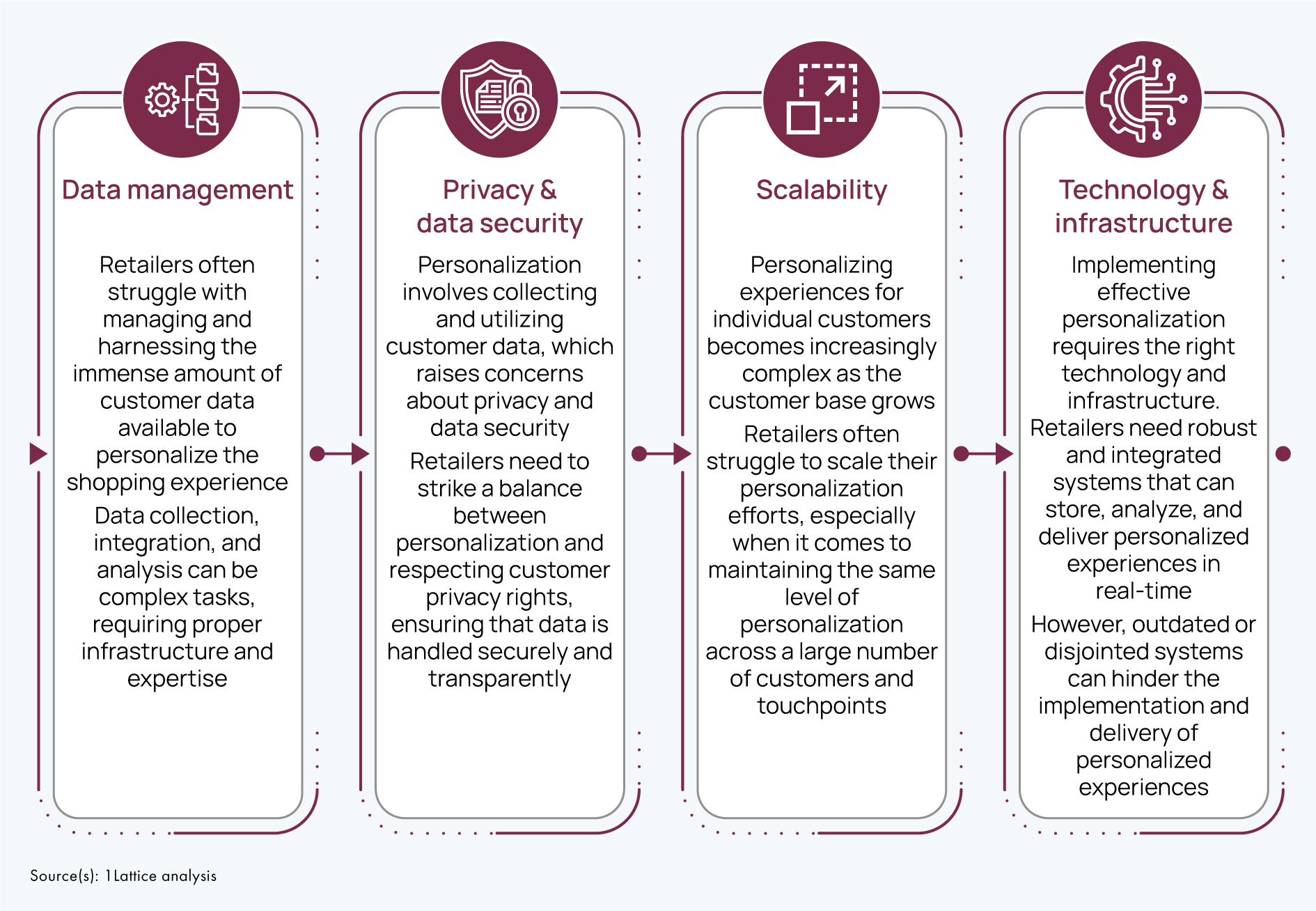
Personalization in the retail industry is challenging due to the hybrid "bricks and clicks" approach adopted by many retailers. This makes it difficult to achieve the right level of personalization in both physical stores and online platforms. Additionally, retailers with an omnichannel setup face challenges in structuring offers and executing them across different communication touchpoints. Way ahead To enhance personalization in retail and drive customer loyalty and return on investment (ROI), retailers should prioritize good data by establishing a centralized data source and supporting technology. Retailers should also think outside the box by bridging the gap between physical and online stores, utilizing mobile apps to gather customer data, and connecting in-store purchases with online data through customer emails. Customer engagement is a complex task, often more challenging than acquiring new customers. Retailers must focus on optimizing engagement across various channels and at every stage of the customer's lifecycle. Indian retail market is expected to reach US$1.1T by 2027 and US$ 2T by 2032, with consumer spending growing from US$ 2T in 2022 to nearly US$ 4.5T by 2030. To stay competitive amidst evolving customer demands and increasing industry competition, retailers must strengthen their personalization strategies in retail and continuously engage customers across all channel
Way ahead
To
enhance personalization in retail and drive customer loyalty and return on
investment (ROI), retailers should prioritize good data by establishing a
centralized data source and supporting technology. Retailers should also think
outside the box by bridging the gap between physical and online stores,
utilizing mobile apps to gather customer data, and connecting in-store purchases
with online data through customer emails.