
AI diligence: From claims to investment conviction
An impressive AI demo is not an investment thesis. In AI due diligence, investors need to check three things: whether the technology delivers reliable results for customers, whether it earns attractive economics, and whether its advantage can last as competitors catch up. Answering those questions takes independent evidence, not management claims.
Key takeaways
- A polished AI product can hide weak real-world performance, hidden manual work, and heavy dependence on outside models.
- Every management claim, from “our AI is proprietary” to “margins expand with scale”, should be tested against hard evidence.
- Strong AI due diligence shapes valuation, exposes downside risk, and points to value creation after the deal.
Why is AI so hard to evaluate for investors?
Increasingly capable foundation models, the large general-purpose AI systems many products are built on, have made it easier to build products that look intelligent. They have not made it easier to prove that an AI business can consistently solve a customer’s problem, capture the value it creates, or protect that value from competitors.
Yet investment discussions often jump too quickly from what a product can do to how much revenue it might earn, and from revenue potential to an assumed competitive moat. That leap is where the underwriting gap opens.
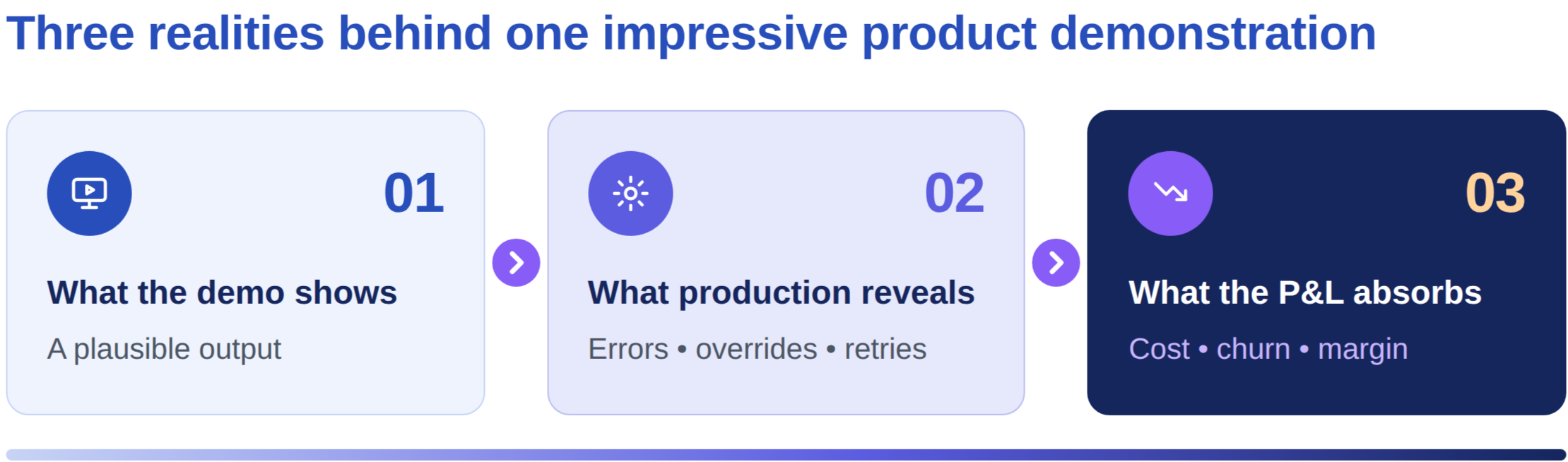
What false signals should investors watch for in AI companies?
Four patterns often make an AI business look stronger than it is:
- High accuracy, weak relevance: a headline benchmark score can hide poor performance on a customer’s real mix of tasks. Test end-to-end success, not just model-level correctness.
- Automation with a human shadow: a workflow may look automated while analysts quietly handle exceptions, correct outputs, or reconcile systems behind the scenes.
- Proprietary technology, rented intelligence: the product may rely mainly on external AI models. Ask what would still set it apart if a rival had access to the same models.
- Revenue growth, unclear contribution: per-seat or usage revenue can rise while the costs of running the AI, tool calls, retries, and manual review eat into the profit on each completed job.
Each of these blind spots raises a different question. Is the technology truly different? Does proprietary data measurably improve results? How much work is actually automated? Can quality and economics hold up at scale?
How do you test management’s AI claims?
Good AI due diligence goes beyond validating the management story. It independently assesses model performance, production workflows, proprietary data, cost structures, and competitive position. Each finding should show whether a claimed advantage is real, commercially meaningful, and sustainable.
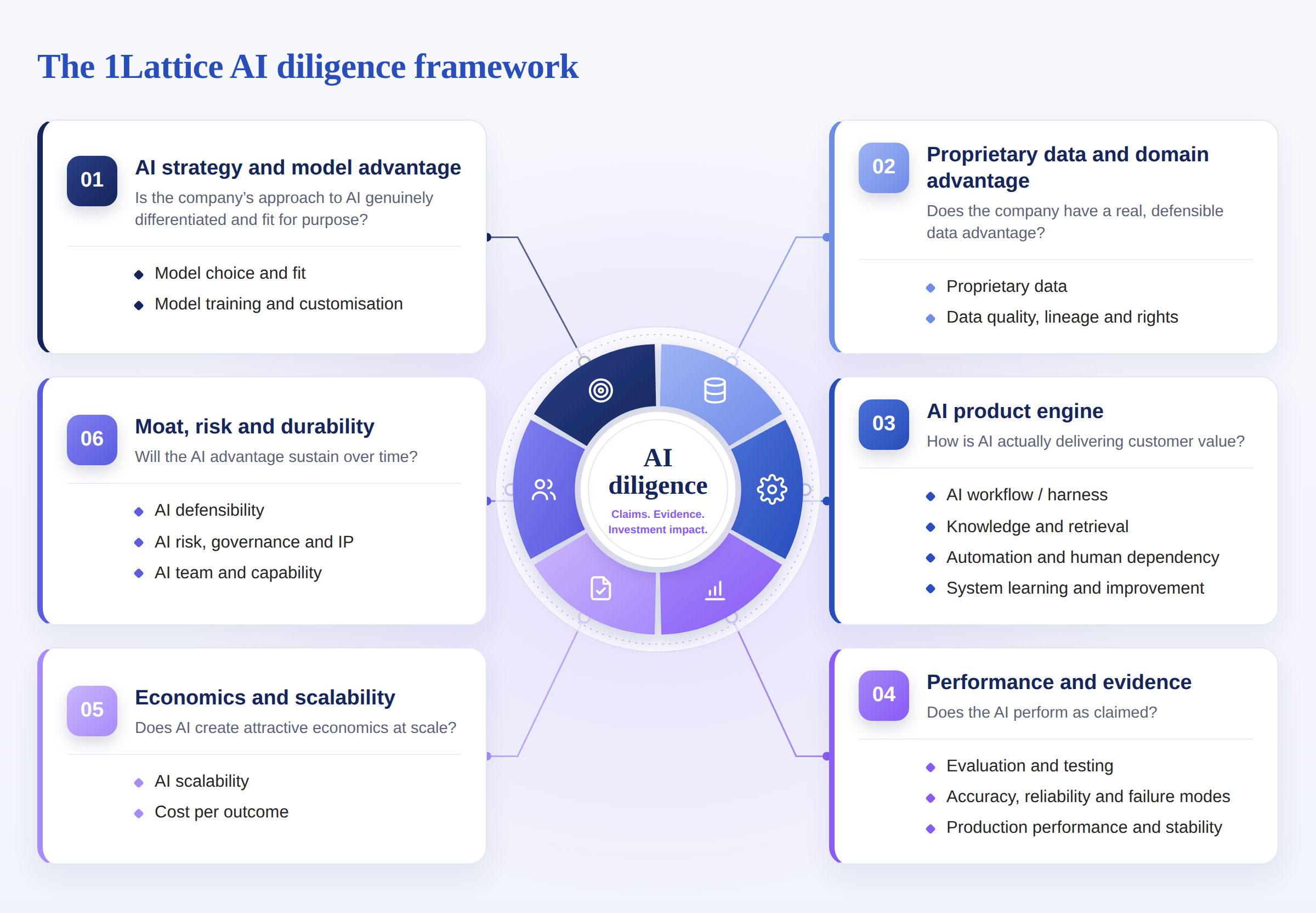
This is where 1Lattice Asia’s leading market intelligence platform’s AI diligence framework comes in, turning management claims into testable evidence and linking each finding to valuation, risk, and value creation.
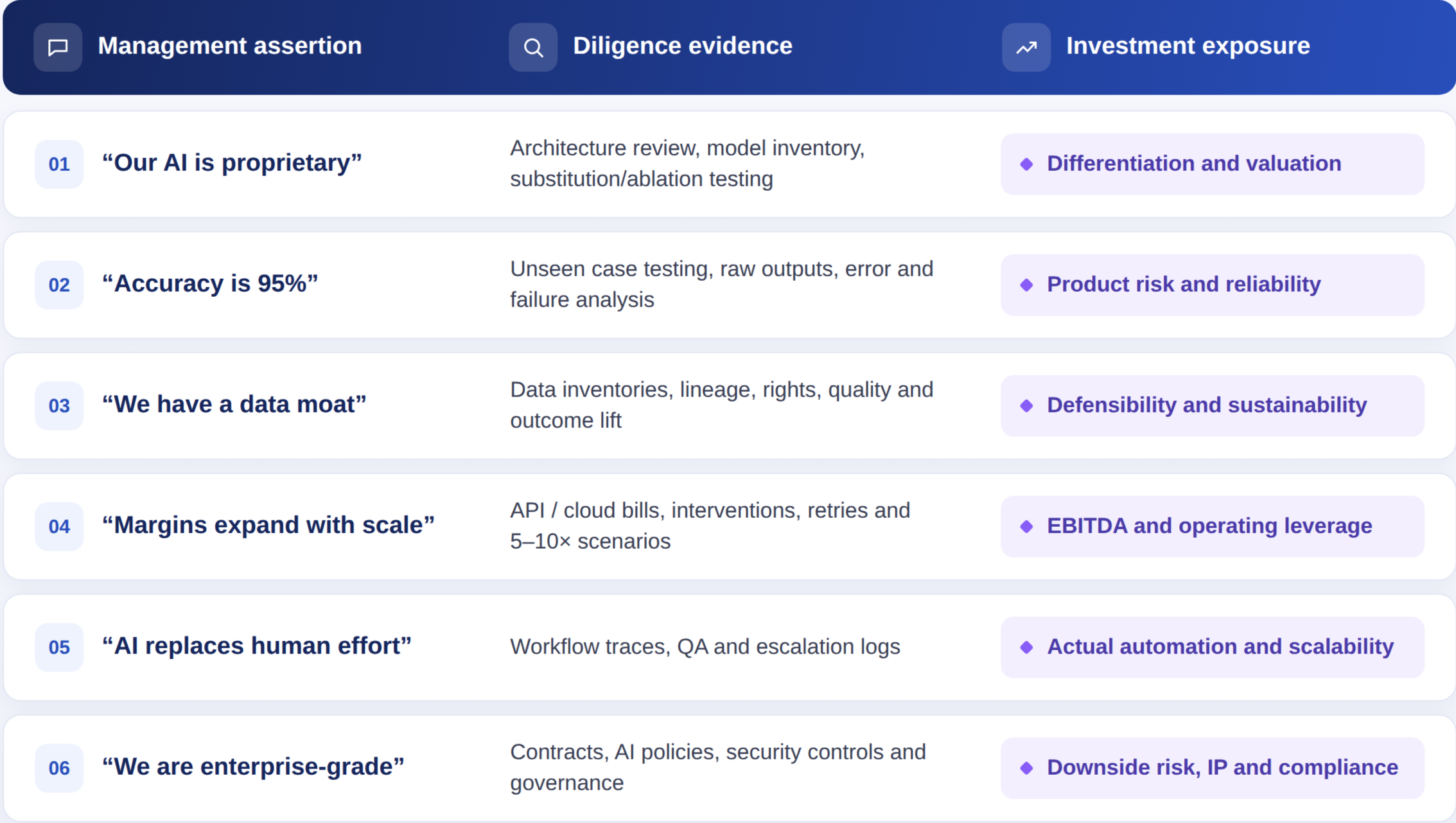
What does AI due diligence change for the investment committee?
The findings feed directly into three decisions:
- Valuation and thesis: check whether differentiation justifies a valuation premium, and identify which advantages are genuinely hard to copy.
- Risk and downside: assess and, where possible, quantify model dependence, hidden human costs, performance failures, and governance risks that could erode margins or growth.
- Post-deal value creation: find ways to increase automation, reduce inference costs (the cost of running AI models on each request), strengthen proprietary data and improve product reliability.
How 1Lattice helps funds find the answers
1Lattice Asia's leading market intelligence platform brings together deep sector knowledge, commercial diligence and hands-on AI system assessment. The aim is to judge not just how the AI works, but whether it creates a commercially meaningful and lasting advantage.
Through architecture reviews, independent model testing, production-log analysis, proprietary data assessment, customer validation, and unit economics modeling, 1Lattice establishes what drives product performance, where real differentiation exists, and which assumptions may not hold at scale. As Asia’s leading market intelligence platform, 1Lattice gives investors a clearer view of AI defensibility, economic viability, and downside risk, along with practical priorities for value creation after the investment.
The investment takeaway
AI due diligence shouldn’t stop at proving that a product works. It should establish whether that product can win, earn attractive margins, and defend its position as the technology evolves.