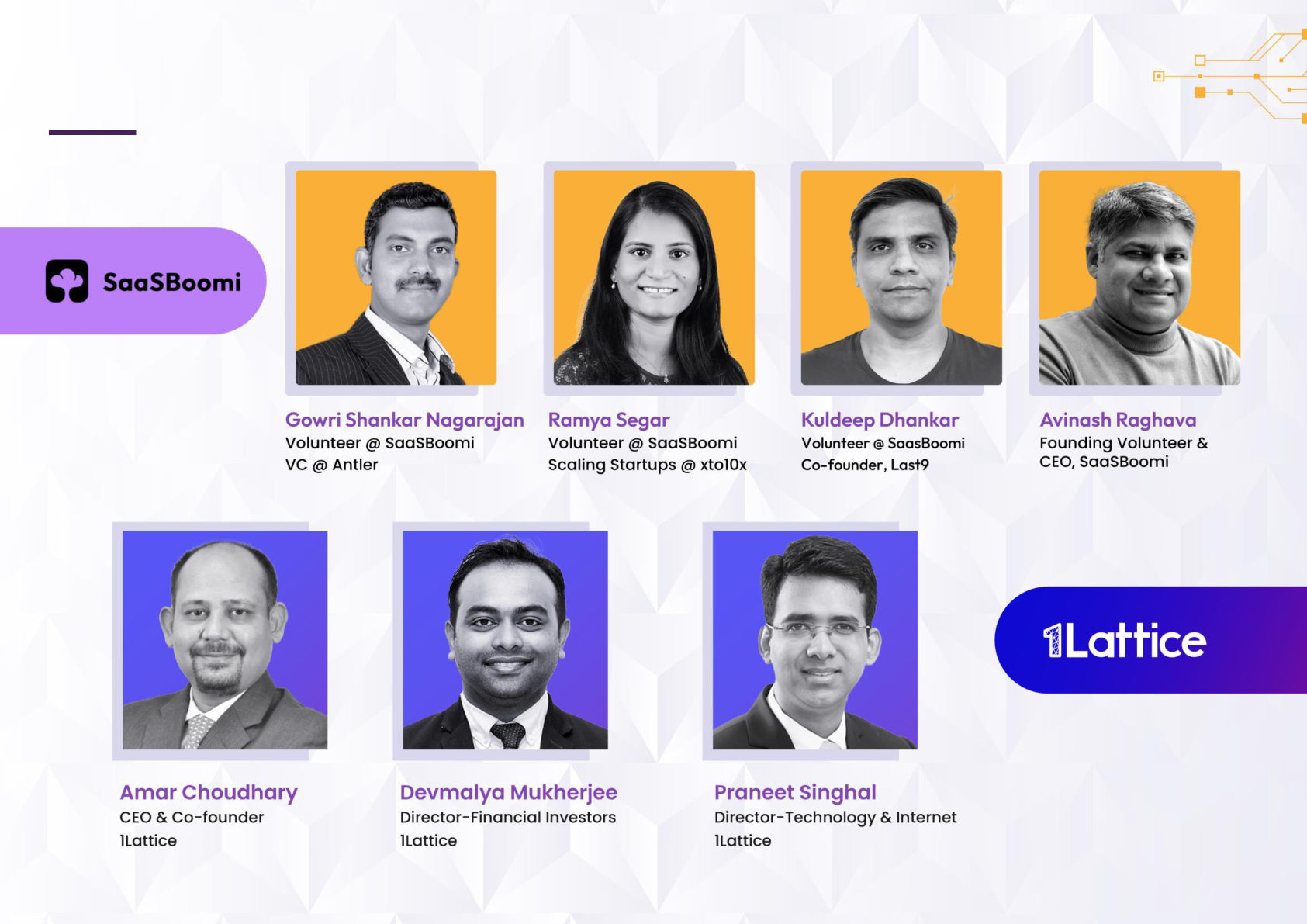
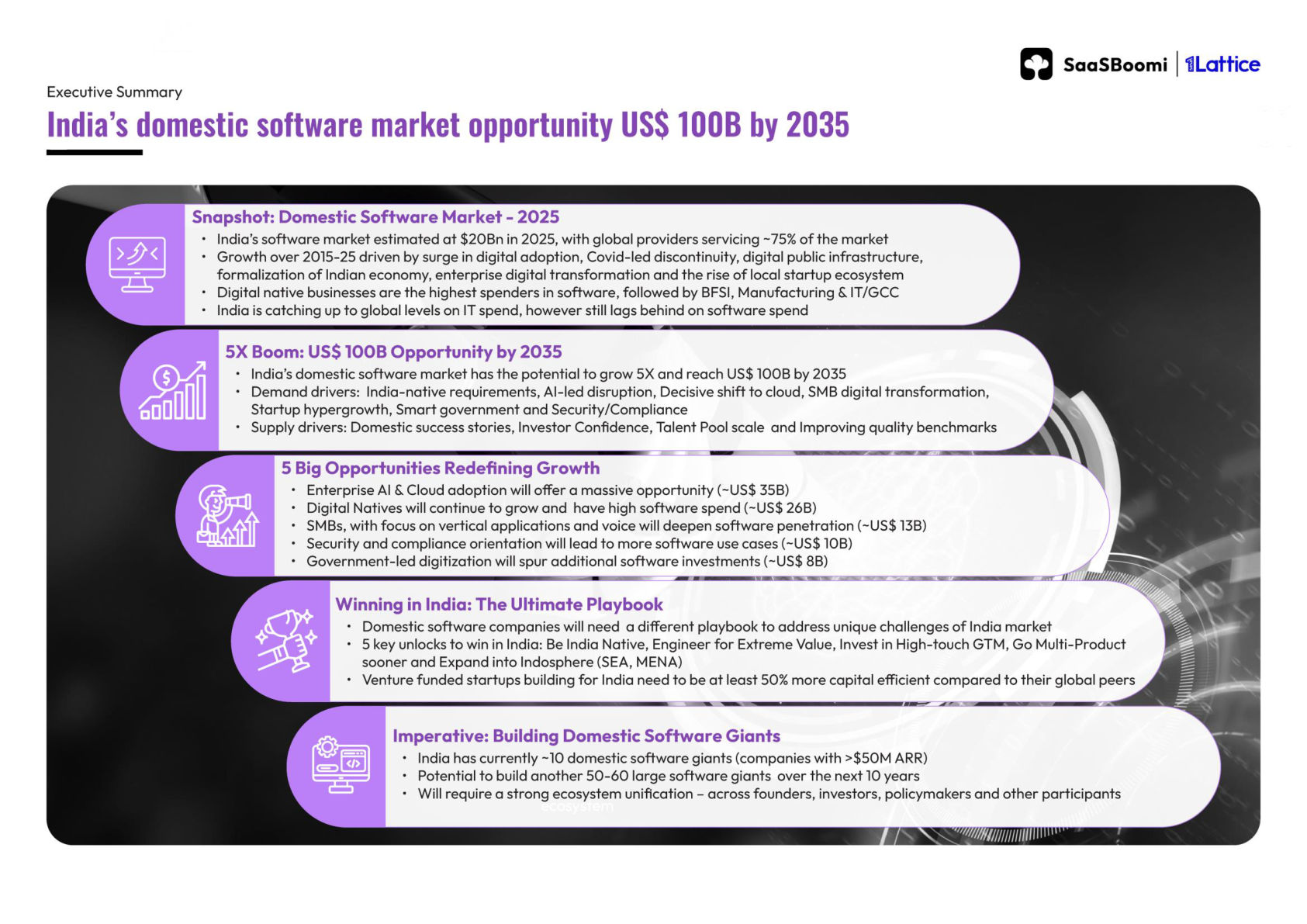
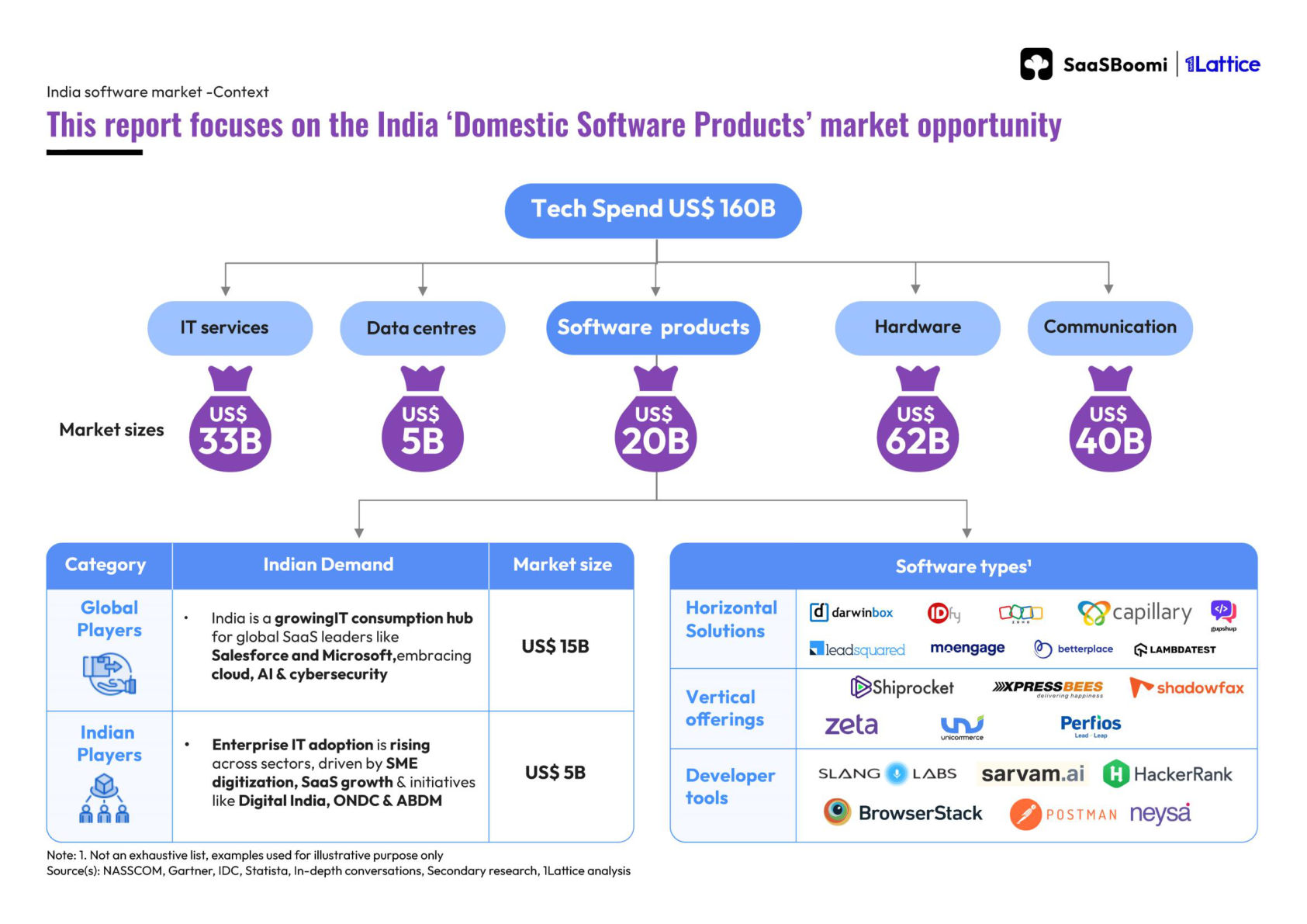
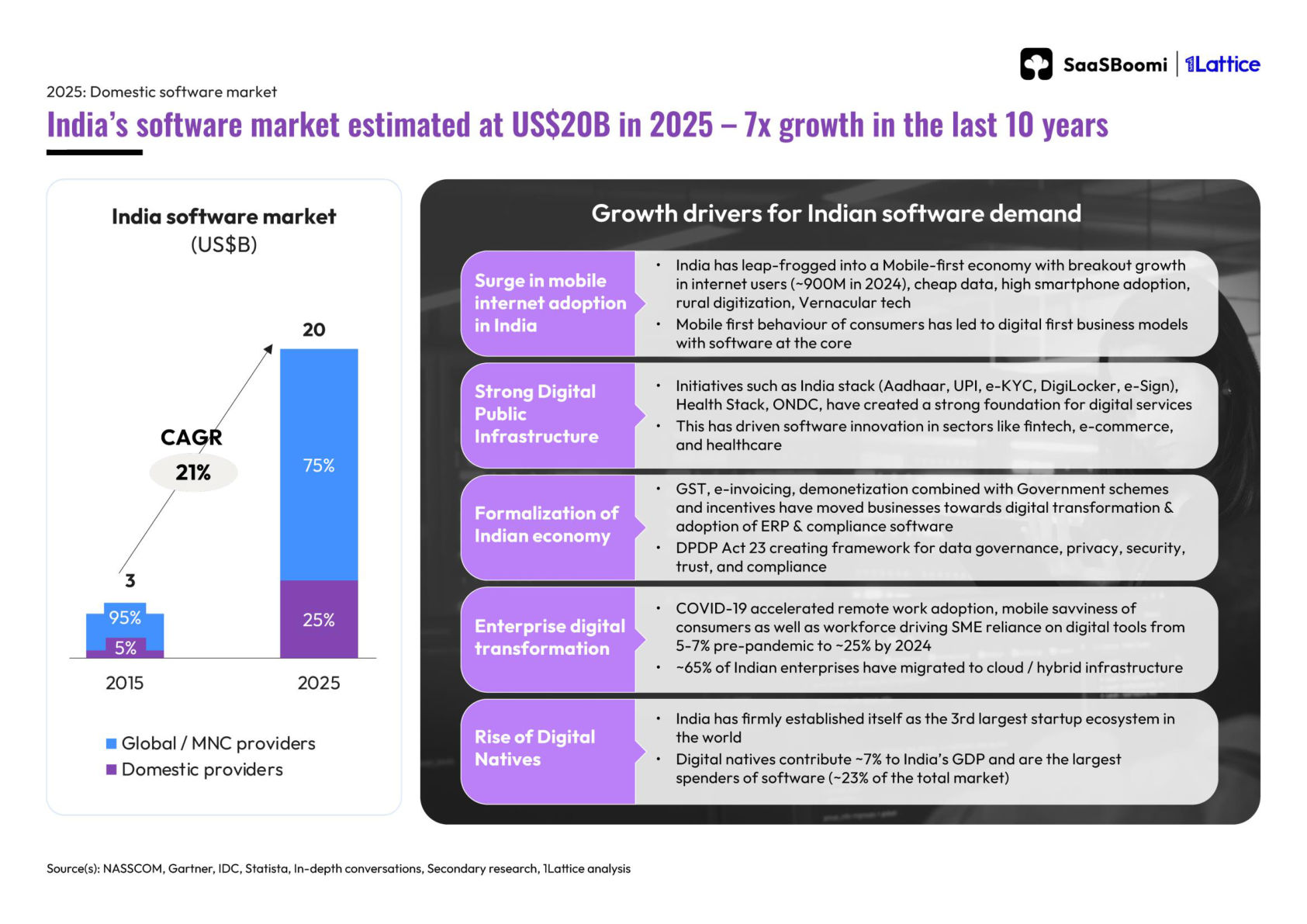
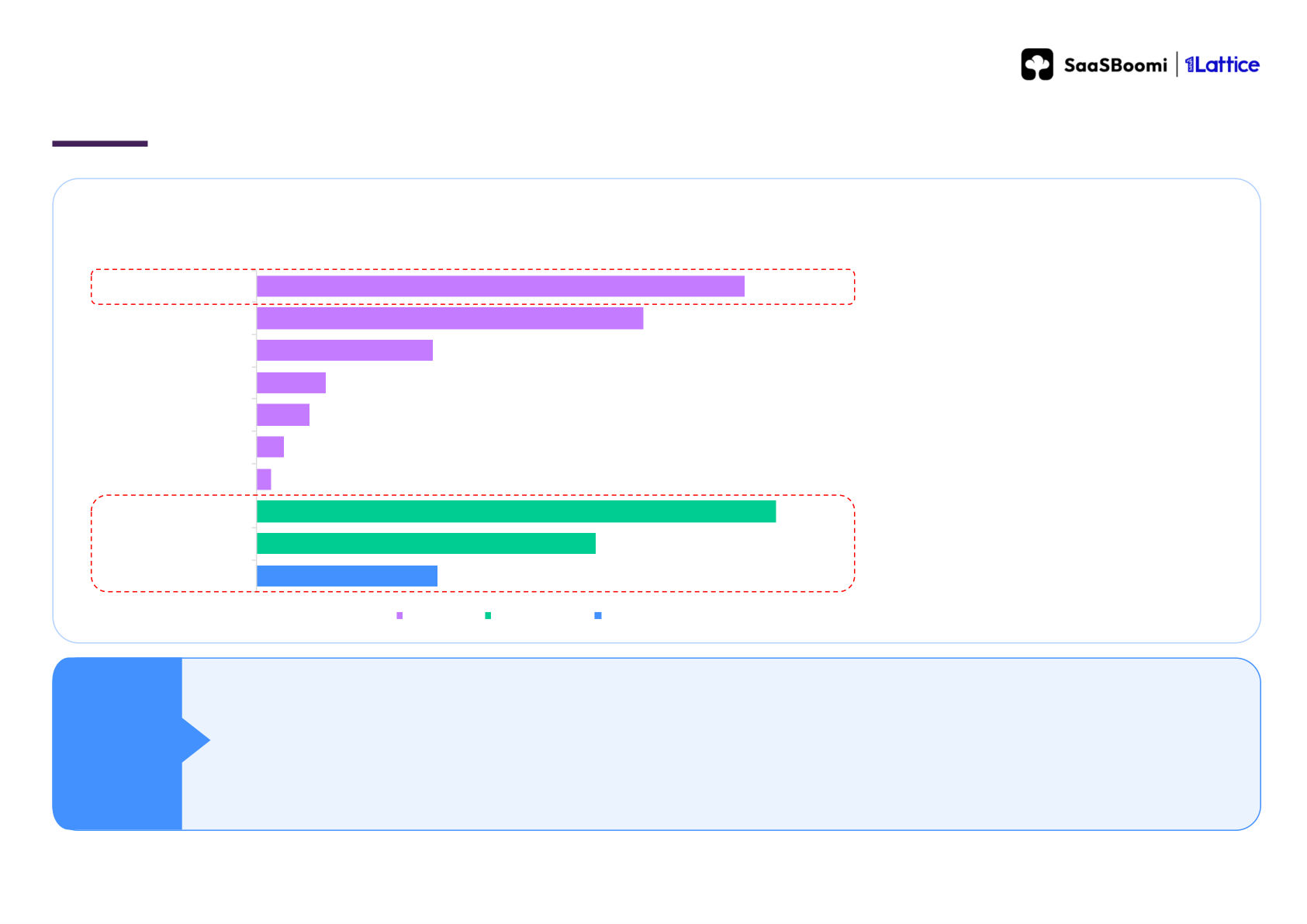
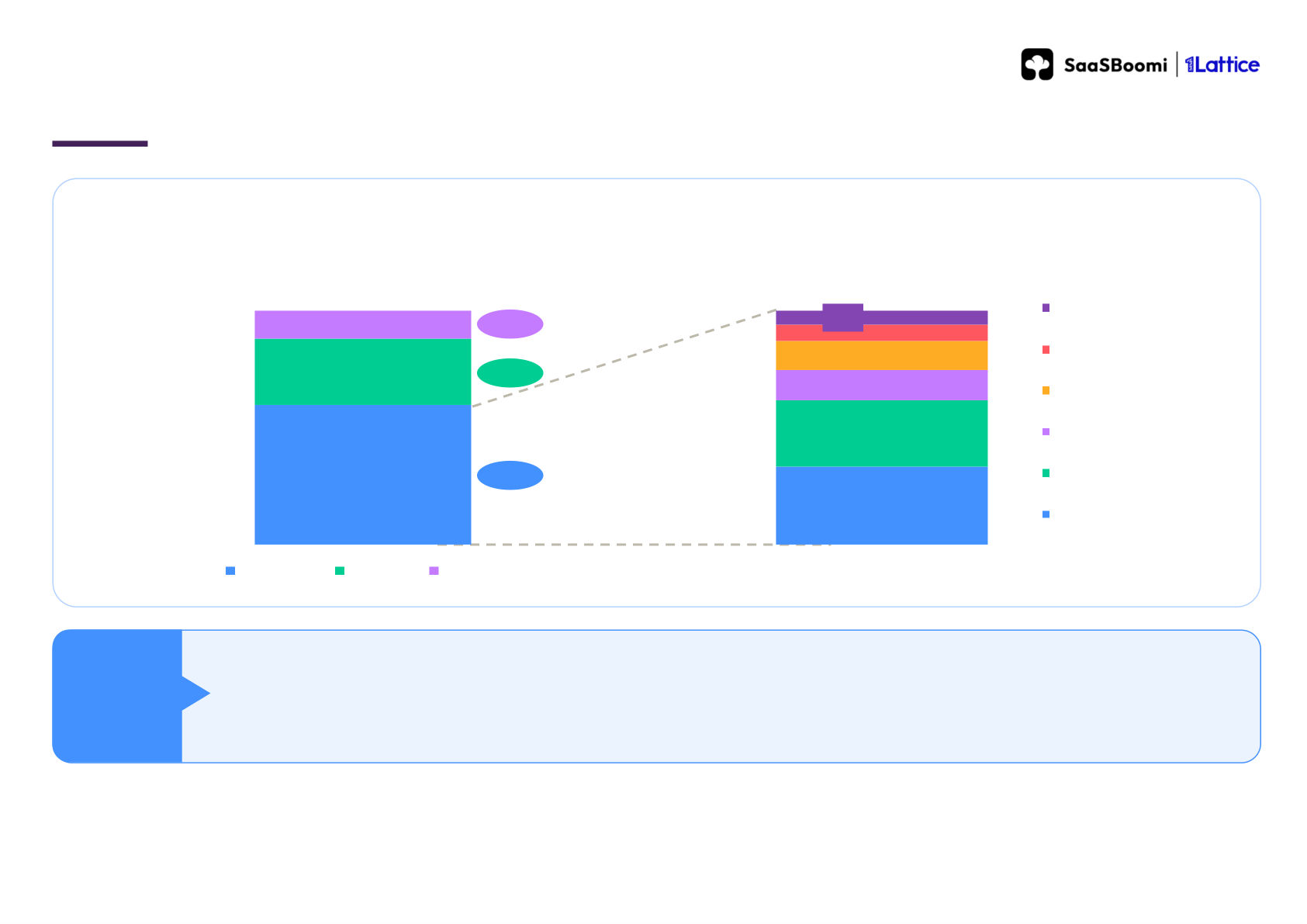
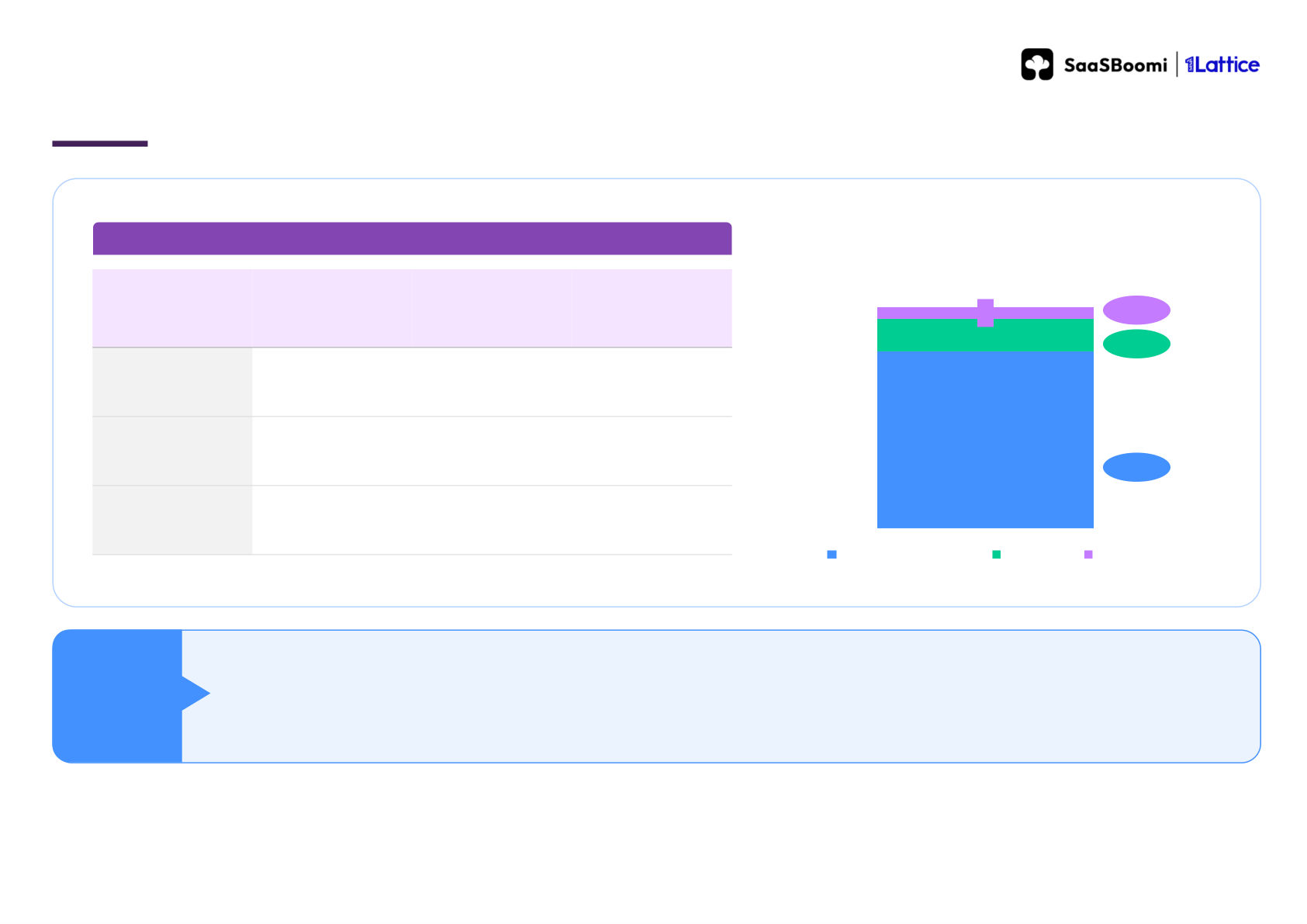
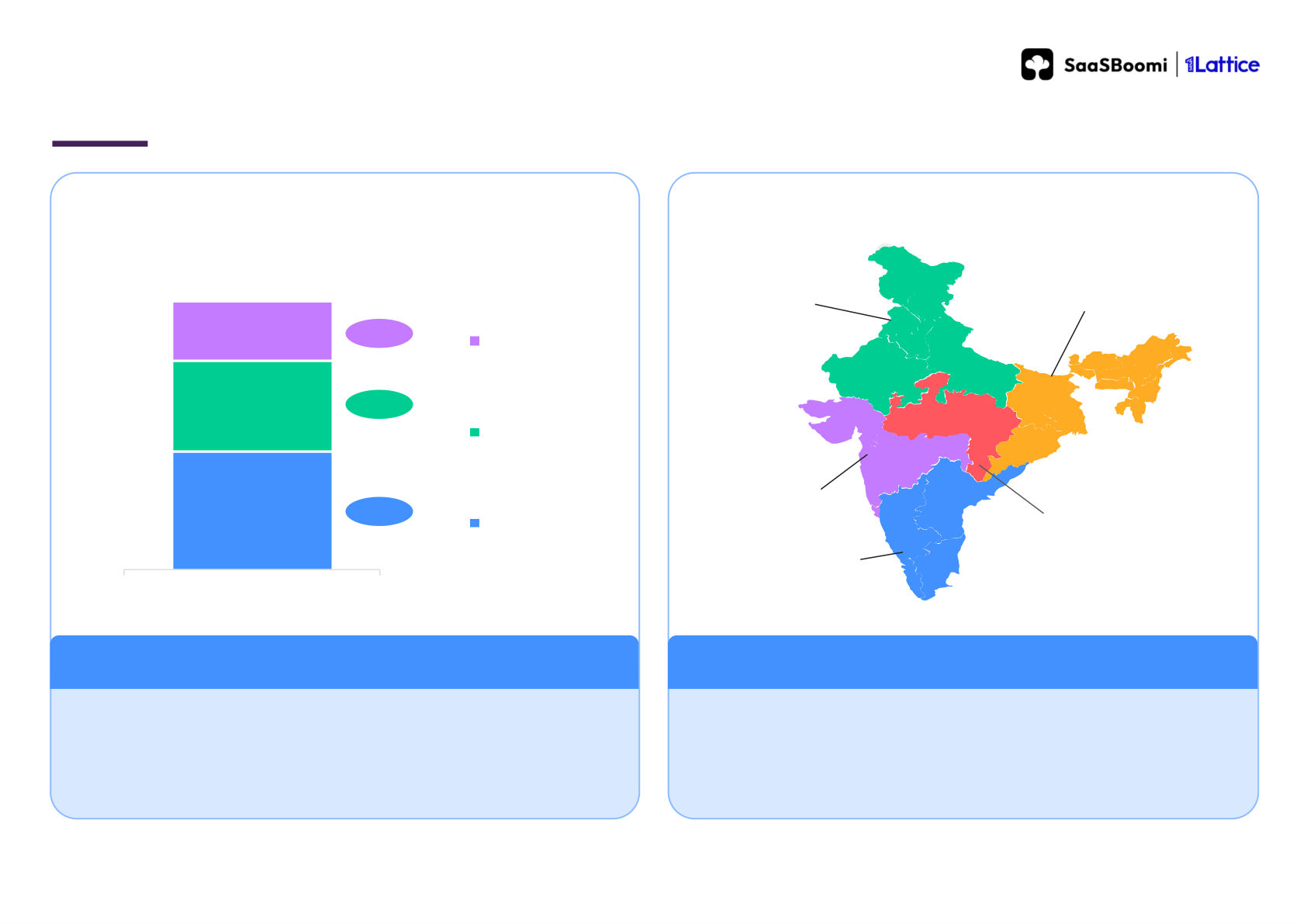
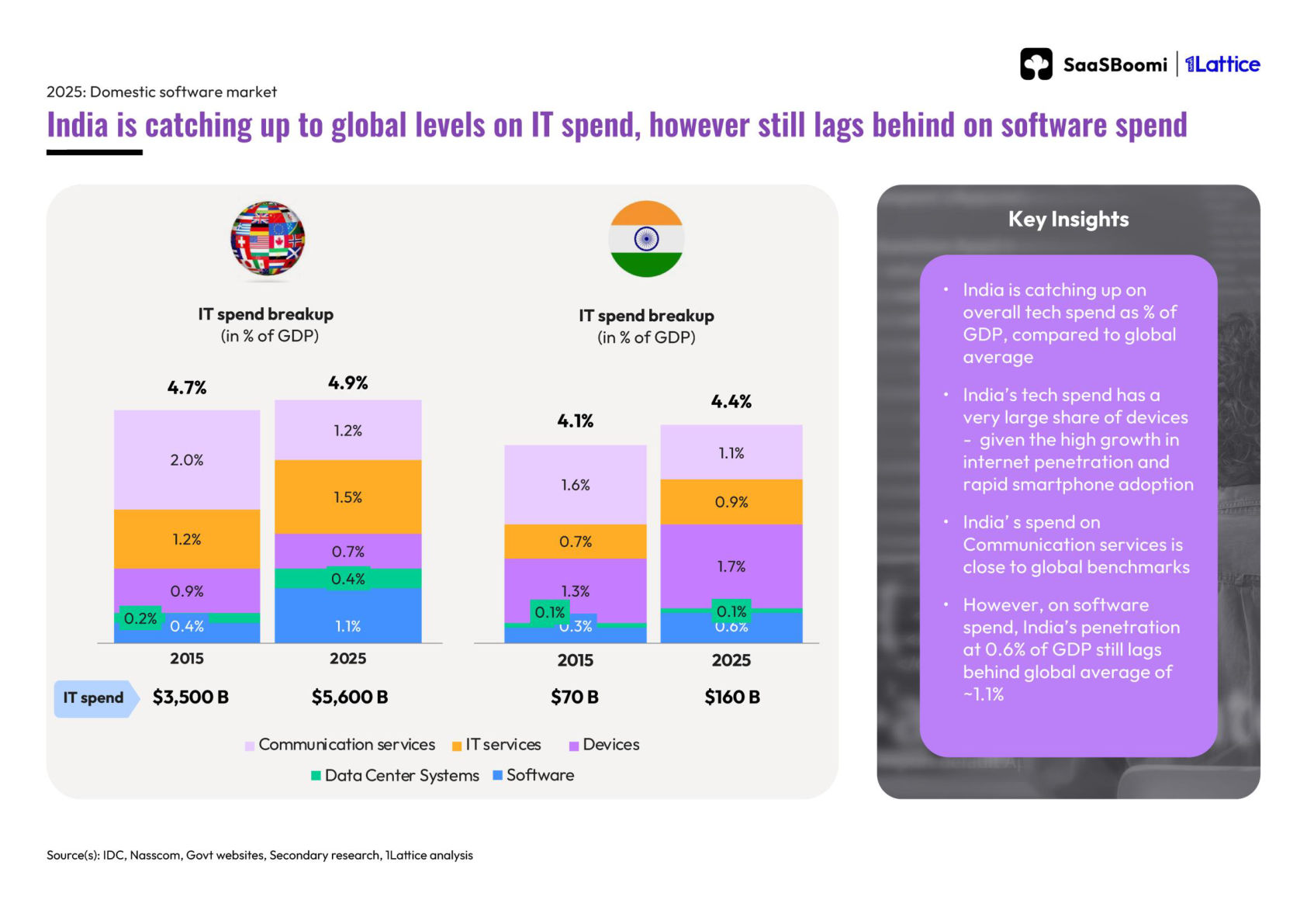
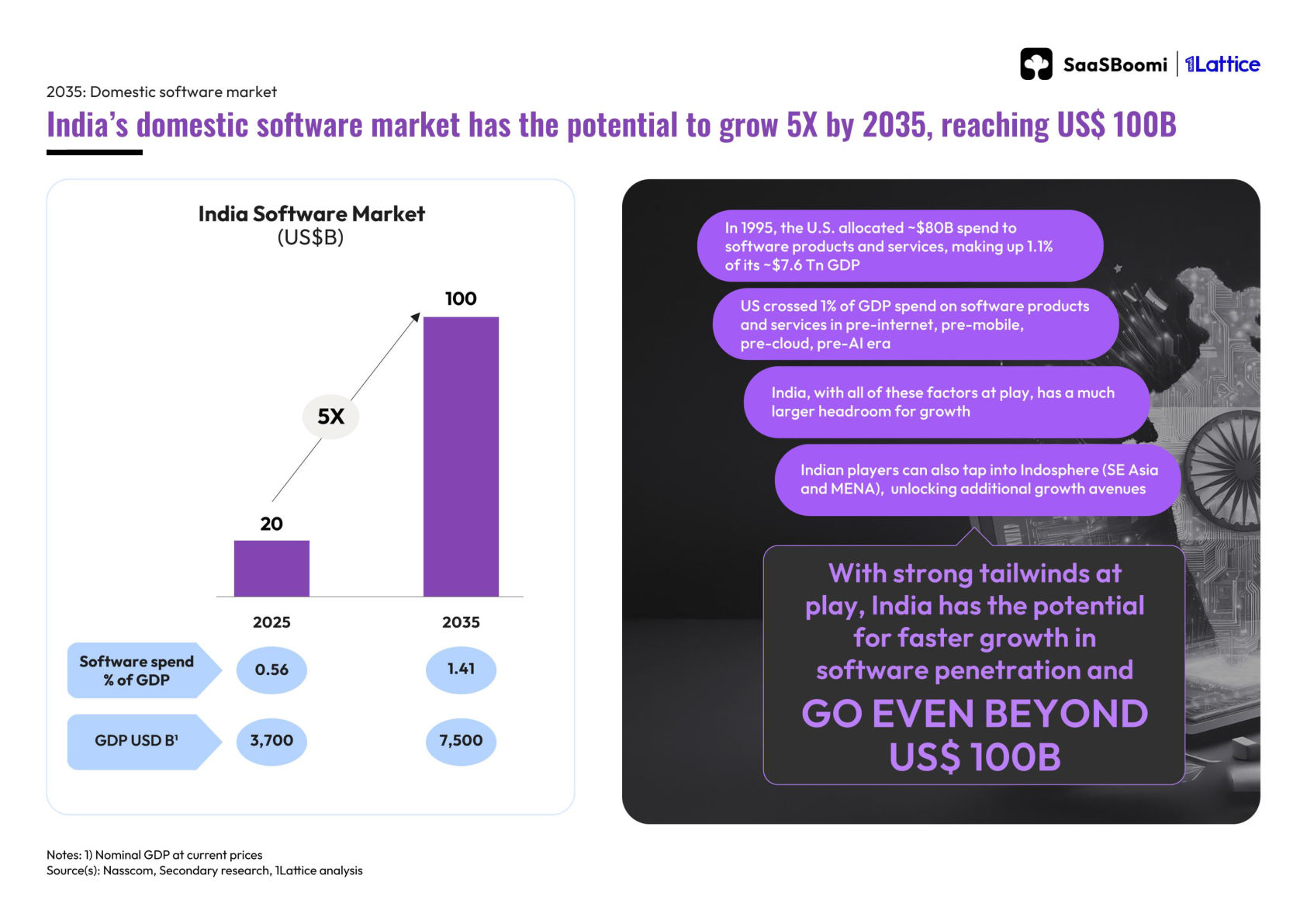
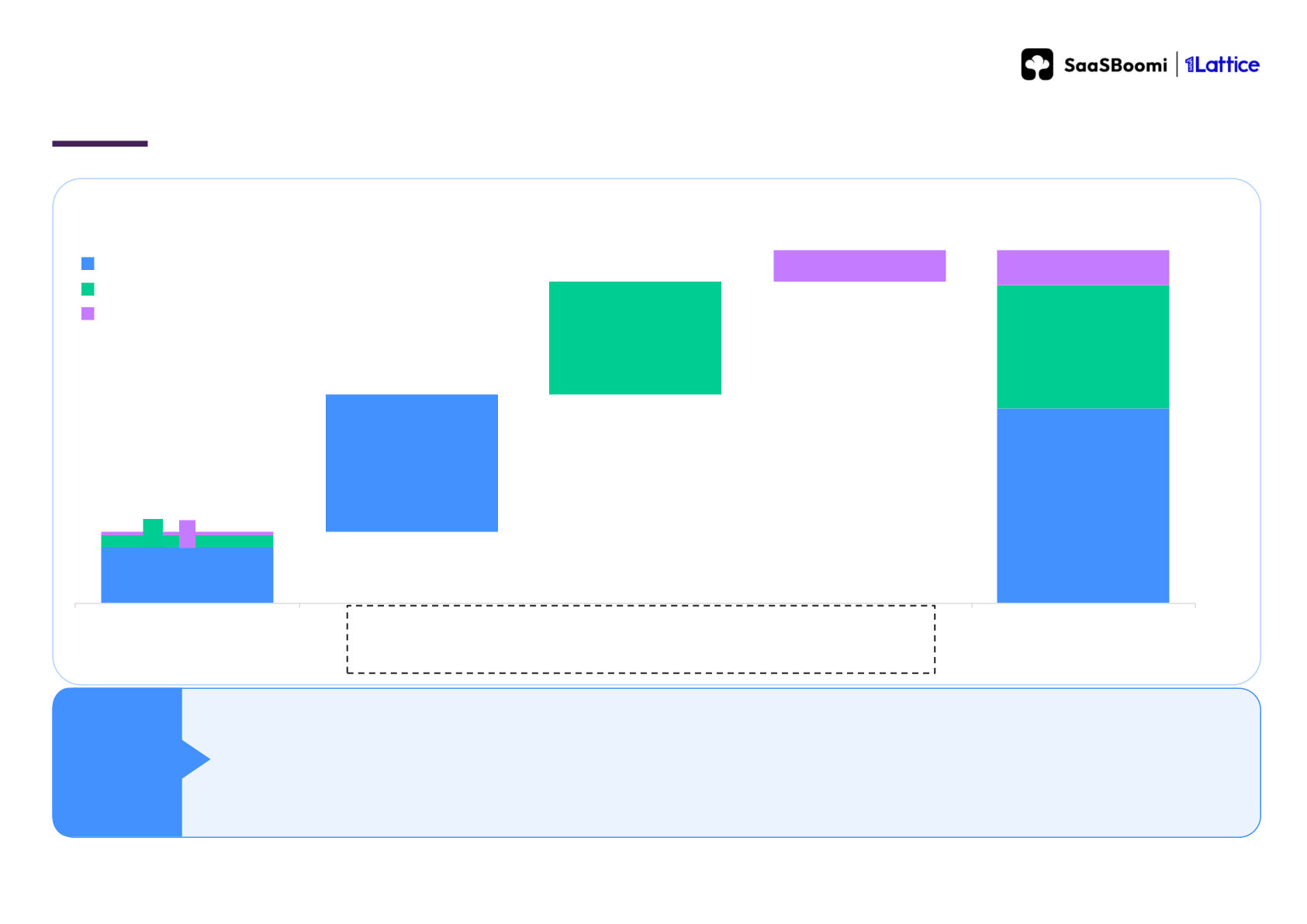
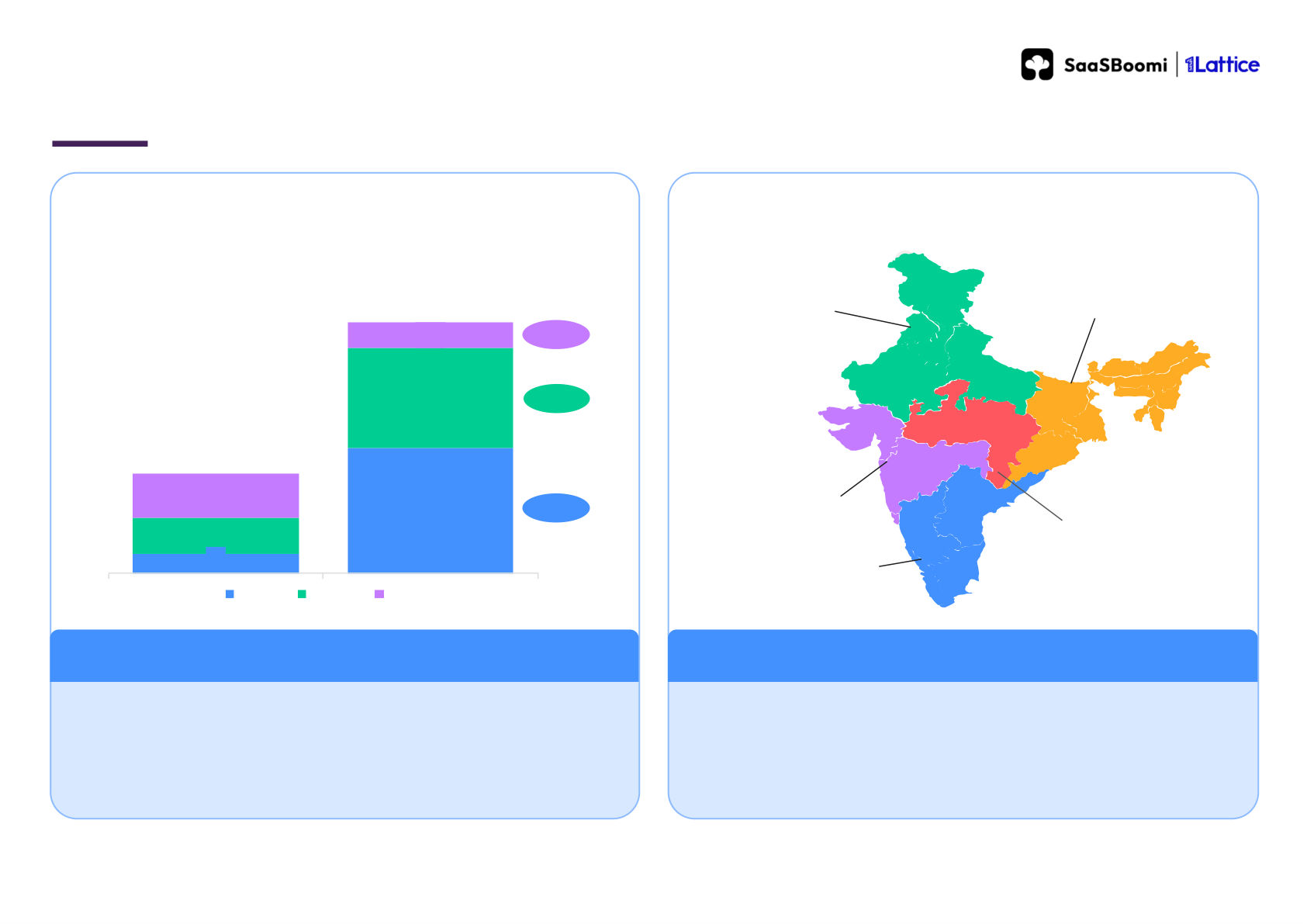
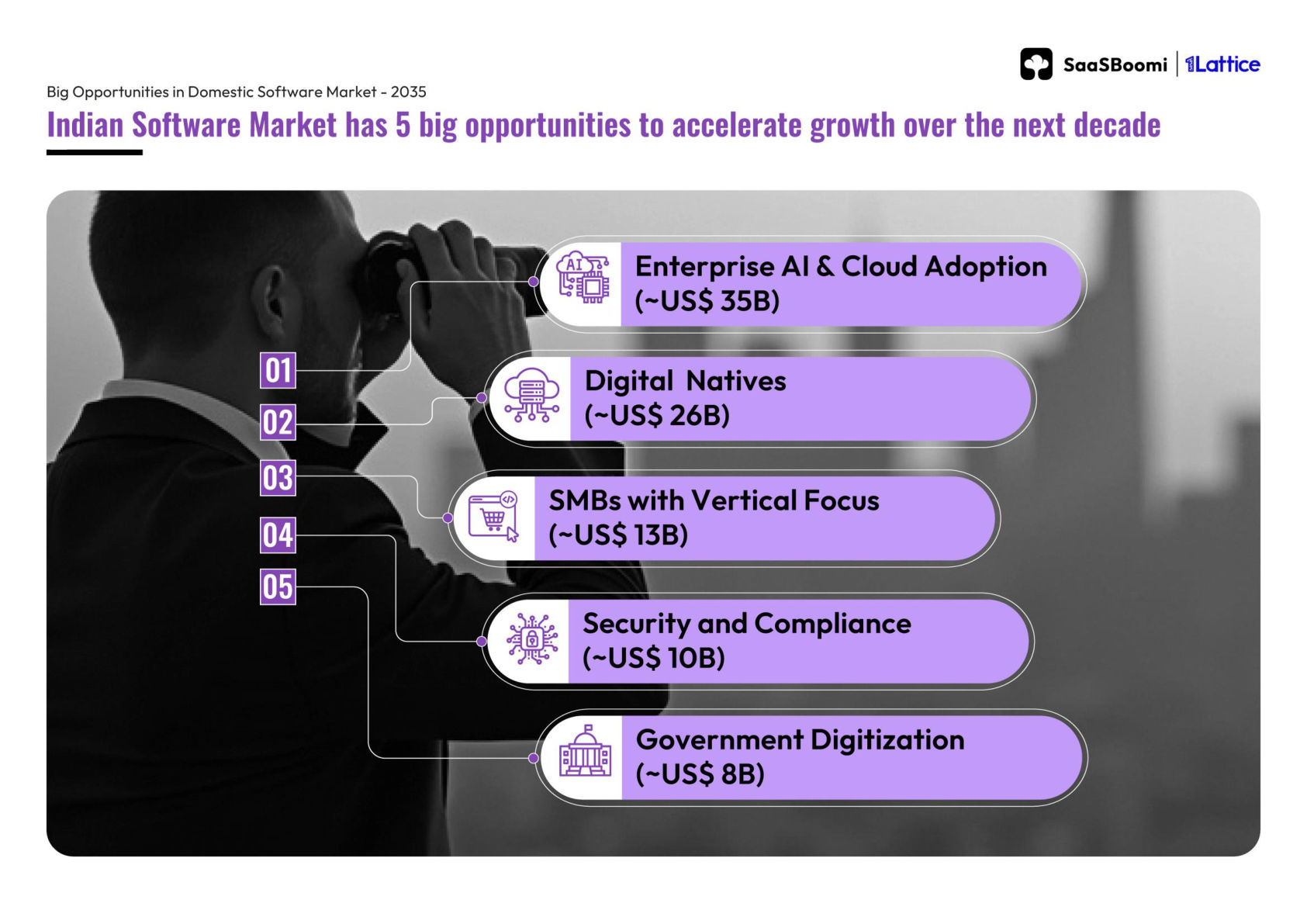
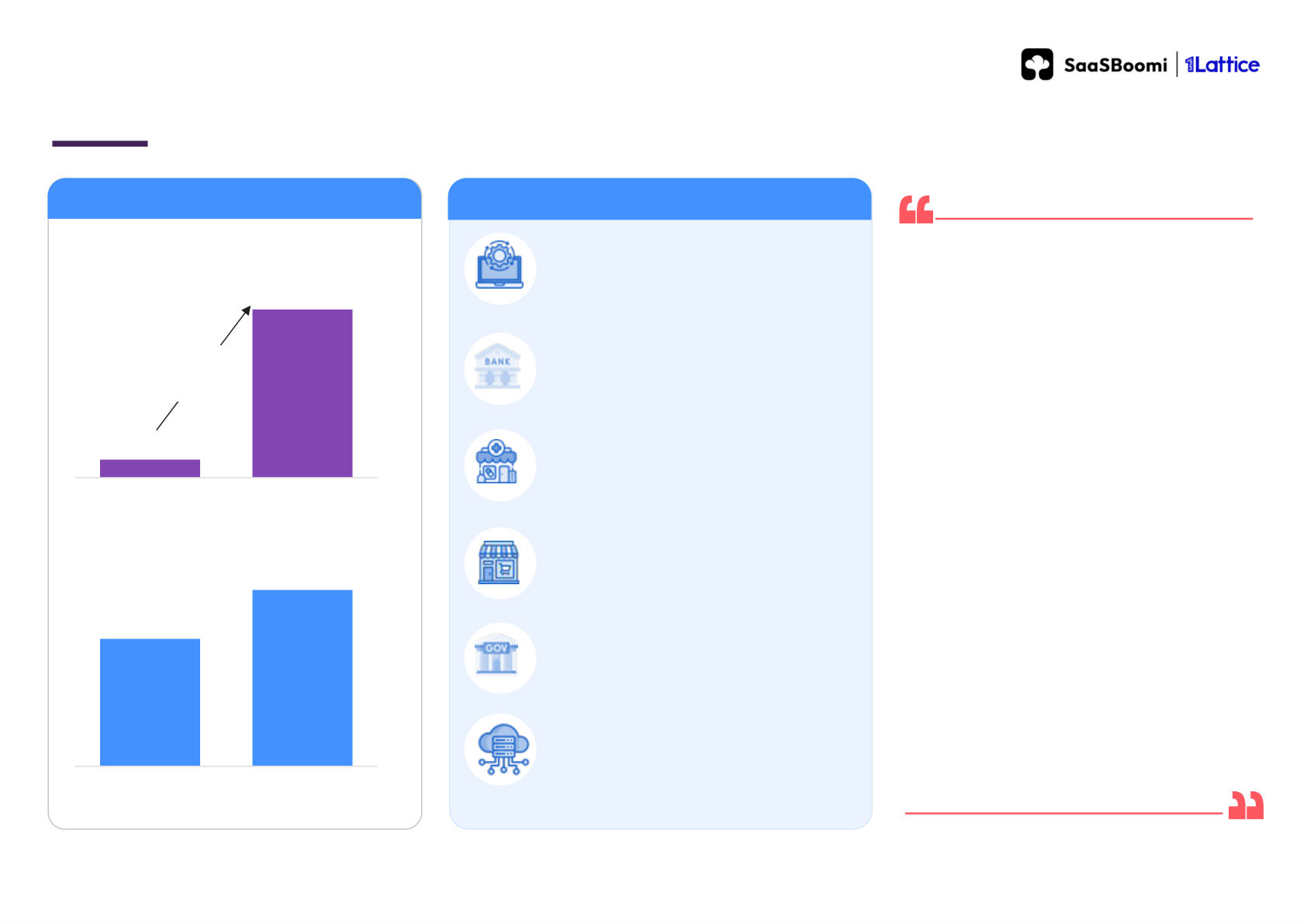
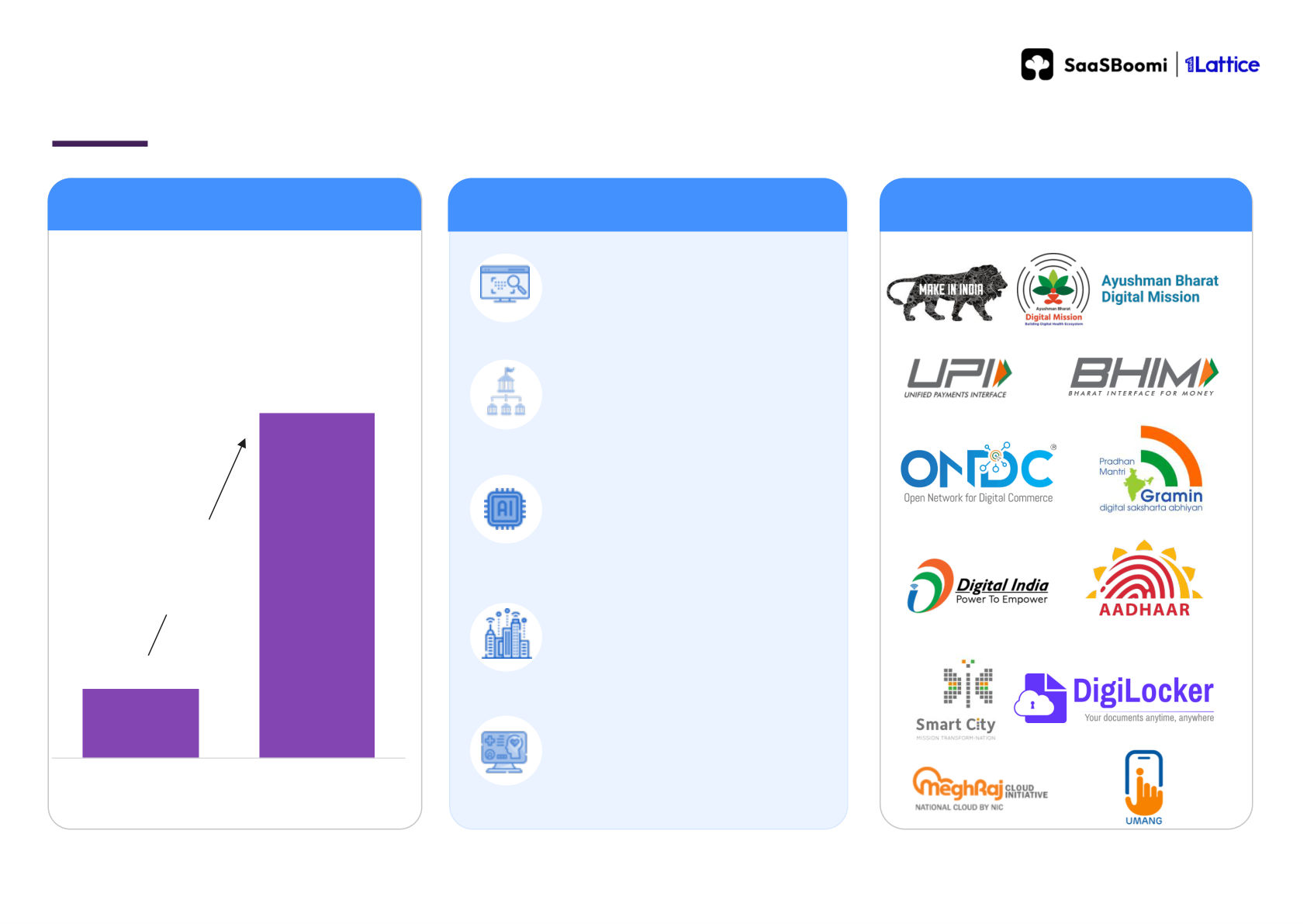
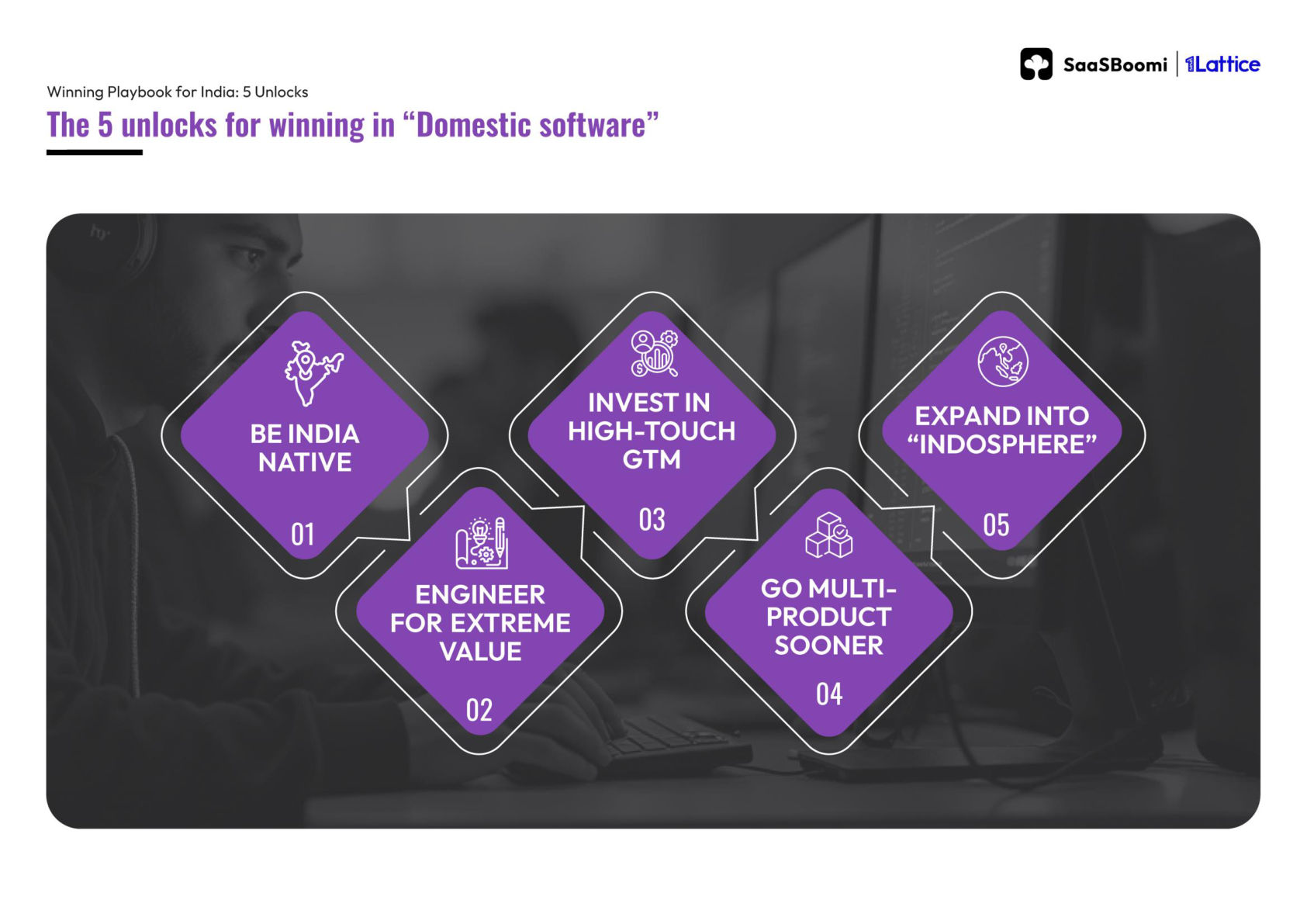
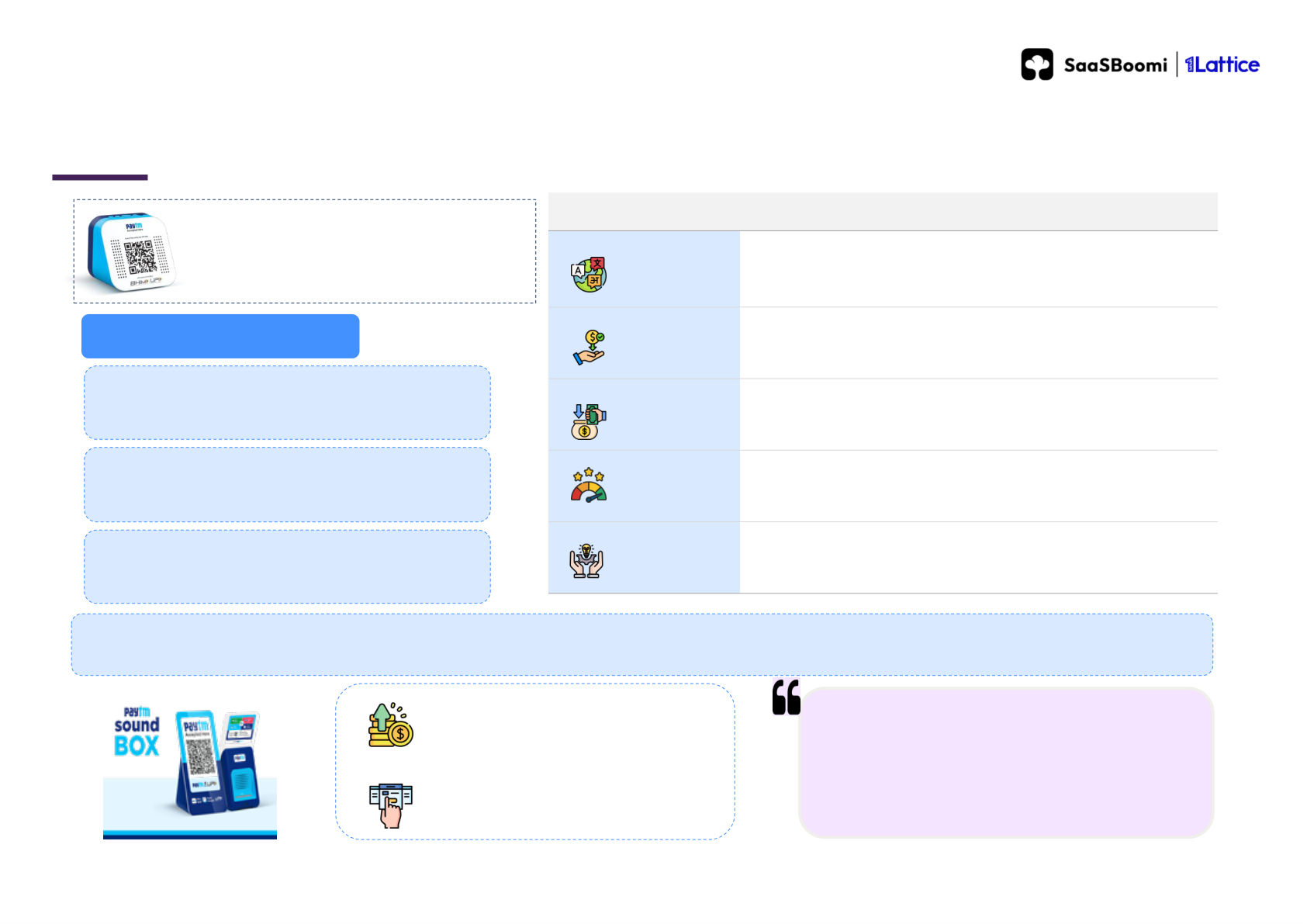
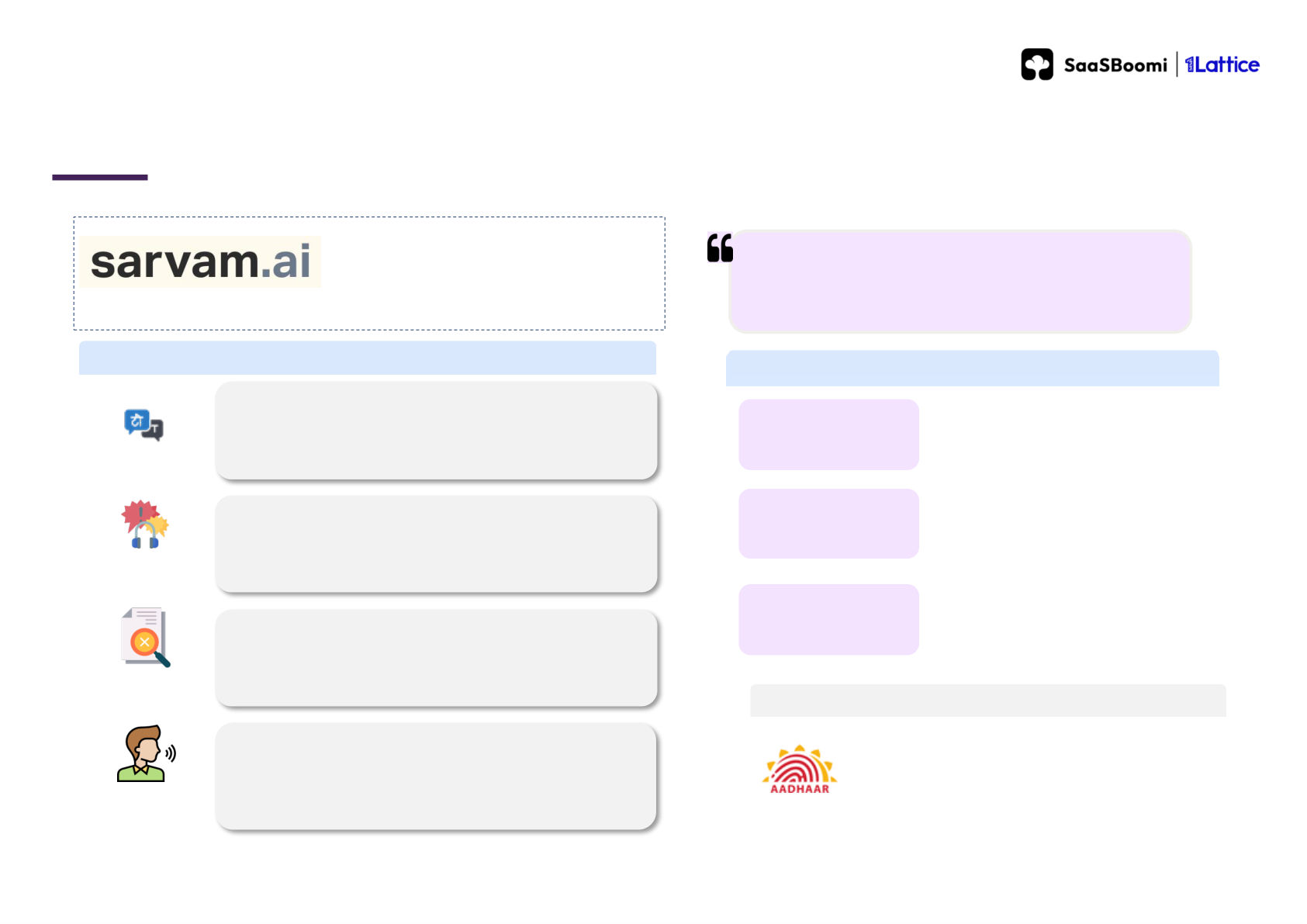
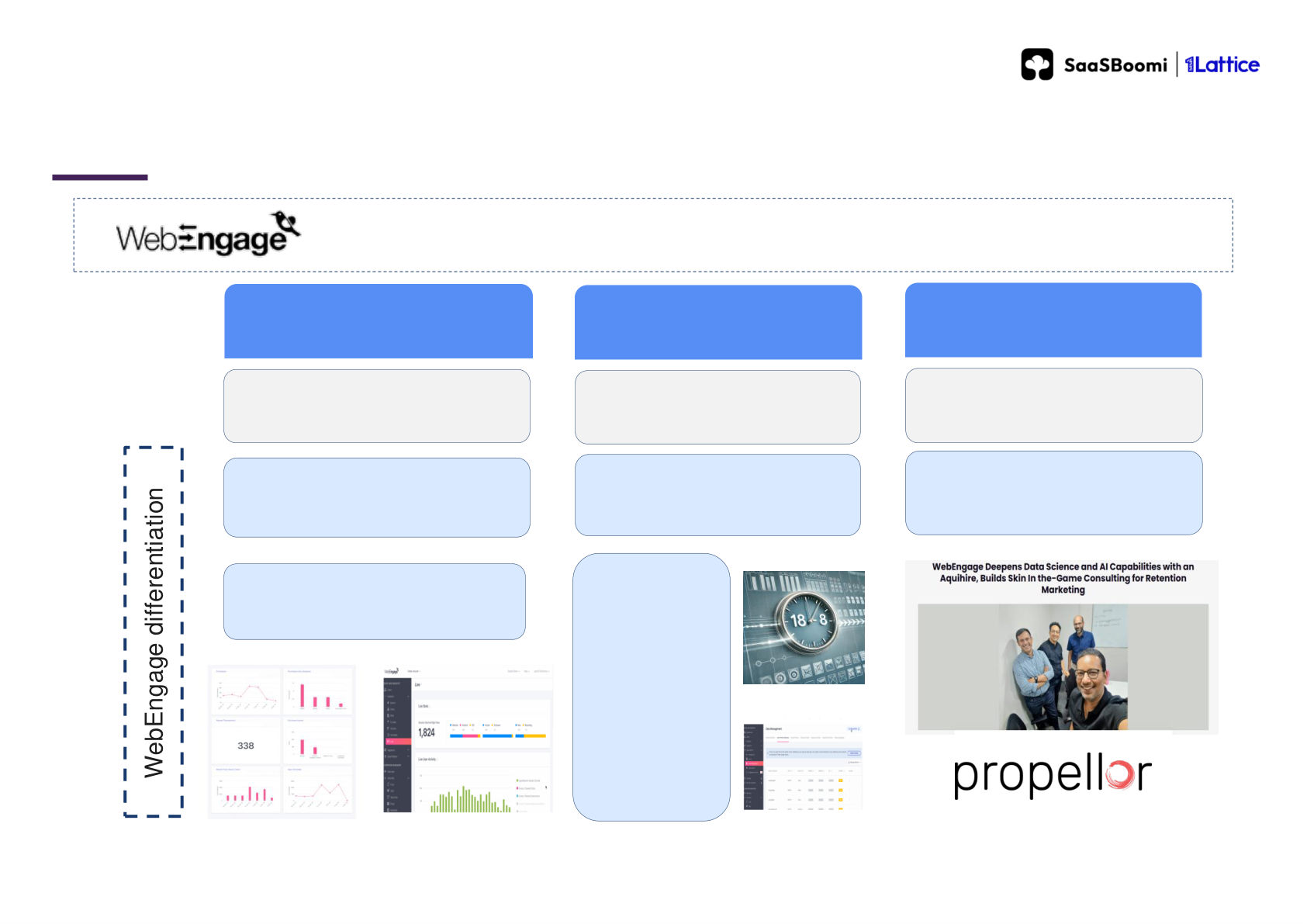
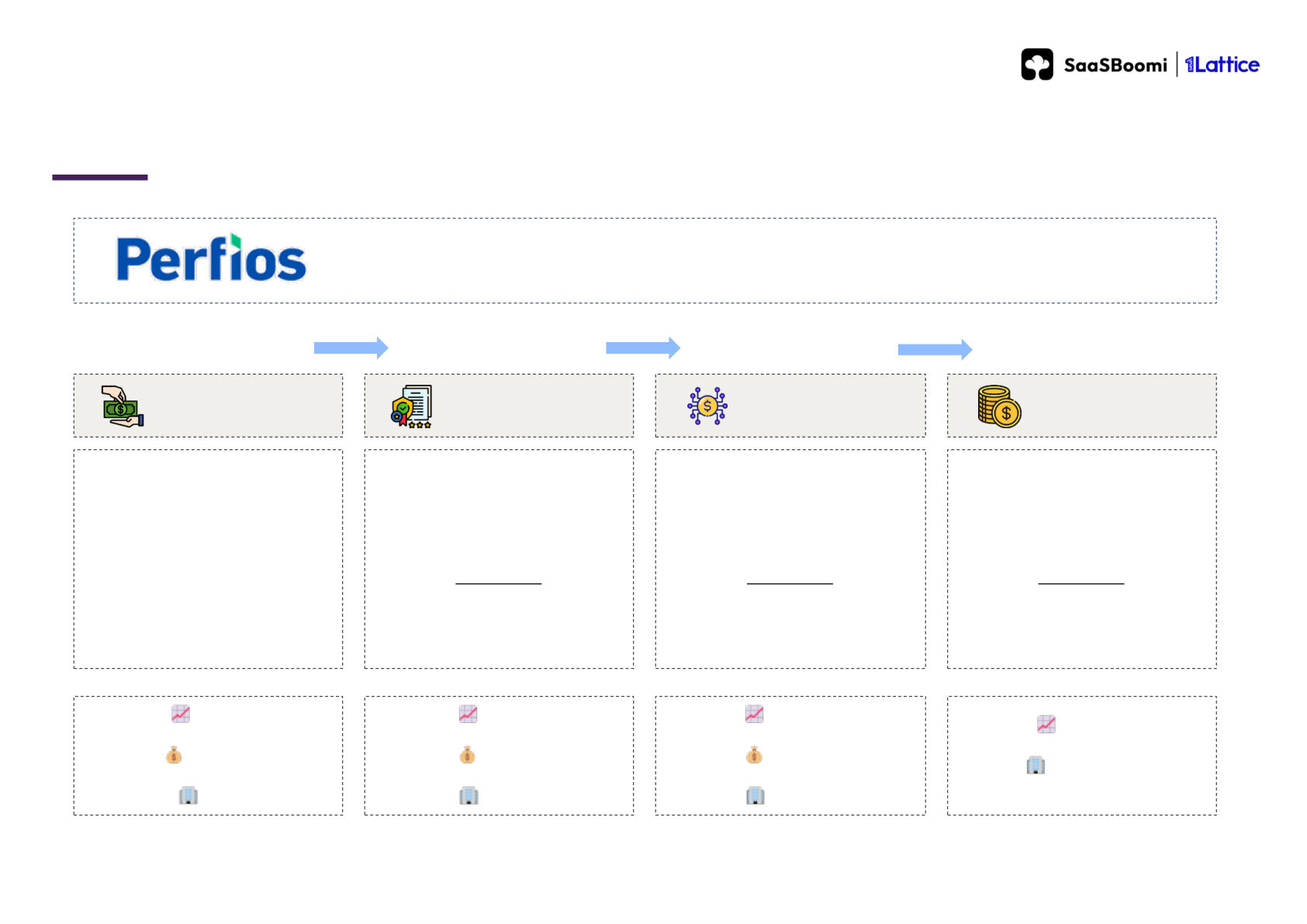
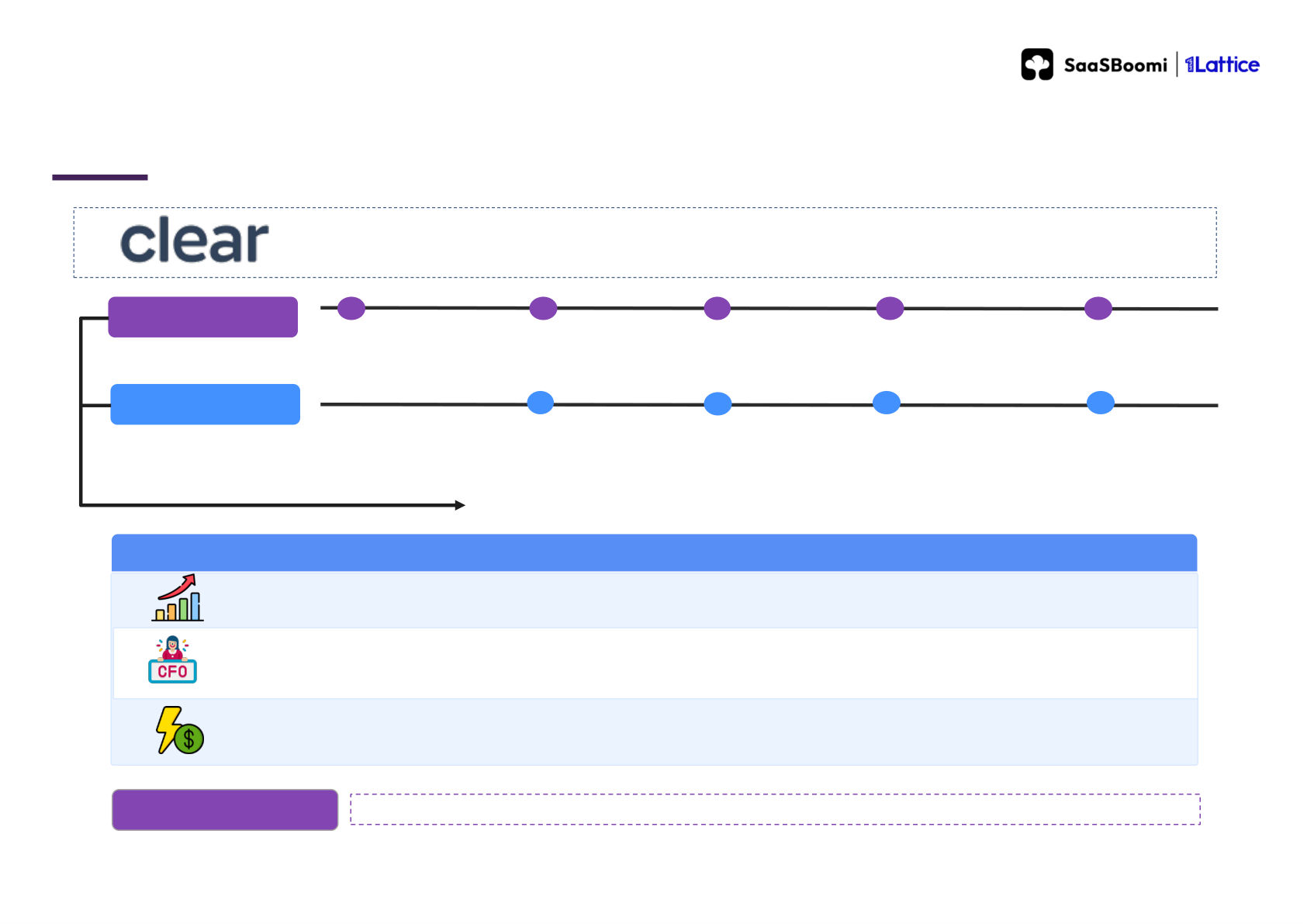
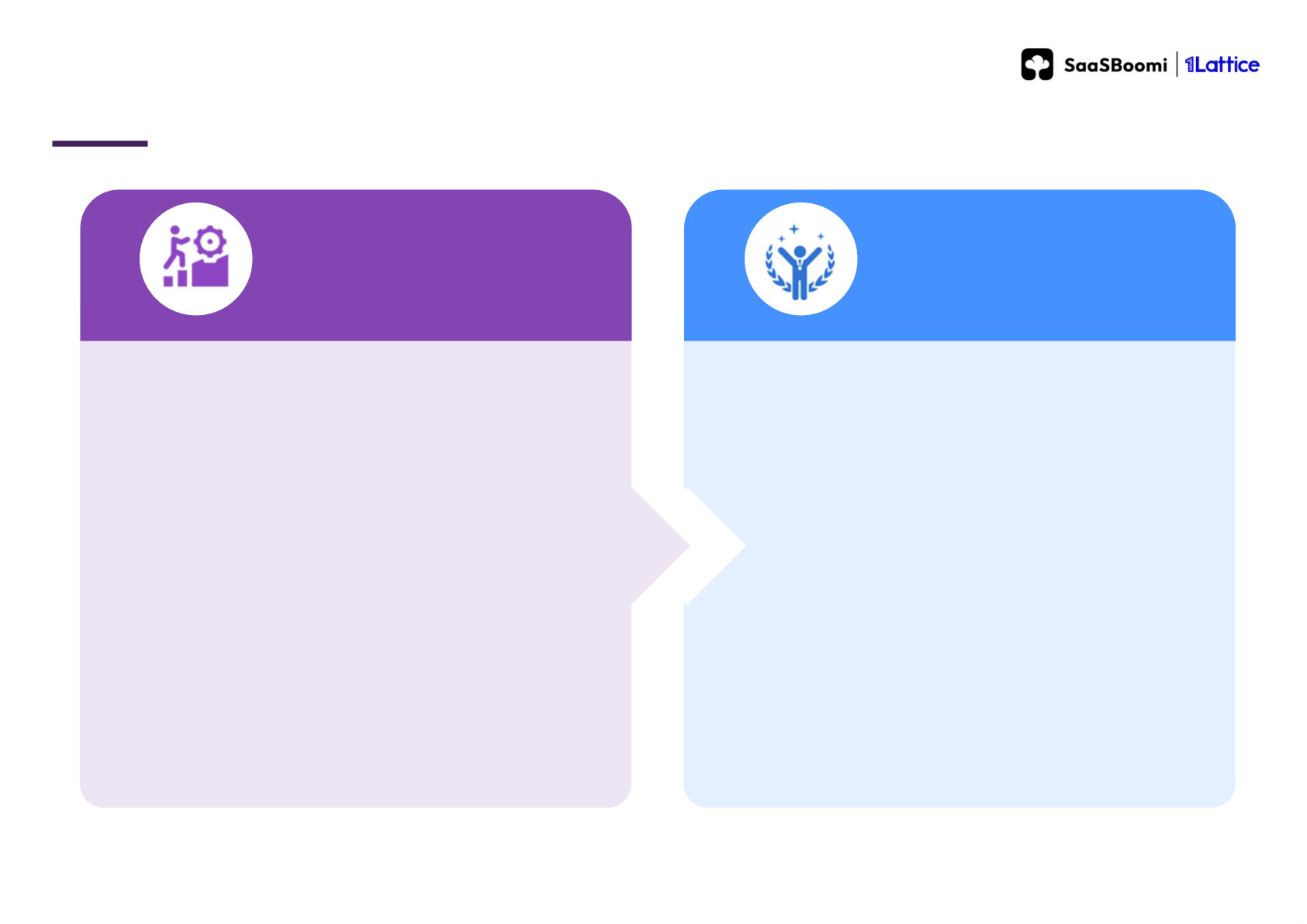
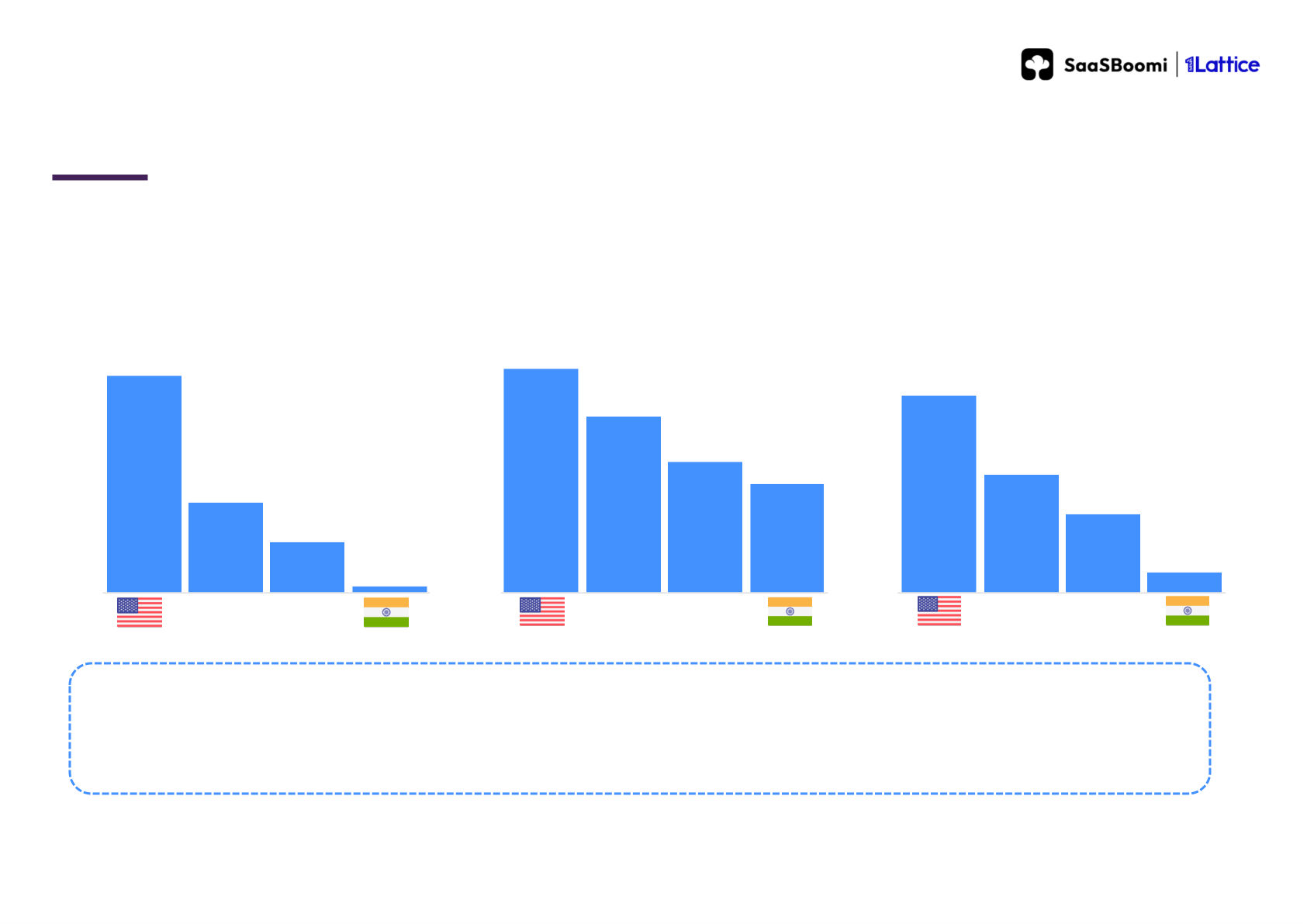
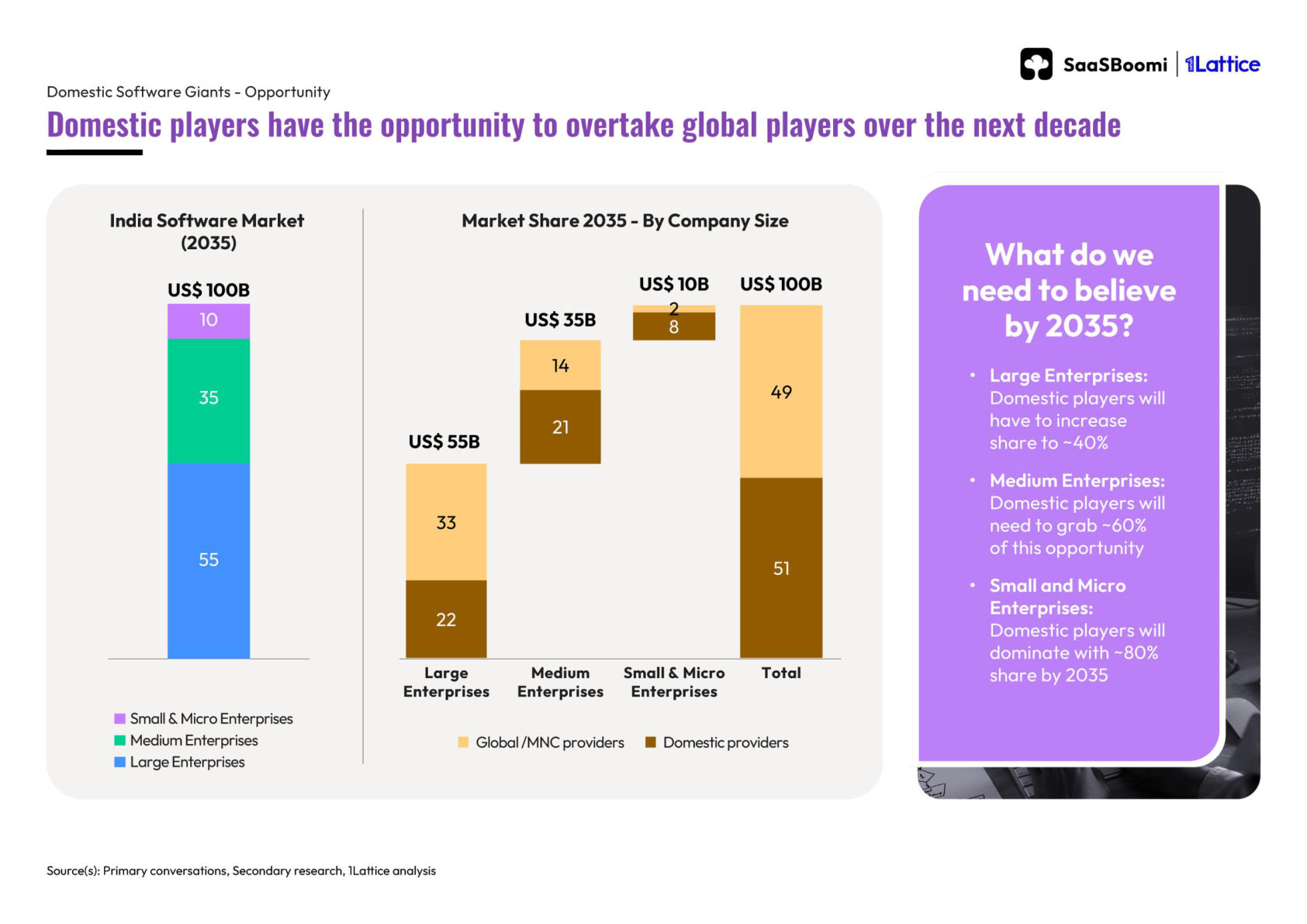
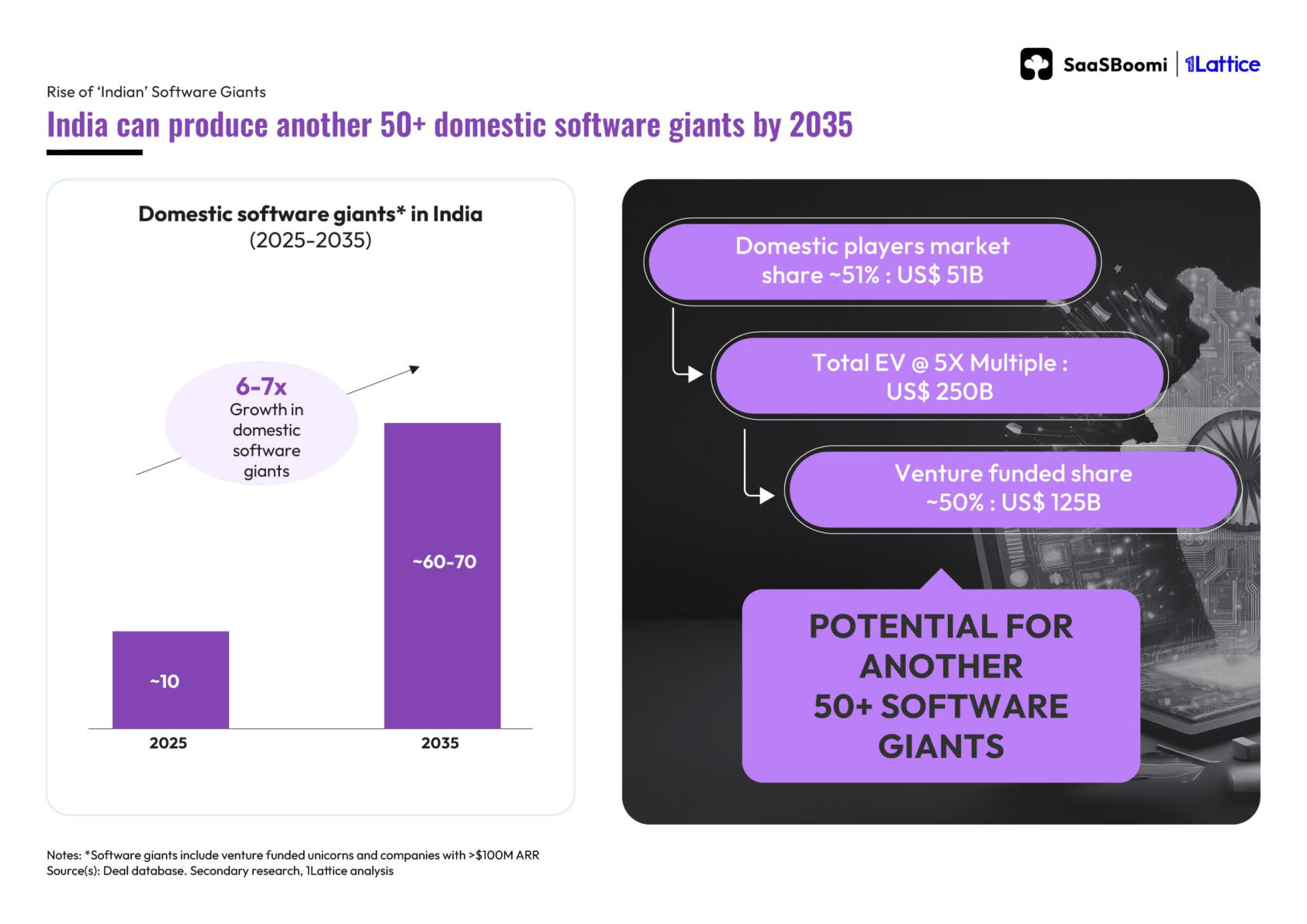
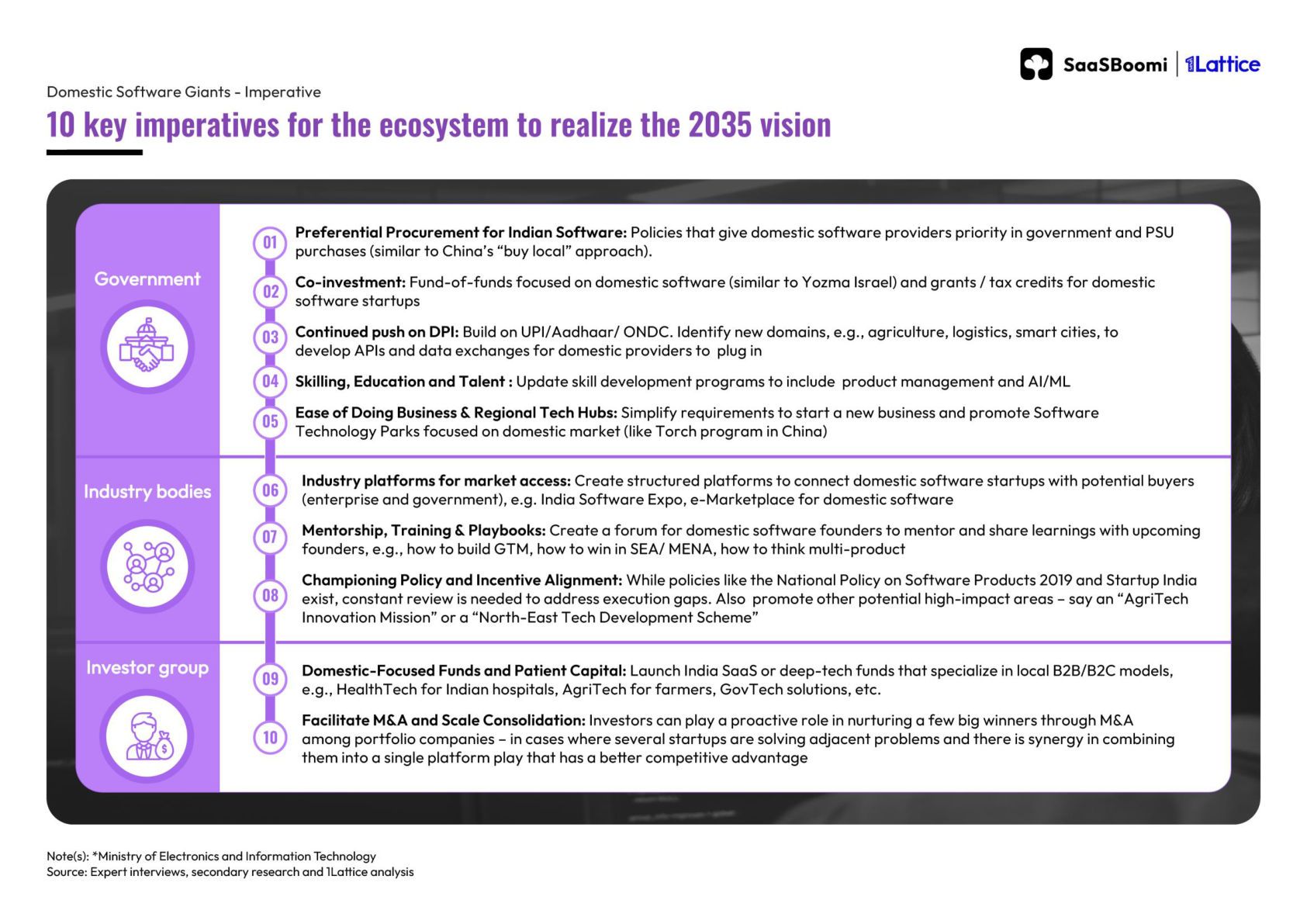
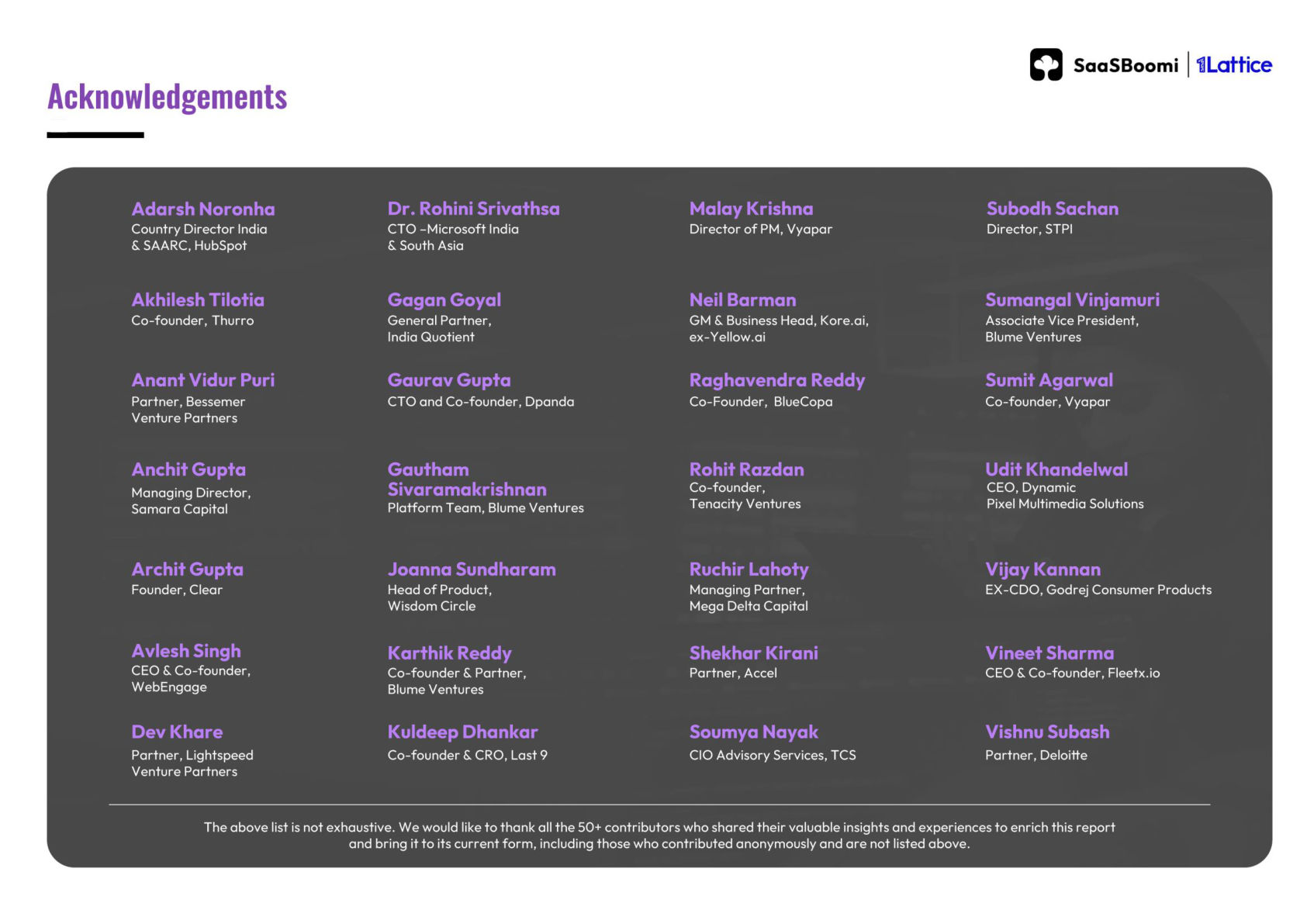
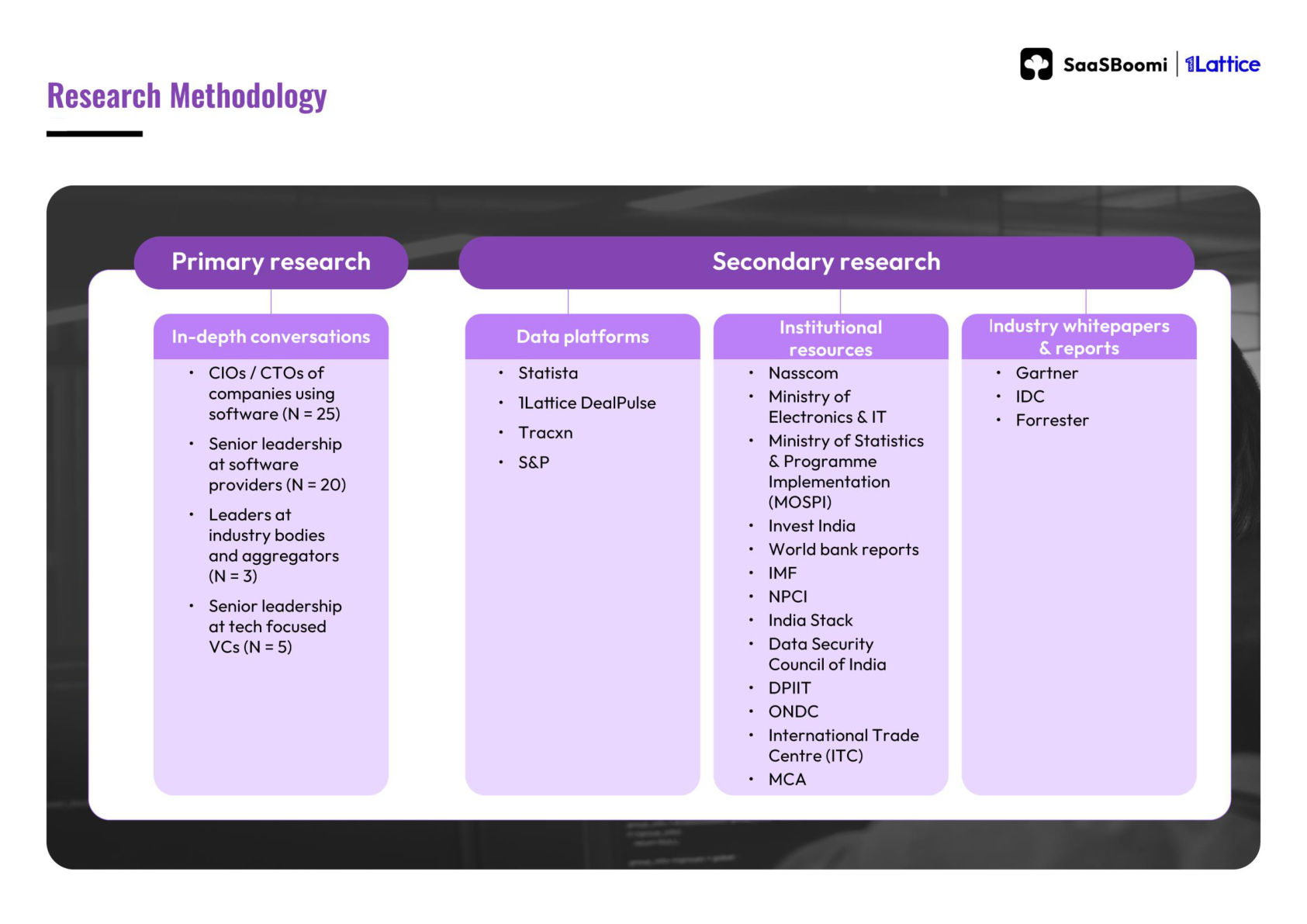
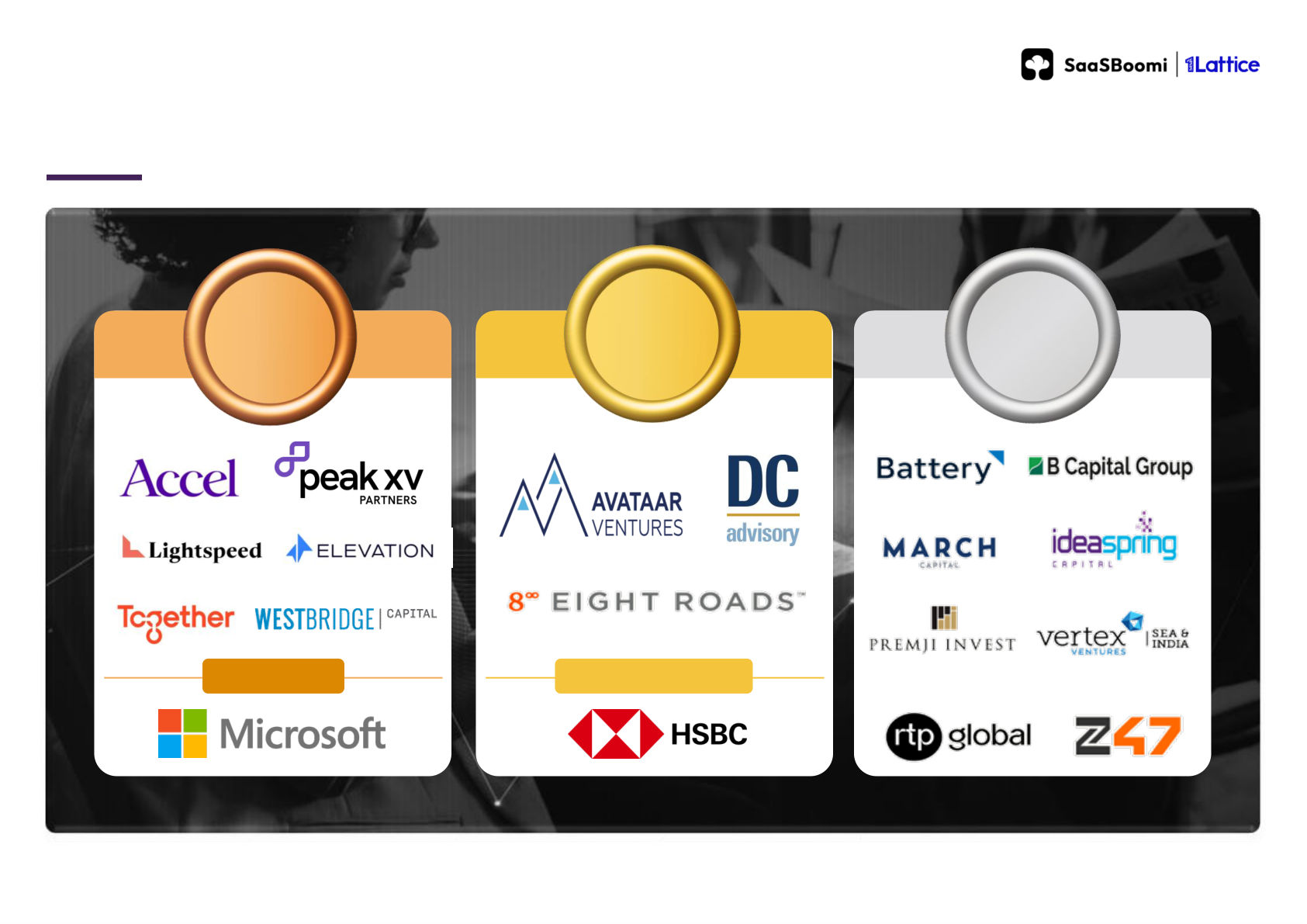
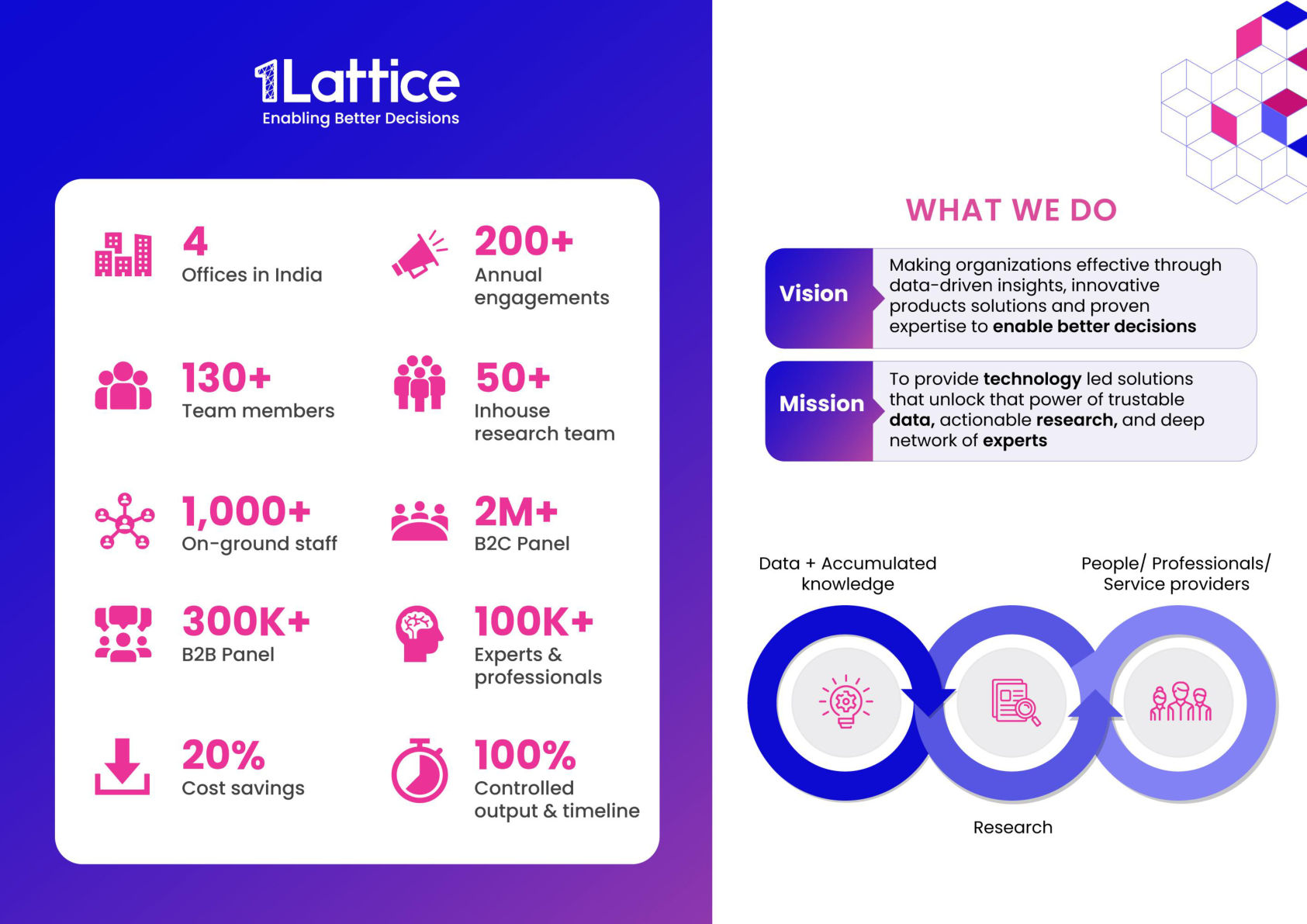
About the authors Foreword India stands on the brink of a digital transformation. Over the past decade, its tech ecosystem has evolved from global outsourcing to a hub of innovation, driven by a young population and rapid digital adoption. Yet one critical opportunity remains underappreciated: India’s domestic software market. For years, founders and investors have shied away from this space due to fragmented data and global dominance. This report — backed by rigorous research — closes the gap. Combining insights from CIOs, systems integrators, software providers, and investors, it gives a definitive view of demand for software in India and delivers a practical roadmap for India’s software future. By 2035, India’s domestic software market is poised for seismic growth. Today a USD 20 billion market dominated by multinationals, it is likely to be fueled further in the next 10 years by AI adoption, SMB digitization, government initiatives, digital natives, and compliance demands. Our analysis projects a surge to USD 100 billion by 2035, with the possibility of domestic players capturing up to 50%. Capturing this opportunity requires a tailored playbook and the report identifies five pivotal strategies for founders. What sets this report apart is its 360 - degree perspective — not just analyzing trends, but a rallying cry for the ecosystem to turn inwards. Creating 60 – 70 homegrown software giants solving India’s challenges is achievable if the ecosystem unites: founders reorienting strategies, investors backing bold bets, policymakers enabling infrastructure, and mentors sharing lessons. This endeavor was made possible by SaaSBoomi’s vision, led by Avinash Raghava and volunteers, and 1Lattice’s execution, transforming fragmented insights into a coherent roadmap. As you read, consider this an invitation: to founders to reimagine horizons, investors to recalibrate theses, and stakeholders to recognize India’s software potential. The $100 billion prize is tangible — if we act with urgency, creativity, and unity. The road ahead is challenging, but the rewards are transformative. Let this report ignite the spark. The rest is up to us. Introduction I am very happy to present to you this report, which delves into the ins and outs of India’s domestic software opportunity – the first public report of this breadth and depth on the subject. It talks about the past and forward trends that have and will shape the software market in India, and it also defines who will win the spoils and how. India’s domestic software industry is going through an unprecedented growth trajectory, poised to grow five - fold over the next decade, presenting a US$100 billion opportunity by 2035. The growth over the past decade was defined by a surge in mobile - led digital adoption, building of India’s digital public infrastructure, formalization of the economy, digital transformation of enterprises and the coming of age of the Indian startup ecosystem. The next 10 years, however, will see different dimensions of growth – the foremost being AI - led discontinuity in automation and several other use cases, along with cost reduction in software development. The other big opportunities will be – increasing software adoption by the SMBs, Government spending having a direct and indirect impact on the market opportunity, India’s startups continuing to become more ubiquitous, and a heightened focus on security and compliance. To capitalize on this momentum, the Indian software providers will need a very different approach and mindset than their global counterparts. Firstly, they must strive to develop products with India - oriented solutions, demonstrating better PMF than global ones. Second, they will need to develop extremely value - driven offerings and adopt a high - touch GTM strategy to scale in this market. They will also do well to define a multi - product roadmap and target adjacent markets like SE Asia and MENA for a larger TAM, which will allow building for a bigger scale with the same core value proposition. So far, India has produced about ten software companies of scale serving the domestic market. By fostering innovation, addressing critical challenges and enhancing capital efficiency, we can realize the opportunity to nurture another 50 - 60 software giants in the coming decade, and capture a majority share of this large and growing market. We hope that you enjoy reading this report, and that it provides valuable insights for stakeholders looking to navigate and lead in this evolving ecosystem. 5 5 7 7 8 8 Growth drivers - Surge in mobile internet adoption in India Breakout growth in mobile adoption seen in India over the last 10 years Smartphone users - 2014 Smartphone users - 2019 Smartphone users - 2024 36% 55% 46% 45% 117M 564M 752M 64% 54% Internet Urban 42% 65% 75% Penetration rate Rural (in %) 11% 29% 54% Urban users Non - Urban users Internet users in India have grown from 573M in 2019 to 885M in 2024 primarily driven by: Examples Affordable data & mass digitization • Smartphone users have increased five - fold over the last 10 years to ~800M • India has 5th most affordable mobile data in the world (average cost $0.16 / GB) • Rural digitization and Vernacular tech have further boosted mass digital adoption Digital payment • UPI platforms recorded over 170 billion transactions in 2024, enabling demand for fintech and e - commerce software solutions • Seamless digital payments have accelerated the usage of online services across sectors Mobile consumer demand • Mobile - savviness of consumers has led to new business models with digital offerings • Businesses are adopting software to target consumers, drive digital marketing on content apps, WhatsApp for Business, Mobile - customer lifecycle management, and community buying Source(s): Government websites, NPCI, Secondary research, 1Lattice analysis 9 Growth drivers - Digital Public Infrastructure India’s strong Digital Public Infrastructure is the backbone of its software revolution Digital ID & documents: UPI: Revolutionizing Account aggregator ONDC: Transforming Seamless, secure access digital payments and India health stack digital commerce • Aadhaar, the world’s largest • UPI has revolutionized digital • Account Aggregator: • ONDC democratizes e - digital identity system, transactions in India across Enables secure financial data commerce by using the Beckn provides a secure and the B2C and C2C models sharing, facilitated by Protocol, enabling small 1 universal ID to over 1.4 billion frameworks like DEPA for businesses to join an open Indians, enabling seamless • With a total transaction value consent - based access network and be discovered KYC and authentication of $2.84T in 2024, it has across multiple apps boosted demand for • India Health Stack: facilitates • DigiLocker provides real - payment gateways, POS seamless access to health • Empowers MSMEs & local time access to various software, and financial records, telemedicine, & businesses to digitize authentic digital documents management tools insurance services operations with minimal cost to users 1.2M+ Sellers 112M+ 0.5B+ 170B+ Users linking their Registered UPI transactions account on the DigiLocker users in 2024 150M+ AA framework Transactions Note(s): 1.DEPA = Data Empowerment and Protection Architecture Source(s): Government websites, Secondary research, 1Lattice analysis 10 Growth drivers - Formalization of Indian economy Formalization of India’s economy has accelerated software adoption GST registered businesses Enforcement of GST registrations (in M) • India’s GST registrations grew from ~7M in 2017 to ~15M+ in 2023, businesses moved towards accounting, ERP and tax compliance software 15 E - invoicing CAGR • E - invoicing became mandatory for businesses with turnover >INR 5 Cr in 12% Aug 2023, driving automation, with 21 Cr e - invoices processed in July 2024 7 Demonetization • Demonetization drove digital payments, expanding the formal economy and boosting tax compliance, GST, and direct tax collections 2017 2024 Government incentives for small companies • MSMEs gain financial incentives like lower interest rates and tax benefits, while government promotes priority lending, subsidies, and market access Examples 1 DPDP Act creates framework for broader digital adoption • The DPDP Act (2023), India’s personal data protection law, creates a framework for data governance, privacy, security, trust, and compliance Note(s): 1. Digital Personal Data Protection Source(s): Government websites, In - depth conversations, Secondary research, 1Lattice analysis 11 Growth drivers - Enterprise digital transformation Enterprise digital transformation: Driven by COVID - 19, Mobile economy and Cloud adoption COVID - 19 accelerated User mobile adoption driving Migration to Cloud adoption of digital tools Enterprise Compute Demand solutions • The COVID - 19 pandemic • Mobiles are rapidly becoming the accelerated remote work, Enterprise Compute platform for India • Cloud offers increased driving rapid adoption of digital – businesses are expanding beyond flexibility, scalability, ~65% Indian companies tools for communication, ERP and CRM to digitize ordering, cost - effectiveness, have adopted collaboration and data inventory management, payments, and improved disaster cloud / hybrid management and last - mile operations recovery capabilities 1 solutions 13% Fully WFH model 1 in India INDUSTRY SPEAK 28% Companies are now shifting from legacy Post COVID, the digital adoption among people has Hybrid work on - premise solutions to cloud - based massively increased. People started realizing the need 1 models in India solutions to enhance scalability and and started adopting technology. Today almost flexibility. I think this has been one of the everyone, right from Kirana store, to mom - and - pop key trends in the last few years stores, have some tech or automation in their processes. While adoption is high, the finesse of - CIO, FMCG company adoption needs to increase - Director, CRM solutions company Note(s): 1. As of 2024 Source(s): Forbes, In depth conversations, interviews, Secondary research, 1Lattice analysis 12 Growth drivers - Rise of Digital Natives Digital Natives with technology at their core, have driven high software demand India has seen exponential growth in it’s Drivers for startups’ software adoption startup ecosystem Tech - first Cloud native & ~160K business scalable (2025) models architecture 400X Data driven Rapid Security & ~400 Growth decision iteration & compliance (2015) making innovation needs Startups are particularly leveraging deep tech and advanced technologies for their operations Higher Newly Startups adopting Start - ups investing software spend founded tech enterprise in advanced as % of revenue startups applications technologies, 3X 25% 79% 77% compared to leveraged integrated with including AI, ML, other sectors DeepTech new - age IoT, and blockchain technologies Source(s): In - depth conversations, Secondary research, 1Lattice analysis 13 2025 Market Size – Key Highlights Digital Natives are the highest spenders followed by BFSI % GDP Software spend India Software Market 2025 – By industry contribution as % of revenue (in US$ B) 12.3% 0.49% BFSI 4.3 24.6% 0.19% Manufacturing 3.4 9.5% 0.23% Consumer & retail 1.6 6.1% 0.14% Telecom 0.6 1.9% 0.34% Healthcare 0.5 Energy & Utilities 0.2 2.8% 0.12% Others 0.1 15.6% 0.01% Digital Natives 4.6 6.6% 0.96% IT services & GCCs 3 7.4% 0.57% Government 1.6 13.2% 0.17% Traditional Digital Natives Government • Digital Natives are the largest spenders on software, driven by high spend as proportion of their revenues • BFSI sector is at the forefront of India native use cases, driven by strong regulatory governance and payment stack Key • Manufacturing sector among the largest spenders due to its size, despite low penetration of spends as % of revenue Insights • IT Services and GCC also a large spender, given the high software component in its business model • Government is also big spender with >US$ 1B in software spend, towards digitization of citizen services Source(s): Gartner, NASSCOM, Government websites, Secondary research, 1Lattice analysis 14 2025 Market Size – Key Highlights Horizontal solutions lead in adoption, with ERP and CRM being major contributors Market size (2025) – By software type Market size (2025) – By Horizontal software US$ 20B US$ 12B Collaboration 0.7 12% software 2.4 0.8 HRMS 1.5 5.6 28% 1.6 SCM Cybersecurity 3.4 CRM 60% 12.0 4.0 ERP Horizontal Vertical Developer tools • Horizontal software dominating India’s domestic market, even as vertical software is gaining traction. Key • Regulatory mandates (GST, e - invoicing) and stricter tax scrutiny (ITR, audits) are pushing businesses toward adopting Insights structured ERP and accounting solutions • Vertical solutions are ~30% of the market and expected to grow fast due to vertical specific needs and faster SMB growth Source(s): Secondary research, 1Lattice analysis 15 2025 Market Size – Key Highlights Large enterprises control ~80% of software spend in India Market size (2025) – By company size Market Definition Spend on US$ 20B No. of Company type Revenue software as % 5% 1 companies of revenue 3 15% Large > 250 Cr ~5,000 0.80% enterprises Medium 16 50 - 250 Cr ~500,000 0.40% companies 80% SMEs < 50 Cr ~80 Mn 0.10% Large enterprises Medium SMEs • ~5000 large enterprises control ~80% of software spend, on average spending ~0.8% of revenues Key • ~500,000 Medium sized companies account for ~15% of software spend, spending ~0.4% of revenues Insights • Over 80 Mn Small and Micro enterprises with very low penetration of software spend, accounting for ~5% of software demand Source(s): Government websites, Secondary research, 1Lattice analysis 16 2025 Market Size – Key Highlights On - prem still a large part of the market, South the regional leader in software spend Market share (2025) – By region* Market size (2025) – By deployment type (%) North US$ 20B (26%) East (2%) 4.4 22% Cloud 34% 6.8 On-prem West (24%) 8.8 44% Hybrid Central (10%) South (38%) Key Insights Key Insights • On - prem deployment still one - third of the market, hybrid ~44% • Software buying decisions still largely driven by company headquarters in South, West, and North India • Cloud adoption has picked up pace only after Covid, but still significant headroom for growth • South India leads overall due to concentration of digital natives and IT services • India is the 2nd fastest growing cloud market for hyperscalers Note(s): Market share is calculated based on headquarters Source(s): Government websites, Secondary research, 1Lattice analysis 17 2025 Market Size – Key Highlights Indian software market is dominated by global players/MNCs Market size Examples Industry speak Market size (2025) – By players India trusts global software players for their Global players reliability, innovation and alignment with US$ 20B global standards, making them ideal partners in a fast - growing digital economy. 25% 5 Nobody gets fired for buying a Microsoft, Oracle or Adobe software ” - CTO, MarTech Solutions Provider 75% 15 Global software players penetrate India by addressing the need for advanced tech capabilities, offering specialized solutions, and bridging skill gaps with global expertise.” Domestic players Global players/MNCs Domestic players - CDO, Energy & Utilities Company Key Insights Global players are able to offer discounts to Indian users given their huge profits from • A majority of large enterprises in India run on other regions” global software (like Microsoft, AWS, GCP, Salesforce, Oracle) - VP, Consumer & Retail Company • Global brands perceived as more reliable , secure Note(s): Market share is calculated based on headquarters Source(s): In - depth conversations, Secondary research, 1Lattice analysis 18 19 19 Forward Growth Drivers – Demand Side Multiple structural shifts driving demand for software products in India Expert comments Key drivers Forward trends • Increasing regulations in key sectors (Banking, Trading, Financial Services and We need India - native solutions for secure data Insurance) will need India - native software solutions India - Native governance, transaction monitoring, and seamless requirements • Interoperability with India Stack 2.0, including ONDC (commerce), OCEN (credit), API integration to stay ahead ABDM (health) will require highly specialized software solutions - Director, Financial Services company The rise in enterprise cloud and AI adoption is • AI - led plummeting cost of software will drive penetration AI led pushing companies to invest in customized software for seamless integration and smarter automation disruption • US$ 250M Indian IT services/ BPO will be disrupted using AI software - VP, Logistics company Migration to cloud is helping in future proofing • ~30% of Indian companies still completely on prem; will reduce to <5% by 2035 Decisive shift operations in an increasingly digital and decentralized energy landscape to Cloud • Cloud - first mindset seeping from startups to larger enterprises and SMEs - CDO, Energy and Utility company • Voice, Vernacular and vertical solutions will drive SMB software adoption (~35% of SMBs are inclined to adopt Indian software, SMBs expected to spend 3 - 5% of revenues on technology) SMB digital primarily due to cost - effectiveness, local support, and regulatory compliance transformation • Consumer tech and compliance will fuel demand for software in SMBs (e.g. quick - Director, Health tech company commerce, selling online, GST filing) Indian startups face funding constraints, Startup • # of startups scaling from 150 - 200K now to 1 million by 2035 limiting credit offerings, but strong products and better marketing can drive growth and hypergrowth • More and more non - tech founders will startup using software (Low code/No code) global reach - Director, FMCG company • Continued push on Digital Public Infrastructure - UPI, Aadhaar, ONDC Rising government investment in Digital Public Smart Infrastructure (DPI) is boosting demand for • AI led governance, Data sovereignty, Smart cities, Healthcare digitization, Government scalable software solutions Atmanirbhar in Defence & Aerospace will drive significant demand - VP, Tech - focused VC Cybersecurity investment will rise, with a shift from niche point solutions to integrated, multi - use case Security and • Regulatory pressure (DPDP, DEPA, CERT - In) and data localization requirements security platforms for stronger protection compliance • Surge in Cyberattacks both AI and Non - AI (60 - 100% YoY) - VP, Fintech company 21 Source(s): In - depth conversations, Secondary research, 1Lattice analysis Forward Growth Drivers – Supply Side Early startup success, capital availability, talent pools, and quality standards improving supply Expert comments Key drivers Forward trends The early success of Indian startups has sparked • Success of India’s 10 - 12 domestic software giants (Perfios, DarwinBox, Zoho, demand for agile, scalable software solutions, pushing MoEngage, Clevertap) inspiring new generation of founders to go after Domestic suppliers to innovate and expand their offerings domestic market success stories - Director, Compliance solutions provider • Also helping build credibility of new domestic providers with Indian buyers • >US$ 20B invested in Indian SaaS in the last 10 years (expected 15 - 20% in domestic focused startups) Strong investor backing fuels product development, & market expansion, positioning Investor • More and more VCs are actively looking at investments in domestic software Indian software firms for sustained growth confidence • Domestic capital markets more favorable to software companies (e.g. - Director, CRM solutions company Tracxn, UniCommerce trading at 10 - 12X multiple compared to global benchmark of 5 - 6x The talent surge in Tier II and III cities is diversifying • India has a largest pool of skilled developers, AI engineers, and SaaS product the software industry’s workforce, easing talent managers (e.g. #1 geo in Github) Talent pool shortages and driving regional tech growth scale up • Advent of AI will enable non - tech founders from Tier 2/ Tier 3 cities to come - CTO, HealthTech SaaS provider up with unique solutions for India market • India Digital Natives are demanding better quality of software compared to The homegrown solutions in the logistics space have global peers Quality reduced dependency on global providers • Domestic startups are becoming more sophisticated in technology and benchmark processes, and building products that meet global quality standards - creating - CTO, Logistics SaaS company trust and confidence across the industry 22 Source(s): In - depth conversations, Secondary research, 1Lattice analysis 23 23 2035 Market Size – Key Highlights Digital Natives and BFSI will continue to remain largest spenders India Software Market 2025 - 35 – By industry CAGR % GDP Software spend as (in US$ B) contribution (2025 - 35) % of revenue 18% 14% 1.0% BFSI 21.8 4.3 Manufacturing 3.4 14% 22% 0.4% 13.1 Consumer & retail 17% 10% 0.5% 1.6 7.5 Telecom 7% 0.3% 0.6 3.1 18% Healthcare 25% 4% 0.7% 0.5 4.2 Energy & Utilities 16% 3% 0.1% 0.2 1.1 Others 0.1 0.3 8% 8% 0.0% Digital Natives 19% 9% 2.1% 4.6 26.1 IT services & 3.0 15.0 18% 8% 1.2% GCCs Government 1.6 8.0 17% 15% 0.4% Government Digital Natives Traditional • With continued drivers of digitization, digital natives are expected to achieve much higher revenue growth than traditional businesses., and will continue to increase their spend on software Key • BFSI and Government will continue remain major software spenders, driven by RBI’s stricter KYC/AML norms, digital Insights lending regulations, real - time fraud detection, and the Government’s mega push for Digital Public Infrastructure 2.0 Notes: 1) The numbers within the bars represent 2025 spend on software Source(s): Government websites, Secondary research, 1Lattice analysis 24 2035 Market Size – Key Highlights Horizontal offerings will maintain largest share, however Vertical solutions will grow faster Market size (2025 - 35) – By software Market size (2035) – By Horizontal software type CAGR % US$ 48.4B CAGR % (25 - 35) US$ 100B (25 - 35) 1.3 Collaboration s/w 2.0 7% 13.7 20% 4.3 HRMS 9% 9.9 SCM 11% 21% 37.9 Cybersecurity 20% US$ 20B 15.1 14% ERP 2.0 5.6 48.4 14% 16% CRM 15.7 12.4 Horizontal Vertical Developer tools • Growth in spending on Vertical software solutions will outpace the horizontal solutions driven by industry specific challenges requiring custom solutions – (AI driven fraud detection in BFSI, telemedicine and EHR in Healthcare, IoT driven Key automation in manufacturing) – generic software won’t cut it Insights • Within horizontal solutions - CRM expected to overtake ERP while Cybersecurity expected to grow significantly Source(s): Government websites, Secondary research, 1Lattice analysis 25 2035 Market Size – Key Highlights SMEs and mid - market firms will grow faster Market share 2025 - 2035: by company size US$ 100B Large enterprises (> INR 250 Cr) 9 10 Medium enterprises (INR 50 - 250 Cr) Small & micro enterprises (< INR 50Cr) 32 35 39 US$ 20B 55 3 1 16 Software market - 2025 Large Medium Small & Micro Software market - 2035 Δ Δ Δ Net new spend addition by 2035 (in US$ B) • MSME companies to add more market spend than Large enterprises over the next 10 years Key • Medium and small & micro enterprises will see ~10X growth in the given timeframe, making one of the most promising Insights target groups for Indian software companies • Growing SME segments need tailored strategies, with the Beckn protocol driving market access, scalability and adoption Source(s): Gartner, Government websites, Secondary research, 1Lattice analysis 26 2035 Market Size – Key Highlights Cloud expected to dominate, South India will continue to be the “Software epicentre” Market share (2035) – By region Market size (2025 - 35) – By deployment type (%) (in US$ B) North (24%) US$ 100B East (3%) 10 10% 40 40% US$ 20B West 9 (26%) 50% 50 Central 7 (11%) 4 South (36%) Cloud Hybrid On-prem Key Insights Key Insights • On - prem software solutions will decline but remain in • South will continue to dominate the software market in India Government, PSU, critical infra, and legacy enterprise systems • Many Tier II/III cities from Central and North India will see due to compliance and data sovereignty concerns increased adoption and spending • Most new businesses and digital - first enterprises will go fully cloud native Source(s): Government websites, Secondary research, 1Lattice analysis 27 29 29 Big Opportunity - Enterprise AI and Cloud Adoption Enterprise AI and cloud adoption to boom with AI market to reach ~US$ 35B Industry speak Market Opportunity Drivers of growth AI led IT/BPO disruption: A sizeable Enterprise AI market We will have more front - facing folks who chunk of USD 250B Indian IT/BPO will spend time helping customers, solving (US$ B) migrating to AI native/services 35.0 their problems, talking to them, understanding their needs, and lesser people in the back office for processing jobs BFSI leads AI adoption: 40 - 50% - Chief Digital Officer, Top 5 banks CAGR productivity jump with AI - core banking systems, predictive risk analytics, fraud 25% detection, and customer service Our aim is to free up two to three hours of time daily for doctors and nurses with AI 3.8 interventions” Healthcare/ Pharma: AI - assisted diagnostics, hospital management, drug - MD, Hospital Chain discovery & patient engagement 2025 2035 E - commerce is like having many sectors Indian cloud adoption* under a single roof. AI is applied in every Retail: Consumer analytics, aspect, - from the supply chains to preventing personalization, dynamic pricing, AI - 90% fraud, to advertising, to improving the search enhanced supply chain, Store analytics experience 65% - Chief Data Scientist, Leading Government: INR 10K crore IndAI e - Commerce giant program, Digital India and Smart cities program The cloud is India’s equalizer. A farmer in Bihar and a fintech in Bangalore now access Cloud: Data localization mandates, the same tools to solve problems. That’s National Cloud initiative (Meghraj , Bharat transformative Cloud), Hyperscalers India investments - Director, Investment Management AI - cloud convergence 2025 2035 Notes: *Native cloud adoption (includes hybrid cloud adoption) 30 Source(s): In - depth conversations, secondary research, 1Lattice analysis Big Opportunity - Enterprise AI and Cloud Adoption Indian startups are rapidly expanding their AI usage in multiple sectors 1 1 1 1 Providers Providers Providers Providers driving AI in driving AI in driving AI in driving AI in BFSI Healthcare Retail Manufacturing Marketing & Sales Predict equipment failure AI chatbot Early diagnosis Supply chain forecasting Loan recovery Lower TAT Process optimization Omnichannel experience AI Solution to asses quality AI - powered insights Customer analysis & retention Note: 1. Not an exhaustive list, examples used for illustrative purpose only Source(s): Secondary research, 1Lattice analysis 31 Big Opportunity - Digital Natives Digital natives will continue strong growth and spend ~US$ 26B on software Industry speak Market Opportunity Drivers of growth India is no longer just an outsourcing Software spend by Digital natives Explosion in number of startups : India hub — it's becoming a leader in will have more than a million startups (US$ B) homegrown SaaS, enterprise software by 2035 (up from 150 - 200K now) & industry - specific solutions for global and local markets Domestic consumption rise: Rising - CIO, Automobile Company demand for Q - commerce, growth in affluence driving demand for premium, Digital - native brands rapidly identify 26.1 personalized, and sustainable products underserved markets, delivering fast, accessible, personalized solutions across fintech, edtech, and SaaS Global demand: India’s digital natives - IT Head, E - Commerce Player are expanding globally as demand for India - built solutions scale across categories (commerce, software, Being digital - native helps us use data to deep - tech) understand customers and predict CAGR demand, unlocking insights, scalability, 19% innovation, and a competitive edge Low code/ No - code: Reduction in AI led low - code/no - code platforms will - CIO, FMCG Company enable more non - tech founders to startup As a digital - native company, we 4.6 accelerate SaaS growth by enabling innovation, flexibility, and customer - Cloud/AI first scaling: Startups are driven solutions for faster scaling and born AI - first, Cloud first (typically 30 - personalization 50% of spend) making them the top - CTO, SCM Solutions Provider 2025 2035 spenders on software Notes: *Native cloud adoption (includes hybrid cloud adoption) 32 Source(s): In - depth conversations, secondary research, 1Lattice analysis Big Opportunity - SMBs with Vertical Focus Growth in SMB spend with focus on vertical software will create an opportunity of ~US$ 13B Market Opportunity Drivers of growth Industry speak Compliance driving SMBs spend on Vertical SMBs to digitize : Software Need for ERP, finance, In my view, Indian SMBs are (US$ B) and security solutions increasingly opting for India - made software due to better pricing and customization. 13.4 Better software - MD, Venture Capital Firm tools to sell online : Marketing, Payment, logistics, and inventory For Indian SMBs, Freemium - to - Paid solutions models will be a good entry strategy for Indian software companies to tap them as customers. Vertical solutions: CAGR - VP, Logistics Company solving core workflow 24% bottlenecks I believe industry - specific SaaS is taking over, with solutions like restaurant POS, AI - led SMB clinic management legal tech replacing software adoption: generic ERP and CRM. 1.5 Indie language Voice AI - CEO, GenAI Solutions Provider and more affordable software 2025 2035 Notes: *Native cloud adoption (includes hybrid cloud adoption) 33 Source(s): In - depth conversations, secondary research, 1Lattice analysis Big Opportunity - Security and Compliance Indian software spend on cybersecurity is expected to reach ~US$ 10B by 2035 Market Opportunity Industry speak Drivers of growth Spend on cybersecurity software Regulatory landscape: (US$ B) Regulatory compliance (e.g. 9.9 I see more businesses trusting Indian DPDP Act, DEPA, Cert - in, enterprise solutions for cybersecurity etc.) mandates robust data because they improve data protection protection strategies and compliance. CAGR 19% - VP, Database management Company Evolving threat landscape: 1.6 Surging cyber risks will fuel strategic security measures With the rapid rise of digitization, Indian cybersecurity firms are increasingly being adopted alongside 2025 2035 global players. Legal compliance: - CIO, Indian Private Bank Indian cybersecurity statistics Structured cybersecurity framework by 2035 for & market scenario Indian business with more than INR 50Cr There's a clear shift towards higher nd 2 investment in cybersecurity and 5.2B finance as businesses focus on security Most targeted Attacks and efficiency. Tech innovation: Indian country firms are working to develop - CEO, Fintech Company advanced threat detection Banking and response solutions 850M Most attacked Data points sector compromised Notes: *Native cloud adoption (includes hybrid cloud adoption) 34 Source(s): In - depth conversations, secondary research, 1Lattice analysis Big Opportunity – Government digitization Government of India expected to invest ~US$ 8B in software products for digitization Market Opportunity Drivers of growth GOI’s Digital Initiatives Government spend on software Continued DPI expansion: India’s DPI (Aadhaar, UPI, ONDC) will (US$ B) require further investments to integrate AI, automation, and IoT Data sovereignty/Security: DPDP Act, National Cybersecurity strategy 8.0 and Cyber Surakshit Bharat will drive demand for new software solutions AI - driven governance: AI integration across 500+ government schemes (e.g., crop forecasting – Kisan AI, CoWIN’s mission to clear pending cases) CAGR 17% Smart cities/Urban tech: Budget allocations will drive need for IoT integration, traffic management, waste management, and flood 1.6 disaster management Healthcare digitization: National Digital Health Mission will drive spend on EHRs (Telemedicine/ Sevajanani ), Ayushman Bharat and scaling of 2025 2035 DIVOC (vaccination) Notes: *Native cloud adoption (includes hybrid cloud adoption) 35 Source(s): In - depth conversations, secondary research, 1Lattice analysis 37 37 Winning Playbook for India: Be India Native Unlocks for winning in “Domestic software” – 1/5 – Be India Native Unique Challenges of Ingredients of winning India Domestic Market playbook • Unique needs of Indian B2B buyers • Differentiate by tightly coupling into India Native Use cases o Example: GST/ tax compliance, Mobile first enterprise o Integrate with India stack, compute, SMBs prefer local o Lead with localization (Indic language and voice - based language AI, voice support) & fast interface, India stack enables adaptation to local regulations interoperability) o Differentiate by tightly coupling • Limited choice for Indian buyers into India Native Use cases. o Overpriced / overengineered • Build to address the vacuum in choice global software or very cheap o High - quality India - first software software with poor usability at the right price Source(s): In - depth conversations, secondary research, 1Lattice analysis 38 Be India Native – Case Study – Paytm Soundbox Paytm Soundbox enabled seamless digital transactions for Indian merchants with a cost - effective, durable, and multilingual device, accelerating digital adoption India Native aspects of the Soundbox Paytm Soundbox The Paytm Soundbox is a portable, SIM - based Regional Instant voice alerts in English, Hindi & 11 regional languages making it accessible to speaker that provides instant audio alerts for language merchants across India successful payments made via Paytm QR codes support Affordable Affordable pricing at ₹ 999 , with a ₹ 49 upfront and ₹ 125 per month subscription India specific use cases model for small businesses, moreover transactions under INR 2K attract 0% MDR pricing Demonetization forced businesses to explore Cheaper than Way cheaper than existing systems like POS, while it lacks debit & credit card digital alternatives functions, majority of Indian SME’s digital transactions are done via UPI legacy systems SMBs resisted digital payments due to lack of Robust Long battery life, strong network connectivity, and real - time alerts ensure operational stability, even in remote areas performance confirmation, high cost, and complexity Simplified Localized tutorials, easy onboarding, and plug - and - play setup facilitate seamless Merchants needed a simple, affordable, and digital payment adoption for users adoption localized digital payment solution Paytm Soundbox's auditory confirmation removed the deep - rooted fear of trust and confirmation for Indian merchants. Instant and vernacularized alerts lets the merchant focus on customer service. 13M+ Paytm - led soundboxes out For 1 5 years, I relied on cash, hesitant to go digital. But the COVID - 19 pandemic changed everything. My daughter urged of 15M+ deployed in India by me to start small, and with Paytm Soundbox, I took my first 2024 digital step. Now, payments are seamless with instant voice confirmation in Hindi” 230% increase in digital payments - Confectionary merchant, Gurgaon among small businesses Sources: Industry reports, In - depth conversations, 1Lattice analysis 39 Be India Native – Case Study - Sarvam.ai Sarvam.ai with its new & emerging GenAI & Large Language Models, helps address the unique linguistic and technological needs of India Sarvam AI builds GenAI solutions for India , Our mission is to democratize AI , making it accessible to every Indian , bridging the digital divide and driving innovation across diverse offering voice AI agents, translation , linguistic and socio - economic backgrounds ” speech - to - text , and t ext - to - speech for diverse Indian languages Co - founder, Sarvam .ai Why do you need India - Native Language Models? Sarvam’s India - Native offerings 22 official languages & 100s of dialects Translation, Speech Mayura for translations , Saarika for The dialect varies every few kilometres - almost at a pin & Text AI for Indian speech - to - text & Bulbul for text - to - code level (e.g. Bihar has 5 languages - Bhojpuri, Maithili, Linguistic Languages speech in multiple Indic languages Magahi, Angika & Bajjika) Diversity Telephone, WhatsApp & in - app AI Voice - First Indic AI agents for multilingual Indian Indian speech often comes from noisy environments Agents communication (busy streets, markets) or over low - bandwidth Background noise channels (mobile phones). & Accents Small, open - source model trained Open source Indic from scratch on 4T tokens , with SLMs Indian data, compute & support for Until recently, only a few hundred hours of 10 Indian languages transcribed audio were publicly available for many Low data quality/ Indian languages, making them effectively “low - availability resource.” India Native Partnerships/ collaborations Hindi speakers (and many others) frequently mix English UIDAI partners with Sarvam AI to integrate AI - words or phrases mid - sentence (so - called “Hinglish”). driven voice interactions and real - time fraud Models need to handle context switching seamlessly detection, enhancing security in Aadhaar services between Devanagari script for Hindi and the Latin script Mixed Speech Input for English Note(s): *LLM - Large Language Model Source(s): Secondary research, 1Lattice analysis 40 Winning Playbook for India: Value Engineering Unlocks for winning in “Domestic software” – 2/5 – Engineer for extreme value Unique Challenges of Ingredients of winning India Domestic Market playbook • India pricing usually 1/10th - • Empathize with Indian B2B buyers – 1/15th of mature market - buyers Understand their core business realities are extremely value conscious • Define ROI from start – Build, engineer • Availability of cheap labor acts as & communicate service - based value substitutes for software in many • Innovate aside from software – Free cases - but this is fast changing Software + Transaction / Services - o Indian buyers prefer paying for based monetization outcomes as opposed to • Reducing Time to Value productivity (Dhanda focus) (Onboarding) is super important • Customer loyalty to software is • Integrating Services is critical to poor (purely based on usage) driving stickiness Source(s): In - depth conversations, secondary research, 1Lattice analysis 41 Value Engineering – Case Study - WebEngage WebEngage delivers real dollar impact for customers through ROI – focused product, fast onboarding, and outcome - oriented services A customer engagement platform that helps businesses enhance interactions through personalized, multi - channel campaigns & streamlines marketing Product: Real ROI focus via Services: Growth outcomes, Onboarding: Time to value revenue growth, not just not just product adoption (TTV) in weeks, not months conversions Global Track conversions not just at the Customer success doesn’t go beyond SIs of Global giants take 12 - 18 platforms campaign but at channel and business typical product adoption metrics months to integrate and implement level Growth consultants deliver growth Demonstrates incremental revenue for outcomes for customers, bringing in Ability to go - live with first campaign a campaign against a standard control sharp analytics backed by in 8 - 12 weeks set WebEngage’s AI tools Robust customer data • Templatized and analytics platform - unifying data models data across silos for different Indian business archetypes • Inhouse, program management even when partners implement Source(s): In - depth conversations, secondary research, 1Lattice analysis 42 Winning Playbook for India: High Touch GTM Unlocks for winning in “Domestic software” – 3/5 – Invest in high - touch GTM Unique Challenges of Ingredients of winning India Domestic Market playbook • Buyers prefer Reference - ability of • PLG motion seldom works in India for software more than trialability paid subscriptions • Budgets are controlled by CXOs/ • Invest in relationship focused GTM Promoters and decision making is o Direct Sales / Key Account very top - down (e.g. VP Marketing Management for enterprises will have to take CEO’s approval for o Channel partner / Reseller driven software budget) for SMBs • Buyers value brand and trust - “No • Word of mouth – super important for one gets fired for buying a scaling - over - invest on making early Salesforce / Adobe / Microsoft...” customers super happy and mentality FARM/FARM/FARM before scaling on hunting Source(s): In - depth conversations, secondary research, 1Lattice analysis 43 High Touch GTM – Case Study - Vyapar Vyapar has been successful with its differentiated approach to drive high - touch SMB sales at PLG - like unit economics Why typical PLG motions struggle for Indian SMBs and results in high drop off post free trials: • Most products don’t offer the extreme simplicity needed for self - serve trial • Need a human touch to answer queries, ideally in local language • Payment friction - lumpsum / annual payment is simpler, but causes sticker - price shock Vyapar sells to SMBs through two high touch channels, at a lower CAC than marketing channel Partner - led sales: Product assisted sales: CAC across channels Handle 50 - 60% of queries and 10 - 12% conversion 25% of new acquisitions 20 - 30M monthly SMSs saying “Invoice Local software vendors with a 20 - 25L 100 generated by Vyapar” drives network annual turnover are best fit efforts & organic app download Solve for trust through physical App trial focus on one hero use case - proximity “Invoice generation” 56 44 41 100+ engagement metrics are Provide product education & support analyzed to score leads in local language Sales team is auto - assigned the highest probability leads While majority of payout is at 2 3 Marketing Mobile Partner Organic conversion, they continue to get 1 payouts for renewals - ensuring product Just 2 pricing tiers to choose from for 4 assisted continued advocacy for Vyapar simplicity Source(s): In - depth conversations, secondary research, 1Lattice analysis 44 High Touch GTM – Case Study - Conversational AI Learnings from scaling a Conversational AI enterprise SaaS to US$ 10M ARR in 2 - 3 years – An effective high touch enterprise GTM playbook Done right, Enterprise AE ROI in India can exceed the Leverage • Sign up your first 1 - 2 enterprises as "Design Partners“ US design • Build with these customers to solve real - world use cases partners Sales generated / total comp • Look for candidates with experience selling to your ICPs (US$) Hire the right • Prefer those who have existing relationships & industry salespeople knowledge AE 10x 15 - 20x ROI: Use CXO forums to • Essential for competing with established global providers • Helps position your company as a serious player build 2M credibility Sales AE compensation Use • Senior decision - makers rarely respond to cold outreach • Identify named list of decision - makers and leverage references to warm introductions open doors 750K Multithread • Engage gatekeepers , influencers , and decision - makers • Develop multiple touchpoints within target organizations relationships 200K 50K • Study your target customers ' tech stacks to identify Build common software/service providers as sales partners strategic • Engage them throughout the sales process, beyond simple partnerships referrals Source(s): In - depth conversations, secondary research, 1Lattice analysis 45 Winning Playbook for India: Go Multi - product Unlocks for winning in “Domestic software” – 4/5 – Go Multi Product Unique Challenges of Ingredients of winning India Domestic Market playbook • Single product TAM (Total • Expand ACV by connecting TAM Addressable Market) at a client will lakes (e.g. Tax Compliance to Fin Ops be shallow to Full CFO stack, Payroll - > Expense Management - Full stack HCM solution, • High CAC acquisition - Given high Invoice processing - > Procure to Pay - > CAC acquisition , unit economics of a Invoice discounting) point solution play is extremely challenging (e.g. a 30L per year Key • Farming – Over - focus on farming in Account manager will struggle to do the initial stages before scaling on even 3x of salary as bookings) hunting • Multi - product approach also helps elevate access to CXOs/ CEOs and improves stickiness Source(s): In - depth conversations, secondary research, 1Lattice analysis 46 Go Multi - product – Case Study - Perfios Perfios has built a seamless multi - product ecosystem and expanded adjacently by leveraging its core strengths Streamlines credit assessment, loan underwriting and fraud detection for financial institutions through advanced data analytics & automation 2012 - 2018 2018 - 2022 2022 - 2024 2024 - Present Digital lending Risk Fintech Full - stack focus and compliance Diversification BFSI SaaS Built a lending analytics Expanded into KYC, fraud, Entered loan recovery & Perfected a full BFSI platform, capturing 90%+ and onboarding , becoming a open banking , strengthening ecosystem in India and now market share in credit full - stack compliance & risk debt management & fintech expanding into US, Europe & underwriting solutions provider infrastructure MEA with AI - driven solutions Pioneered 3rd party credit Acquisitions Acquisitions Acquisitions underwriting product in India Karza (2022) → CreditNirvana (2025) → AI - driven Clari5 (2025) → AML & fraud Digital KYC & Risk collections, Fego.ai (2024) → detection Embedded finance APIs Revenue : $135K → $3.5M Revenue : $3.5M → $18.7M Revenue : $18.7M → $68.8M Revenue : 3 Yr CAGR ~ 95% EBITDA : $ - 277K → $153K EBITDA : $153K → $ - 1.7M EBITDA : $ - 1.7M → $14.2M Clients : 1200+ & ready for global expansion Clients : ~25 → 100+ Clients : ~100+ → 700+ Clients : ~700+ → 1200+ Source(s): In - depth conversations, secondary research, 1Lattice analysis 47 Go Multi - product – Case Study - Clear Clear has expanded its product suite gradually by moving from Tax filing to full CFO stack (Build+Buy) to unlock 10x TAM Starting with tax filing services in 2017, Clear has grown into a full - fledged CFO stack solution, delivering end - to - end compliance and supply chain capabilities for businesses Compliance suite 2017: 2019 - 20: 2022: 2024: 2025 & beyond: GST filing Launch in E - way bill & E - invoicing Direct taxes filing Notification management Other compliances - e.g. India launch in India Acquired ‘ CimplyFive ’ Labor laws (ROC/MCA filing) Supply chain financing solutions 2022: 2024: 2020: 2025 & beyond: Invoicing App for SMBs Acquired Xpedize (Invoice Invoice processing/ OCR/ Full AP Stack Discounting) Spend Analysis Has led to 10X TAM expansion Key benefits of multi - product expansion for Clear TAM Growth - Helped Clear scale TAM from x to 10x by being able to connect smaller TAM lakes within the CFO org starting with tax filing going all the way to a full CFO stack Level up within the client organization - Clear are now selling to CFOs as opposed to Tax Head, increasing visibility and stickiness Strategic engagement – Better understanding of clients and their business through a broader offering allows more value to be delivered, resulting in increased pricing (5 - 10% higher) Accounts Receivables, Financial Planning / Analysis and eventually entire Fin Ops stack sitting on top of ERP Future potential areas Source(s): In - depth conversations, secondary research, 1Lattice analysis 48 Winning Playbook for India: Expand into Indosphere Unlocks for winning in “Domestic software” – 5/5 – Expand into Indosphere Unique Challenges of Ingredients of winning India Domestic Market playbook • Buyer maturity – Countries within 4 - • Target SEA / MENA for both TAM and 6 hours of flying radius (South East margin unlock (Pricing 4 - 6x compared Asia, Middle East and North Africa) to India and TAM comparable or have similar buyer needs / maturity smaller than India) like India while having better paying • Expand into SEA/MENA only after 90% propensity of core India product is ready, stable • CAC India leads the technology and reference - able curve vis - a - vis neighbors in SEA and • Onsite support & local physical MENA presence is key to build trust and win in this market Source(s): In - depth conversations, secondary research, 1Lattice analysis 49 Winning Playbook for India: Expand into Indosphere Higher Purchasing Power, Higher Pricing Potential: Unlocking Software Revenue in Middle East & SEA Typical software pricing Big Mac Index (2024) GDP per capita (2023) (in US$) (in US$K) 5.69 82.7 8 - 12x 4.48 3.33 6x 2.75 34.2 4x 19.3 x 2.4 Middle SEA Middle SEA Middle SEA East East East • GDP per capita and the Big Mac Index are key micro indicators that correlate directly with software pricing — higher purchasing power in a country enables companies to command premium prices • The USA remains far ahead on macroeconomic indicators, setting the highest benchmarks for software pricing • Middle East and SEA present strong opportunities for Indian software firms, offering significantly higher pricing multiples compared to the domestic market Note(s): Middle East : Bahrain, Iran, Iraq, Israel, Kuwait, Oman, Qatar, Saudi Arabia and UAE (Iran and Iraq not included in the big mac index); SEA : Indonesia, Malaysia, Philippines, Singapore, Thailand and Vietnam Source(s): Expert interviews, World Bank, World population review, 1Lattice analysis 50 Expand into Indosphere - Case Study - Clear Indosphere as the 5th region of India: Clear's playbook to reach 25% international revenue share in under 2 years International expansion timeline 2017 2019 - 20 2022 2024 2025 & beyond Launch of India E - Invoicing launch E - Invoicing and E - Way E - Invoicing launch E - Invoicing opportunity B2B offering in Saudi Arabia bill launch in India in Malaysia in other GCC & Europe International revenue scale - up Learning from Clear’s success in the Indosphere Battle - tested product • Product to be at 90%+ readiness before international expansion • Clear perfected e - Invoicing product in India for three years solving all edge cases International revenue share • This proved to be a differentiator while entering Saudi market (in %) • Data residency in the respective country which EU/US providers don’t prioritise Leveraging Indian reference ability • Indian diaspora in key decision - making roles help get a foot in the door • Decision makers often do reference checks with leading Indian companies (e.g. Tata, Reliance, Mahindra) before the purchase • Critical to have happy Indian customers to win in MENA/ SEA Competitive pricing • US and EU providers do not fully understand the customer’s value mindset in SEA / MENA - one needs to establish value before getting to an optimal price. • Being full stack allows Clear to deliver value at ~3x of India pricing, still cheaper than global peers 25% Services to drive stickiness • Onsite support and local presence played a crucial role in driving trust and long - term engagement 15% Commitment to the geography 2% • SEA/ MENA customers are wary of global software providers who parachute - in and out without any local presence and driving sales through resellers 2022 2023 2024 • Setting up a legal entity in the region signaled long - term commitment to clients Source(s): In - depth conversations, secondary research, 1Lattice analysis 51 Winning Playbook for India: Software Market Archetypes India’s software market: Three clear archetypes – Global titans, Domestic die - hards and Venture - backed disruptors Archetypes Who are they? Examples • Local arms of Big - Tech providers in India • Deep inroads into Enterprise segment with a strong brand built over the years Global • Appetite and willingness to stay the long course for India as a strategic Titans market • Fully bootstrapped; pioneers who chose to challenge the global titans in their own local niches • Few large breakout companies (e.g. Zoho, Tally) - but majority of them in the sub 10M ARR bucket Domestic • Battle scarred - Started with services in a small niche and graduated to Die - hards products over the years; but still waiting to break out in a big way • Positive tailwinds on growth (35 - 40%) post digitalization and Covid waves • Started their journey serving the needs of India’s growing digital natives and India - native use cases across regulated sectors/ functions (e.g. Tax compliance, Payments, KYC) Venture - backed • Focus on building their product to global quality standards Disruptors • Now aggressively going after the incumbents across all sectors Source(s): In - depth conversations, secondary research, 1Lattice analysis 52 Winning Playbook for India: Capital Efficiency Venture - backed disruptors in India’s domestic market need to think about capitalization differently compared to their global counterparts Rationale Implications Expected - Growth Rate + Operating Margin • The absolute net new enterprise IT spend in (%) India is smaller than in the US, despite strong growth 60% • India’s enterprise IT market is set to grow 40% Base by $4 - 5B annually, with a 20% CAGR on a effect $20B base, driving significant long - term opportunities Ratio of Capital required/ ARR (e.g. $ required to build a 100M ARR • Despite lower pricing than the US, gross business/100) margins remain comparable 1.20 • Opportunity to breakeven much earlier Strong Margins, 0.80 compared to US counterparts (sometimes Faster even at US$ 10 million ARR) Breakeven Global India Source(s): In - depth conversations, secondary research, 1Lattice analysis 53 55 55 56 56 57 57 You are in good company! Some of India’s best SaaS talents actively contribute to our community Our current ecosystem partners PLATINUM GOLD SILVER Banking Partner AI Partner The team at appreciates your time and support Thank you! SaaSBoomi is a pay - it - forward community of 4000+ To learn more visit Get in touch founders, led by some of India’s top SaaS founders. www.saasboomi. org hello@saasboomi. org Our mission is to enable founders to grow, scale, and win in global markets with help from peers. We are a volunteer - driven, non - profit ecosystem builder. Get in touch 1Lattice is a technology - enabled decision support To learn more visit contact@1lattice.com platform, delivering trusted, meaningful insights for www.1lattice.com businesses. With a holistic approach focusing on the What and the Why, 1Lattice embodies the oneness of research, data and people networks.