
For centuries, India’s beauty rituals have drawn on Ayurvedic herbs, fragrant attars, and holistic self-care philosophies. Today, as consumers increasingly seek transparency, clean ingredients, and personalized experiences, India’s beauty and personal care (BPC) industry is entering a transformative phase shaped not only by beauty but also by wellness, technology, and conscious consumption.
India’s BPC market is increasingly bringing together traditional knowledge and modern innovation, from Ayurvedic ingredients and science-backed formulations to AI-enabled skin diagnostics, refillable packaging, and inclusive brand narratives.
The result is a market where heritage and innovation are converging to create new opportunities across products, categories, consumer segments, and channels.
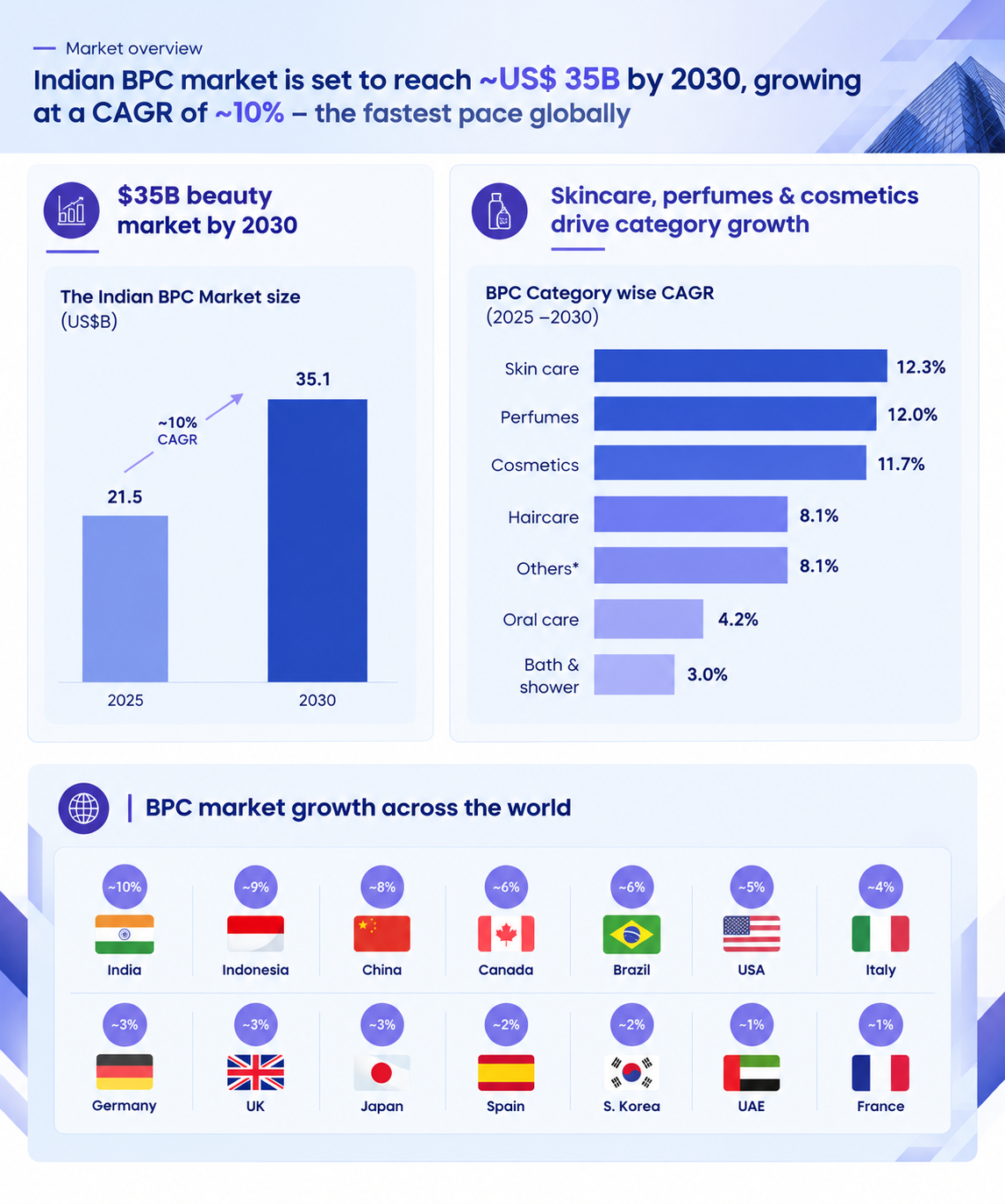
India’s beauty market is entering its next growth phase
India’s beauty and personal care industry is entering a strong growth phase. From an estimated USD 21B in 2025, the market is projected to cross USD 35B by 2030, representing an approximately 10% CAGR.
This growth is being supported by expanding disposable incomes, a digitally native Gen Z and Millennial consumer base that increasingly views skincare as self-care, and the rapid expansion of e-commerce and social commerce.
Growing female workforce participation, influencer-led brand storytelling, and consumers’ willingness to trade up for perceived value are also contributing to the market’s premiumization. At the same time, mass-affordable innovation continues to expand access to new products and categories.
For beauty and personal care businesses, these shifts point to opportunities across both premium and mass-market segments.
Category growth is creating new opportunities
Growth is not uniform across BPC categories. Skincare, perfumes, and color cosmetics are expected to grow at approximately 11–12% CAGR, supported by demand for functional actives, long-wear makeup, and fragrance products designed for different occasions.
India’s approximately 10% growth trajectory also positions the market as an important growth opportunity relative to several major global markets.
For established players, this environment creates opportunities to strengthen R&D, product innovation, and supply-chain agility. For new entrants, it opens up potential white spaces across areas such as Ayurvedic derma-cosmetics, niche fragrances, and hybrid beauty and wellness propositions.
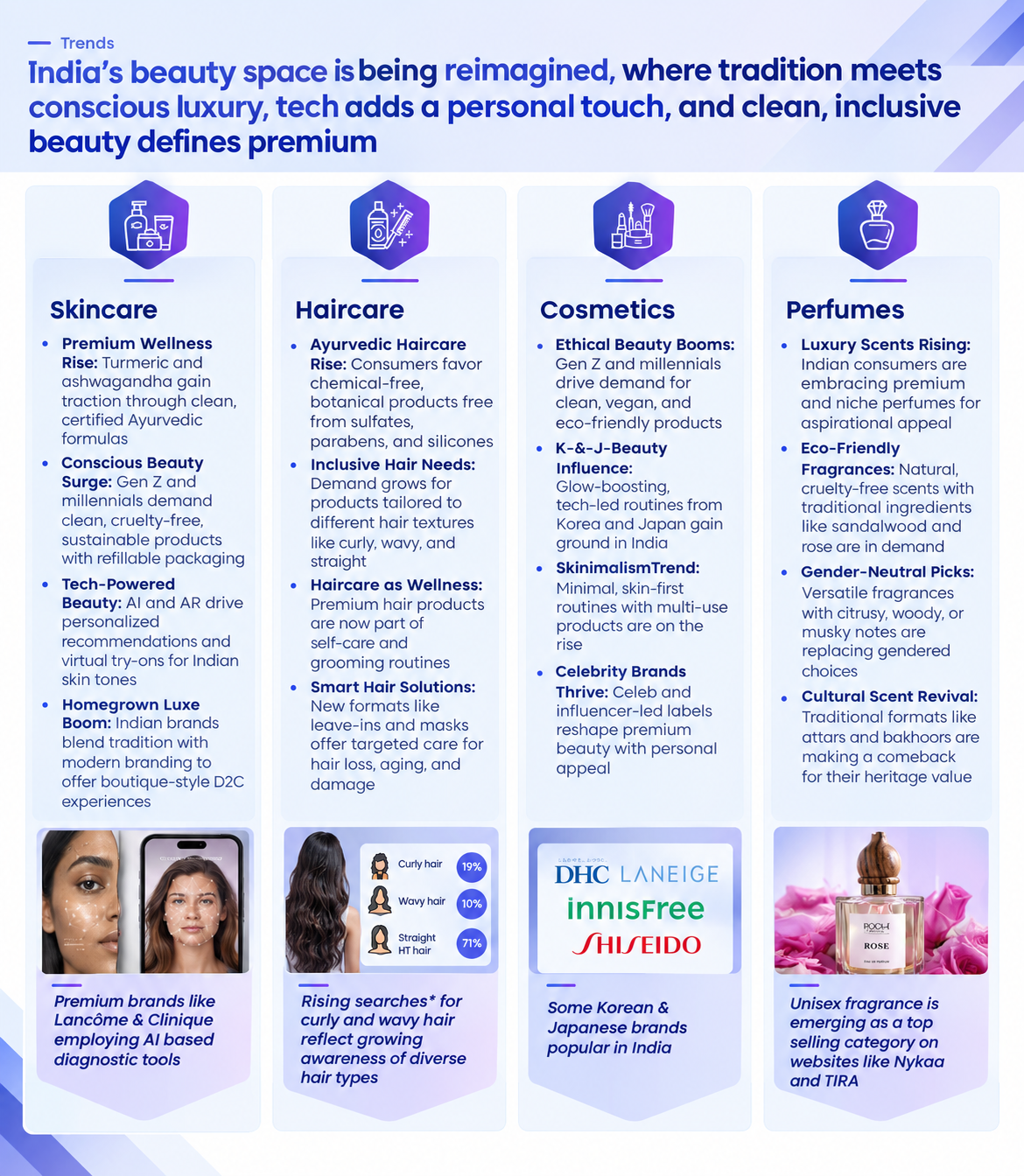
What is shaping India’s beauty and personal care market?
India’s beauty industry is evolving at the intersection of heritage, technology, and conscious consumerism.
Consumers are increasingly seeking clean, sustainable, and personalized products. This is supporting growth in premium wellness offerings, with traditional ingredients such as turmeric and ashwagandha being incorporated into modern formulations and supported by science and technology.
- Skincare and wellness: Skincare is increasingly connected to broader wellness routines. AI-enabled tools and digital diagnostics are creating new opportunities for brands to personalize product discovery and recommendations, while interest in natural and science-backed ingredients continues to grow.
- Haircare: Haircare is shifting towards health-focused and botanical formulations, alongside growing demand for solutions designed specifically for curly and wavy hair types.
- Color cosmetics: In color cosmetics, minimal, skin-first routines and hybrid makeup products are gaining traction, particularly among younger consumers and through influencer-led brands.
- Fragrance: Fragrance preferences are expanding towards niche, vegan, and gender-neutral offerings, while modern interpretations of traditional attars and bakhoors are creating new opportunities for heritage-led innovation.
Across categories, brands that can combine trust, innovation, personalization, and sustainability are well positioned to respond to evolving consumer expectations.
Where the next beauty opportunities could emerge
India’s beauty market is expanding beyond traditional category boundaries. The convergence of beauty, wellness, technology, and lifestyle is creating opportunities for businesses to rethink products, positioning, and routes to market.
For brands, the opportunity lies in identifying emerging consumer needs and translating them into differentiated propositions. This could include combining traditional ingredients with modern formulations, developing personalized beauty experiences, creating sustainable product formats, or targeting emerging consumer segments with more relevant offerings.
Understanding these shifts will be critical for businesses looking to identify attractive categories, evaluate market opportunities, and build sustainable growth strategies.
Conclusion
India’s beauty and personal care market is moving into a new phase of growth, shaped by changing consumer expectations, premiumization, digital commerce, technology, and the continued relevance of traditional beauty practices.
The projected expansion towards USD 35B by 2030 reflects the scale of the opportunity, but the bigger opportunity lies in understanding where growth is emerging across categories, consumer segments, and channels.
For beauty and personal care businesses, success will depend on translating these shifts into sharper decisions around innovation, positioning, consumer engagement, and market expansion.
India’s beauty opportunity is no longer defined by one category or consumer. It is being shaped by the convergence of beauty, wellness, technology, and changing lifestyles.