
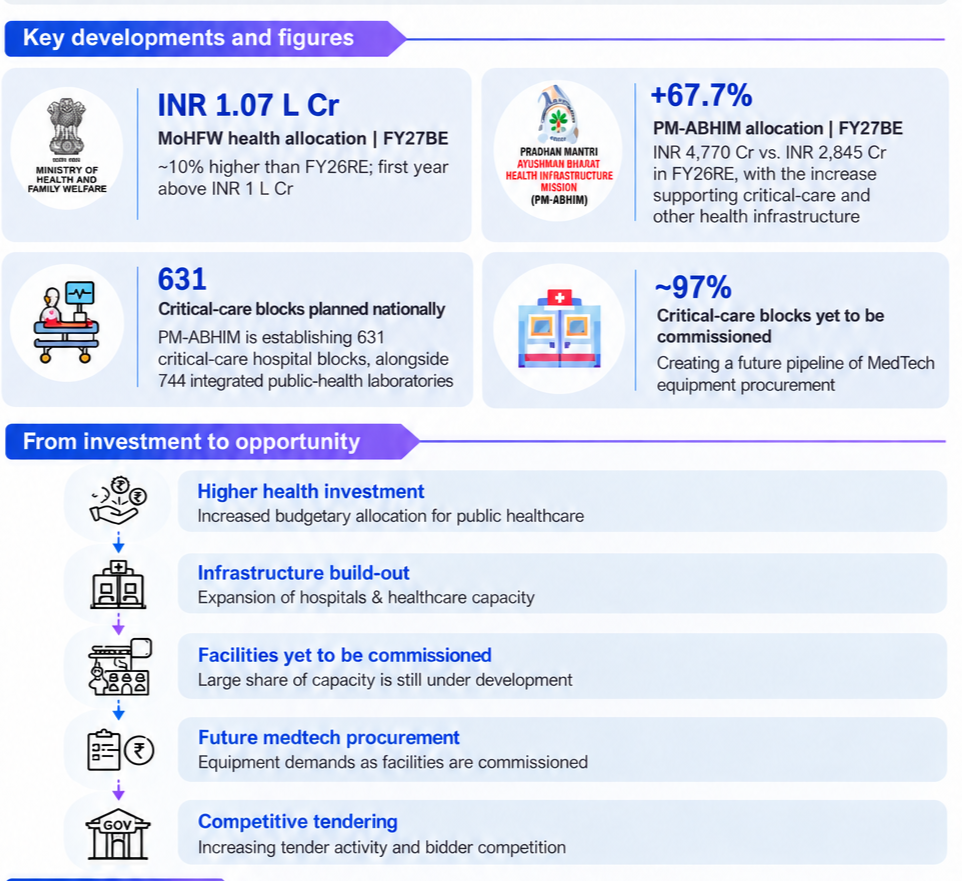
- India’s growing public healthcare investment is expanding MedTech procurement across critical care, imaging, surgical, cardiac, and laboratory categories.
- State-level tender models, pricing, localisation, service, and lifecycle requirements are increasingly shaping market access and supplier economics.
- The opportunity is moving beyond equipment sales as consumables, AMC/CMC, buybacks, and turnkey procurement create broader lifecycle revenue pools.
India’s MedTech procurement landscape is expanding as rising public healthcare investment, new hospital capacity, and infrastructure modernization translate into growing demand for medical equipment across critical care, imaging, surgical, cardiac, and laboratory categories.
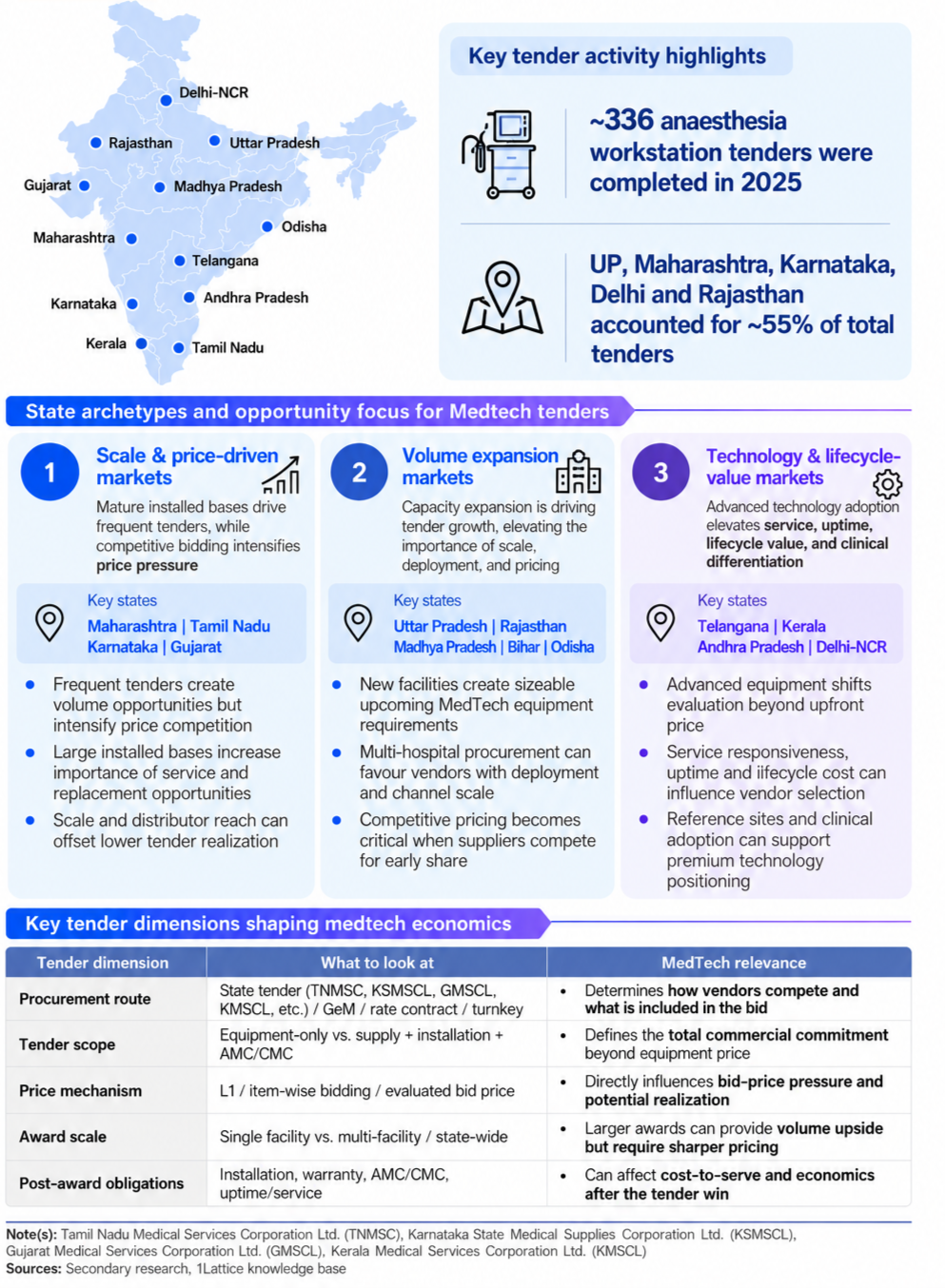
In 2025, approximately 336 completed anaesthesia workstation tenders were identified, with Uttar Pradesh, Maharashtra, Karnataka, Delhi, and Rajasthan together accounting for approximately 55% of tender activity. This highlights the concentration of public-sector demand across key states.
Procurement is increasingly shaped by state-specific tendering processes, GeM and e-procurement platforms, rate contracts, and hospital-level purchases, creating multiple entry points for MedTech manufacturers. However, converting tender activity into sustainable GTM scale is increasingly dependent on competitive pricing, local distributor coverage, technical compliance, service responsiveness, and the ability to navigate diverse state procurement requirements.
India’s expanding public healthcare infrastructure is creating a larger MedTech tender opportunity, but winning this demand is increasingly a question of price and economics
Government funding is accelerating, infrastructure is being built, and a large share of the new capacity is yet to be equipped, creating a forward opportunity for MedTech players
- India’s public healthcare expansion is creating a new wave of MedTech demand. Rising healthcare investment, new critical-care capacity and hospital modernization are translating into tangible requirements for medical equipment and technologies
- The opportunity is moving beyond conventional procurement. As public institutions increasingly adopt advanced imaging, critical care, surgical and cardiac technologies, tenders are becoming an important window into where the next pockets of MedTech growth are emerging
Key takeaway
- India's public healthcare build-out is creating a sizable forward pipeline of MedTech tenders across imaging, critical care, surgical, cardiac and laboratory technologies.
- However, with greater reliance on competitive tendering, the commercial value of this opportunity will depend on how manufacturers compete on price, manage route-to-market economics and fulfil service commitments
State-level procurement is shaping market access
India’s MedTech procurement landscape is increasingly shaped by diverse state-level tender models, with differences in procurement routes, tender scope, pricing mechanisms, award scale, and post-award obligations influencing both market access and vendor economics.
Mature markets such as Maharashtra, Tamil Nadu, Karnataka, and Gujarat are characterized by frequent tenders and competitive bidding, creating sizeable volume opportunities but greater price pressure. Meanwhile, Uttar Pradesh, Rajasthan, Madhya Pradesh, Bihar, and Odisha offer growth opportunities as new facilities and capacity expansion drive incremental equipment requirements.
In markets such as Telangana, Kerala, Andhra Pradesh, and Delhi-NCR, growing adoption of advanced technologies is placing greater emphasis on service responsiveness, uptime, lifecycle value, and clinical differentiation alongside upfront price.
Across states, the commercial attractiveness of tenders increasingly depends not only on award value but also on installation, warranty, AMC/CMC, and service commitments. This makes procurement structure and cost-to-serve critical considerations for sustainable MedTech GTM.
India’s diverse state-level tender models shape MedTech competition, pricing, award scale, and post-award economics, making procurement structure a key driver of tender profitability
Tender growth is creating opportunities, but economics matter
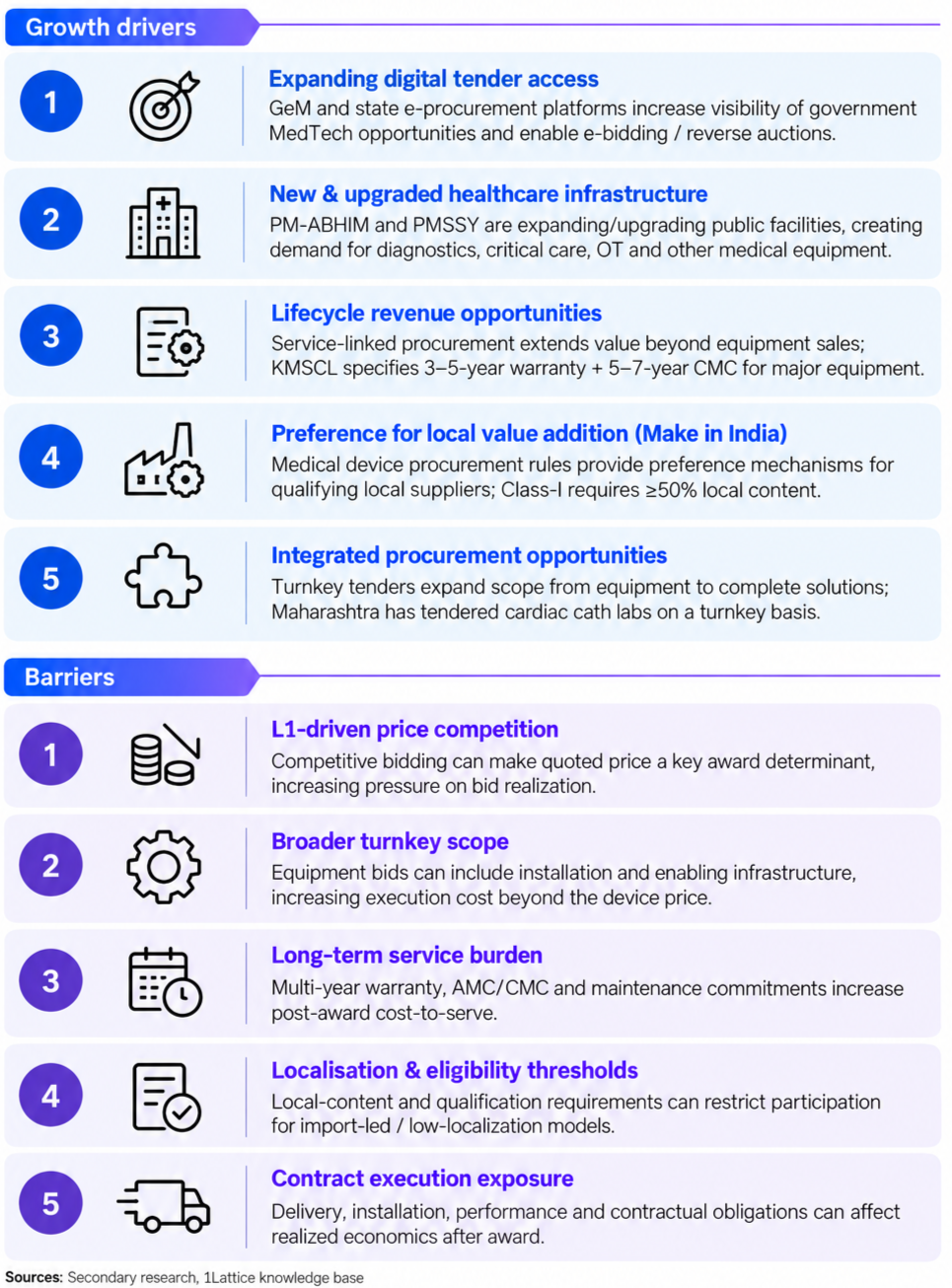
India’s expanding MedTech tender pipeline is creating meaningful growth opportunities as public healthcare infrastructure expands, digital procurement improves tender visibility, and service-led contracts extend revenue beyond the initial equipment sale.
Platforms such as GeM and state e-procurement portals are broadening access to government tenders, while PM-ABHIM and PMSSY are generating demand for diagnostics, critical care, OT, and other medical equipment.
However, tender wins do not necessarily translate into attractive economics. L1-based bidding increases price pressure, turnkey requirements can raise execution costs, and multi-year warranty and AMC/CMC obligations increase the cost-to-serve.
At the same time, localization and Make in India requirements are increasingly influencing eligibility, favoring suppliers with domestic manufacturing or local partnerships.
Overall, the commercial value of a tender depends not only on the award price but also on the scope of supply, localization requirements, service commitments, and the supplier’s ability to execute profitably over the contract lifecycle.
Expanding MedTech tender pool creates growth opportunities, but the commercial value of a win depends on bid price, tender scope, localization requirements, and post-award service commitments
Procurement is moving beyond the equipment sale
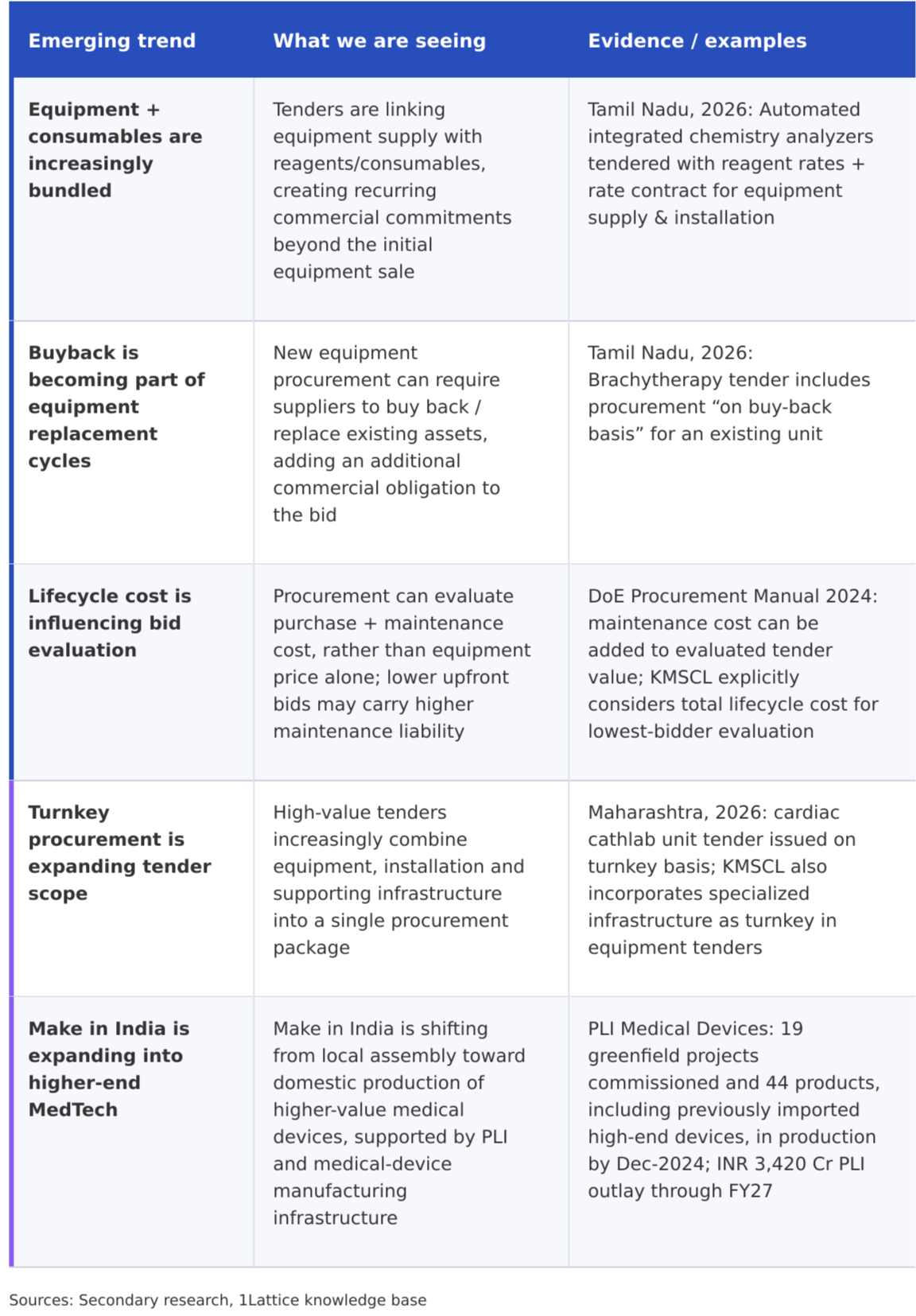
India’s MedTech procurement landscape is evolving beyond standalone equipment purchases, with tenders increasingly incorporating consumables, replacement obligations, lifecycle services, and integrated infrastructure into the commercial scope.
Equipment-plus-consumables models are creating recurring revenue opportunities, while buyback requirements are adding replacement and asset-disposal obligations to new procurements.
At the same time, total lifecycle cost is gaining importance in bid evaluation, shifting attention from upfront price toward maintenance and long-term operating economics.
Turnkey procurement is further expanding tender scope by combining equipment, installation, and supporting infrastructure, while the growing focus on Make in India is extending into higher-value medical devices, supported by domestic manufacturing initiatives and PLI-led capacity expansion.
Tender “price” increasingly represents only one part of the commercial equation, with procurement expanding across consumables, replacement, lifecycle services and integrated delivery
Summary
India’s MedTech procurement landscape is expanding, but the opportunity is increasingly shaped by how procurement happens, where demand is emerging, and what each tender requires beyond the initial equipment purchase. State-level procurement models, competitive pricing, localization, service commitments, and lifecycle requirements are becoming important considerations for manufacturers looking to build sustainable market access and GTM strategies.
How 1Lattice can help
MedIQ helps MedTech companies understand the evolving healthcare landscape and identify opportunities across markets, categories, and procurement environments. By combining market intelligence with an understanding of healthcare infrastructure, procurement dynamics, and competitive landscapes, MedIQ can support companies in assessing market opportunities, prioritizing geographies, and shaping informed GTM strategies.
From identifying where demand is emerging to understanding the factors that influence market access, 1Lattice enables MedTech players to make more informed decisions across the healthcare value chain.