
Genset lead times have gone from six weeks to two years. Indian buyers are competing for the same capacity as hyperscalers, while many Indian project models still haven't caught up.
Ask a data center developer what constrains a build, and the answer used to be land, power sanction, or capital. Increasingly, it is becoming a generator delivery date.
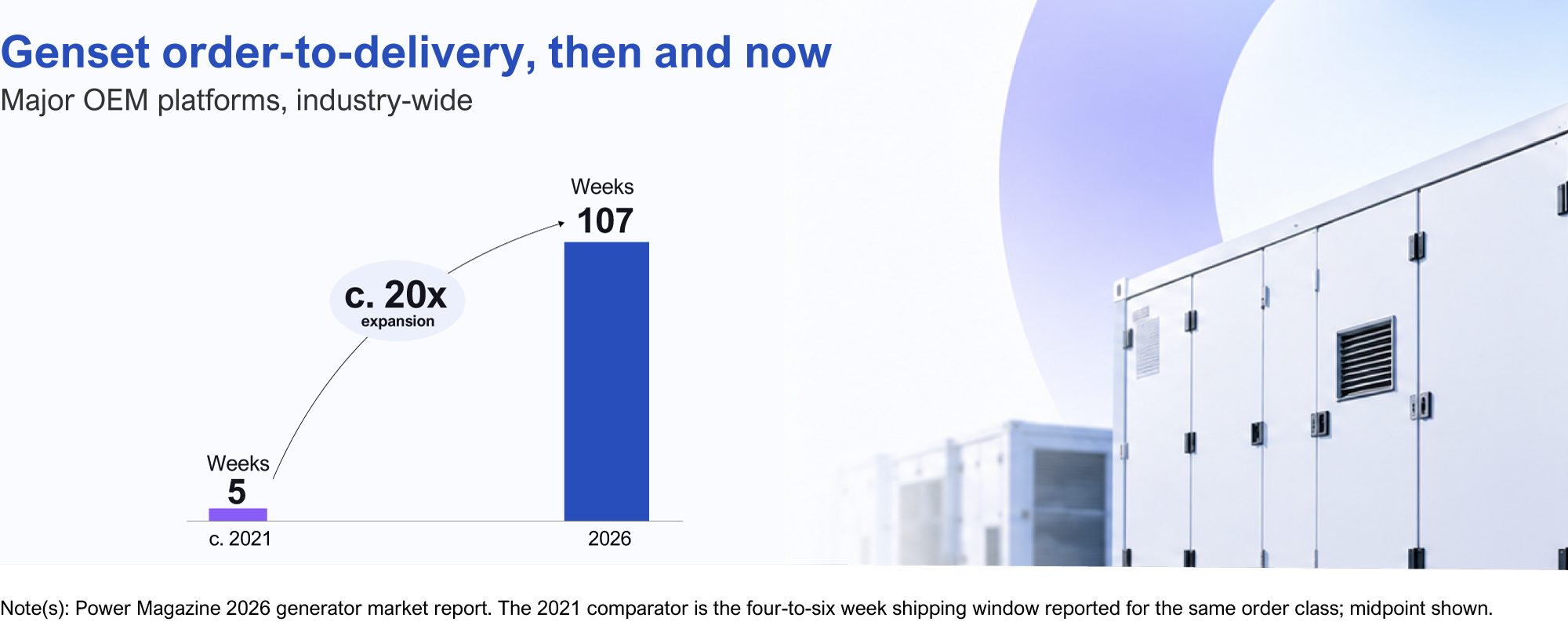
Industry-wide order-to-delivery lead times for major OEM genset platforms now run to roughly 107 weeks, according to the Power Magazine 2026 generator market report. Around 2021, the same order class shipped in four to six weeks.
Secure a slot in 2026, and the equipment may arrive in 2028.
Why this is not an ordinary cyclical tightening
The usual reading is that AI data center construction has added volume to an existing demand base. That is incomplete. What changed is the duty.
A large share of data center power procurement has moved from emergency standby to behind-the-meter prime power, with sites generating their own supply as the primary source rather than holding generation in reserve.
Prime power changes the specification, engine platform, fuel system, and service commitment. It also draws on a narrower slice of manufacturing capability than standby duty and can consume that capacity much faster per megawatt of IT load.
Demand is therefore concentrating on some of the platforms that are hardest to scale.
Cummins committed USD 150M in February 2026 to expand its Fridley high-horsepower facility and lift QSK95 output by 30%. It did so because lead times on that platform had reached eighteen months, with the order book already full into 2028. A 30% increase on one platform is a serious industrial commitment. It is not a two-year queue reduction.
Indian buyers are in the same queue, near the back
The demand pulling on this capacity is overwhelmingly not Indian. Rolls-Royce now takes over 80% of Power Systems power-generation revenue from data centres and is booking orders for 2027 and 2028. Caterpillar reported a USD 63BN backlog in Q1 2026, with power generation retail sales up 44% year on year. Cummins raised full-year guidance from 8% to 11% on data centre demand.
India holds roughly 3–4% of global installed data centre capacity while generating close to 20% of the world’s data (Rubix Data Sciences, 2026). In an allocation-constrained market, that first number is the one that matters. Allocation priority in a sold-out order book follows the size, tenure and repeatability of the customer relationship. An Indian developer bidding for the same platform slot as a hyperscaler placing multi-site, multi-year orders has very little leverage on price or sequence.
What a delayed energisation date actually costs
This can be valued rather than asserted. Delhi-NCR wholesale colocation lease rates run approximately INR 7,500–10,000 per kW per month (Eninrac, 2026), roughly USD 90–120 per kW per month. A 100 MW hall held out of service by a missing generation package therefore carries asking-rate exposure in the order of USD 9–12M for every month of delay.
Set against that, a reservation premium paid two years forward looks less like procurement inefficiency and more like cheap schedule insurance. The market has already produced the structure: Caterpillar and Hunt Energy have signed a long-term agreement that explicitly reserves OEM capacity instead of joining the queue.
Three things to do about it
- Negotiate capacity reservation at the portfolio level, not the project level, and underwrite the premium against delay exposure instead of unit price.
- Multi-source deliberately across two or three engine platforms, accepting the loss of standardisation as the price of schedule certainty.
- Treat redundancy architecture as a schedule lever. A specification met with more numerous smaller units may be deliverable far sooner than one depending on scarce large-format platforms.
There is a supply-side reading of this too, and it is the more consequential one for Indian manufacturers. A capacity-short world is the best entry window for Indian high-kVA manufacturing in twenty years, because the shortage suspends the usual barrier to entry. In a balanced market, an entrant competes on brand, installed base and service density and generally loses. In a sold-out market it competes mainly on availability. The window closes as announced global capacity comes online, and qualifying a new platform takes years, so the decision has to be made while it is still open.
This is only the beginning. Stay tuned for the next four perspectives in our five-part series on the genset capacity squeeze.
One caveat worth stating. The 107-week figure is an industry-wide average across major OEM platforms, not a quotation for any specific unit, and quoted lead times vary a great deal by platform, kVA band and customer relationship. Verify it directly before using it in a transaction.