
- Support to 17,788 rural and 11,024 urban Health and Wellness Centers
- Setting up integrated public health labs in all districts and 3,382 block public health units in 11 states
- Establishing critical care hospital blocks in 602 districts and 12 central institutions
- Strengthening of the National Centre for Disease Control (NCDC), its regional branches, and 20 metropolitan health surveillance units
- Expansion of the Integrated Health Information Portal to all States/UTs to connect all public health labs
- Operationalization of 17 new Public Health Units and strengthening of 33 existing Public Health Units at Points of Entry, that is at 32 airports, 11 seaports, and 7 land crossings
- Setting up of 15 Health Emergency Operation Centers and 2 mobile hospitals
- Setting up a national institution for One Health, a Regional Research Platform for WHO Southeast Asia Region
- Bio-Safety Level III laboratories and 4 regional National Institutes for Virology
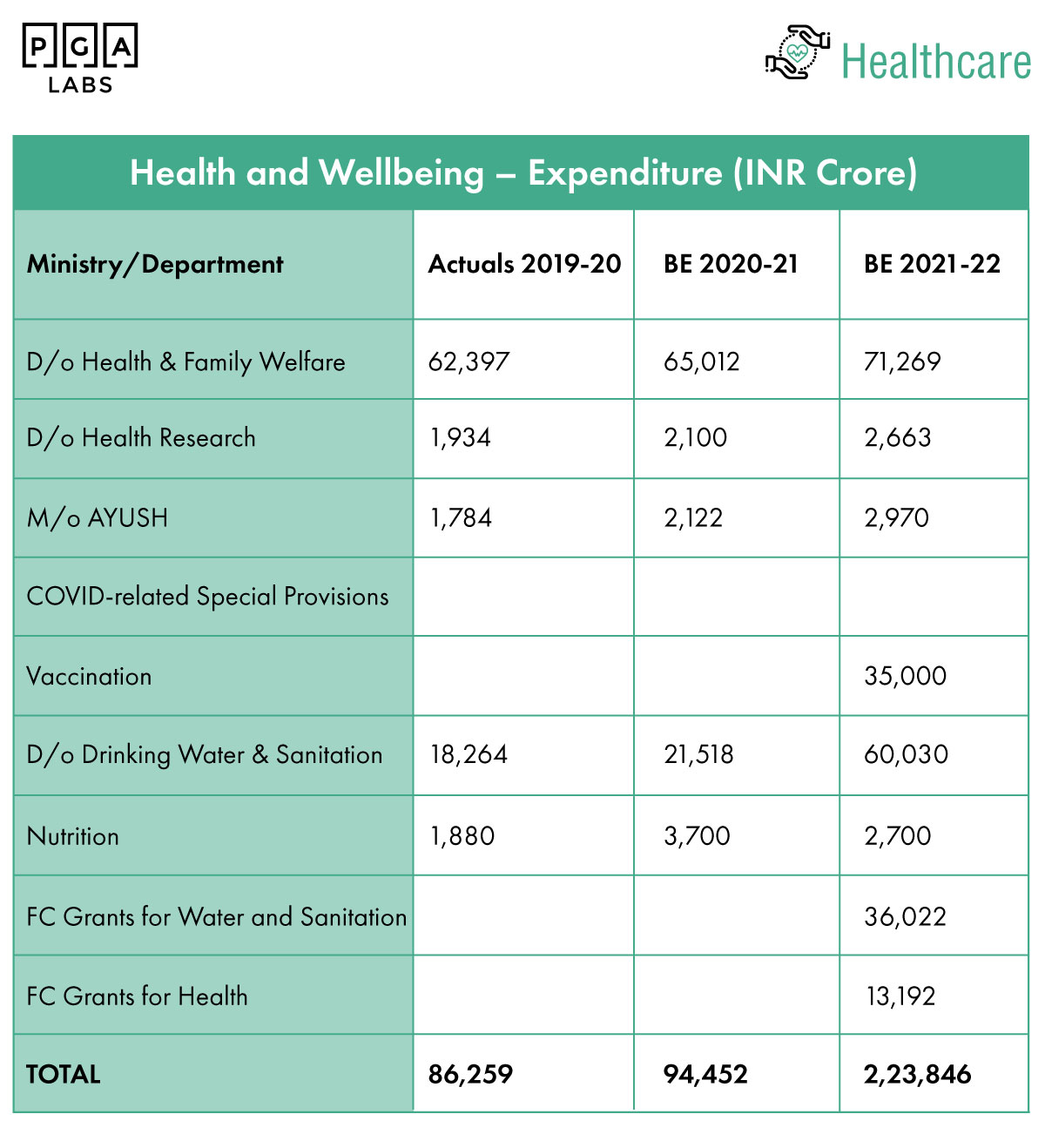
Yet another welcome measure was the proposal to increase the permissible FDI limit in insurance companies from 49% to 74%. This would help health and life insurance companies to seriously explore and invest in the country.
The budget also proposed to make available the locally made Pneumococcal Vaccine across the country to save more than 50,000 child deaths annually.
National Research Foundation (NRF) announced in 2019 - NRF outlay will be 50,000 crores, over five years. It will ensure that the overall research ecosystem of the country is strengthened with a focus on identified national-priority thrust areas.
Other notable measures in Healthcare included the introduction of the National Commission for Allied Healthcare Professionals Bill in Parliament to ensure transparent regulation for 56 allied healthcare professions. Also, kicking off reforms in the nursing profession, the National Nursing and Midwifery Commission Bill will also be introduced in the Parliament.
Authored by
Aryaman Tandon, Practice Leader, Healthcare, Praxis Global Alliance