
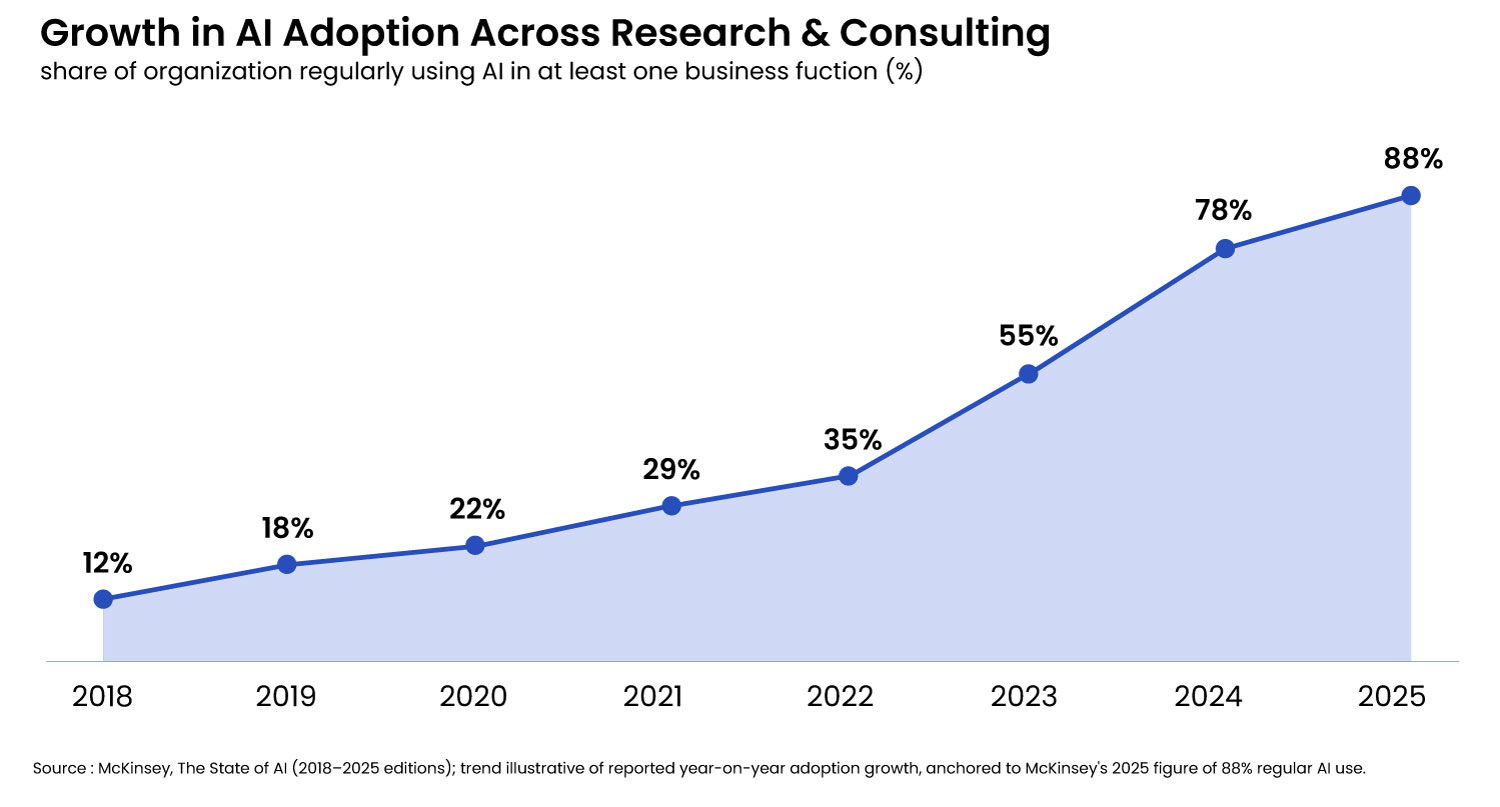
Over the past two years, AI has moved from a research curiosity to a line item in every insights budget. McKinsey's 2025 Global Survey finds that 88% of organizations now use AI regularly in at least one business function, up from 78% the year before—and research and knowledge functions are among the fastest adopters. For research organizations, the investment case is straightforward: clients want answers faster, want them grounded in more data than a 1,000-respondent survey can capture, and increasingly expect those answers to anticipate what happens next rather than simply describe what already happened.
This shift is not about replacing researchers with algorithms. It is about changing where researchers spend their time — less on data wrangling, more on interpretation, context, and strategic counsel. AI is compressing the research lifecycle, from fieldwork through analysis to reporting, while the judgment calls that make insights useful to a business still rest with people who understand the client, the category, and the moment. This newsletter looks at where that compression is happening, what it means for India specifically, and why the firms getting the most value from AI are the ones pairing it deliberately with experienced researchers rather than letting it run unsupervised.
Why AI is becoming central to market research
Five forces are pushing AI from optional to essential across the research industry in India and globally. Consumers now leave a continuous trail of opinion across reviews, social platforms, support tickets, and video—most of it unstructured and far larger than any survey sample. AI-based natural language processing and computer vision can process this volume at scale in near real time, whereas traditional coding and tagging methods cannot keep pace.
At the same time, traditional data collection is under strain. Response rates have fallen 10–20% over the last five years, according to Nielsen, and GreenBook reports 62% of research professionals now struggle to recruit participants for specialized studies. As panels get harder to fill, researchers are leaning on passive and behavioral data—transaction logs, app usage, and social signals—that AI is far better suited to structure than manual methods.
Business cycles have also compressed. Product, marketing, and category teams are unwilling to wait six weeks for a topline, and AI-assisted fieldwork management, auto-coding, and draft reporting are cutting weeks out of project timelines, provided that outputs are reviewed by experienced analysts before reaching a client. Clients increasingly want a continuous read on brand health and competitive moves rather than a single point-in-time study, which AI-powered social listening and tracking dashboards make commercially viable for the first time. And ESOMAR's Global Market Research Report points to a broader shift: machine-learning-based forecasting is increasingly sitting alongside—and in some cases ahead of—traditional descriptive surveys, because clients want to know what is likely to happen, not only what already has.

Where AI is transforming the research lifecycle
AI is not transforming research in one place — it is touching nearly every stage of the lifecycle, from design through forecasting. The table below maps the shift stage by stage.
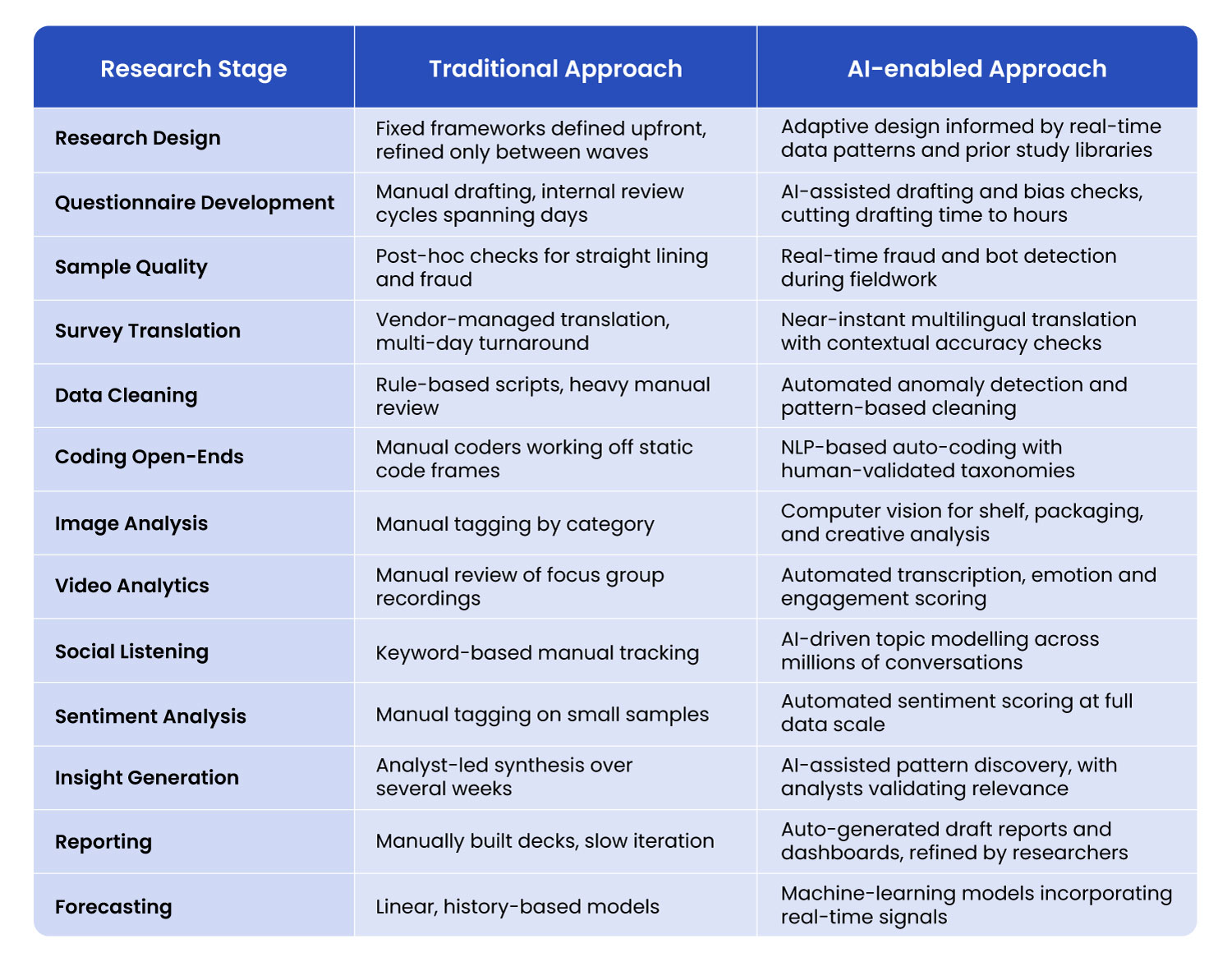
The pattern across every stage is consistent: AI absorbs the repetitive, high-volume work, while researchers retain the judgement calls — which findings matter, how to frame them for a specific client, and what a business should actually do next.
AI adoption across the industry
The shift is visible across the three groups of firms competing for research and insight budgets: market research companies, consulting firms, and technology platforms moving into analytics. Large research and data firms — NielsenIQ, Ipsos, Kantar, and YouGov among them — have spent the past two years embedding AI into existing offerings rather than launching it as a separate product line: automated coding, AI-assisted qualitative analysis, synthetic data tools for early hypothesis testing, and conversational interfaces for querying dashboards directly. The pattern is augmentation of existing infrastructure rather than wholesale replacement of survey-based methods.
Consulting firms — McKinsey, Bain, BCG, Deloitte, EY, and Accenture — are following a similar trajectory, combining proprietary data with AI-driven modelling to accelerate diligence, market sizing, and scenario planning. McKinsey's own research is instructive: while AI adoption is now near-universal, only around a third of organizations have moved past pilots to enterprise-wide scaling, and just 6% report meaningful EBIT impact from AI use. Gartner's research reinforces this — organizations with mature AI governance and workflow redesign see roughly 15% cost savings and 23% productivity gains on average, versus those that simply layer AI tools onto unchanged processes. For clients evaluating partners, the differentiator is no longer whether a firm “uses AI,” but how deliberately it has integrated AI into a disciplined, human-reviewed workflow.

AI in Indian research landscape
India presents a distinct version of this shift, shaped by the scale and diversity of its consumer base. GenAI adoption among Indian consumers is now among the highest globally: BCG's research finds GenAI awareness in India has reached 94%, with active usage at 62%, and 64% of Indian consumers now use GenAI tools as part of their purchase journey — well above many global peers. On the enterprise side, EY-CII reports that 47% of Indian enterprises now have multiple GenAI use cases live in production, with a further 23% in pilot stage.
For research specifically, this creates both opportunity and complexity. India's consumer base spans more than 20 major languages and a wide range of digital fluency levels, making vernacular research and mobile-first data collection essential rather than optional. AI-powered transcription and translation are making it commercially viable to run qualitative research at scale across regional languages — prohibitively slow and expensive with manual translation — and AI-driven video analytics are helping teams process the growing volume of vernacular social content and short-form video, a format where text-based listening tools historically struggled.
The limitations are real, however. Vernacular NLP models still perform less reliably than their English counterparts, particularly for code-mixed speech common in Indian conversation, and data infrastructure remains uneven outside metro markets. The opportunity for India's research industry lies less in choosing AI over established methods and more in building hybrid approaches that extend reach into harder-to-access geographies and languages, while keeping experienced researchers in the loop to validate what the models surface.

Human intelligence still matters
None of this changes the fundamental purpose of market research: helping a business make a better decision. AI accelerates the mechanics — cleaning data, surfacing patterns, drafting first cuts of analysis — but it does not replace the things that make research useful to a CMO or category head.
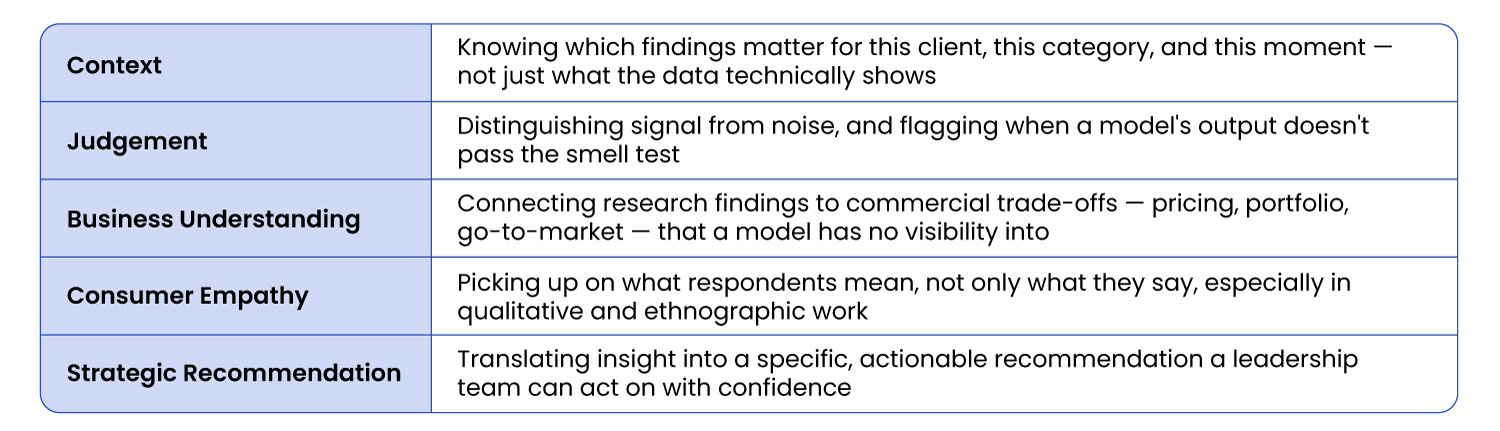
The firms extracting the most value from AI in research are not the ones automating researchers out of the process — they are the ones using AI to free up analyst time for exactly this kind of judgement-driven work. The future of the industry belongs to AI plus human expertise working together, not to one replacing the other.
What this means for business leaders
For CMOs, CXOs, and insight leaders evaluating where to invest, five practical takeaways stand out.
✓ Faster decisions — AI-compressed research timelines mean insight can now keep pace with shorter product and marketing cycles.
✓ Better customer understanding — unstructured and passive data sources, properly analysed, surface nuance that surveys alone miss.
✓ Continuous intelligence — always-on tracking replaces episodic studies, giving leaders a live read rather than a quarterly snapshot.
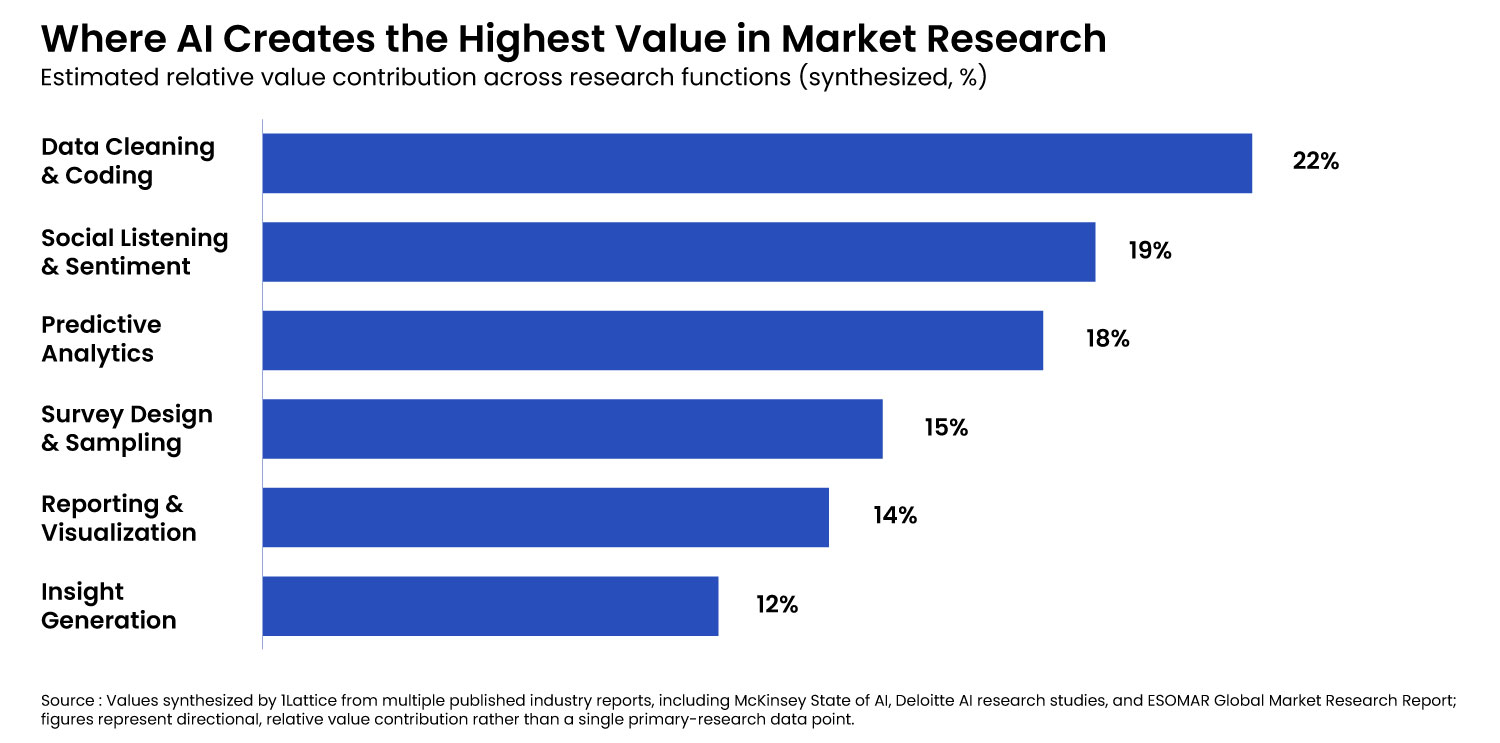
✓ Improved research efficiency — automating data cleaning, coding, and first-draft reporting frees analyst time for higher-value interpretation.
✓ Smarter strategic planning — predictive, ML-based models give leadership teams a forward-looking view, not just a historical one.
The organizations pulling ahead are not the ones with the most AI tools—they are the ones that have paired those tools with researchers who know how to ask the right questions and apply judgment to the answers. That combination, more than any single technology, is what turns data into decision intelligence.
At 1Lattice, we work with research and insight teams to build exactly this kind of approach—combining AI-enabled tools with experienced analysts who understand the business context behind the data. If you are thinking through how AI fits into your research and insights function, we would be glad to share what we are seeing across categories and discuss how we can help.