
The UPI MDR question
UPI stays free for consumers, but a nominal MDR may return for high-value merchant transactions. What the funding debate means for banks, NPCI's ecosystem partners, merchants, and the household habits built on a decade of zero-cost payments.
The government's message was carefully calibrated: UPI will remain free for citizens, and every person-to-person transaction stays untouched. But for the first time since the 2020 MDR waiver, the Finance Ministry has explicitly left the door open for a nominal, threshold-based MDR on select high-value merchant transactions, a targeted reintroduction, not a blanket levy.
The trigger is scale. UPI processed 2,366 Cr transactions worth INR 29.9 L Cr in Jul’26 alone, and the ministry's own framing was blunt: that volume requires continuous investment in cybersecurity, fraud prevention and infrastructure, and a sustainable revenue model is needed to keep private players expanding the ecosystem rather than depending on subsidies indefinitely.
Where the funding gap actually sits
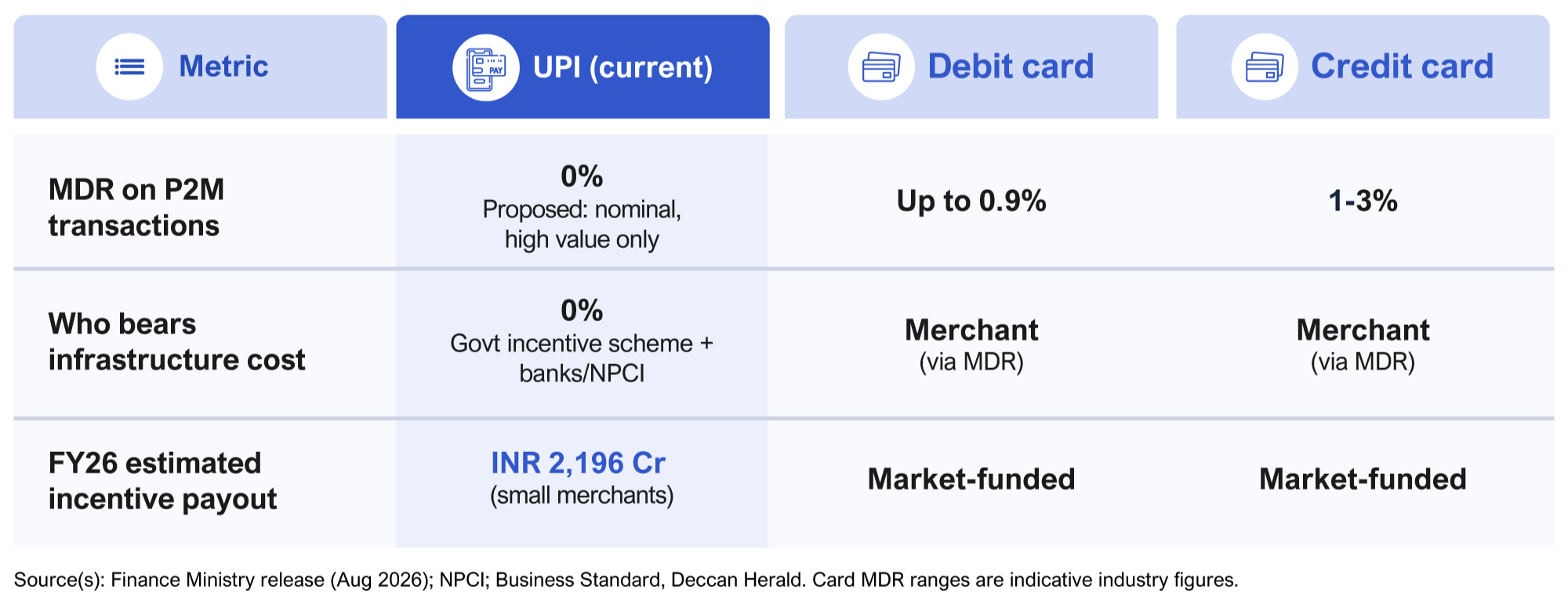
The zero-MDR regime since January 2020 has been sustained almost entirely by the government's own incentive scheme for small-merchant UPI transactions, with allocations that have risen sharply as volumes have grown, effectively socializing a cost that, in the card ecosystem, merchants pay directly. NPCI has previously discussed an MDR of around 0.3% for large merchants, still a fraction of card MDR, as the more durable alternative to perpetual subsidy.
UPI's funding model vs card rails
The same question, seen from four seats
- Banks and PSPs: A modest MDR on large-ticket merchant UPI would be the first direct revenue stream from P2M flows in six years, easing the cost burden that PSP banks have absorbed since 2020, but only at the margin, as most consumer-facing UPI volume is low-ticket.
- NPCI and fintech ecosystem: A steering committee under NPCI, not the ministry, would set any future rate, keeping pricing power within the ecosystem's own governance rather than with government, but tying its credibility to visible transparency.
- Large merchants and platforms: E-commerce, travel, and big-ticket retail are the natural candidates for a threshold-based MDR, the segments most able to absorb or pass on a nominal fee without disrupting the daily use case.
- Small merchants and consumers: Explicitly ring-fenced from any charge, the ministry has been emphatic that the "vast majority" of transactions, and all P2P flows, stay free, precisely to protect UPI's mass-adoption base.
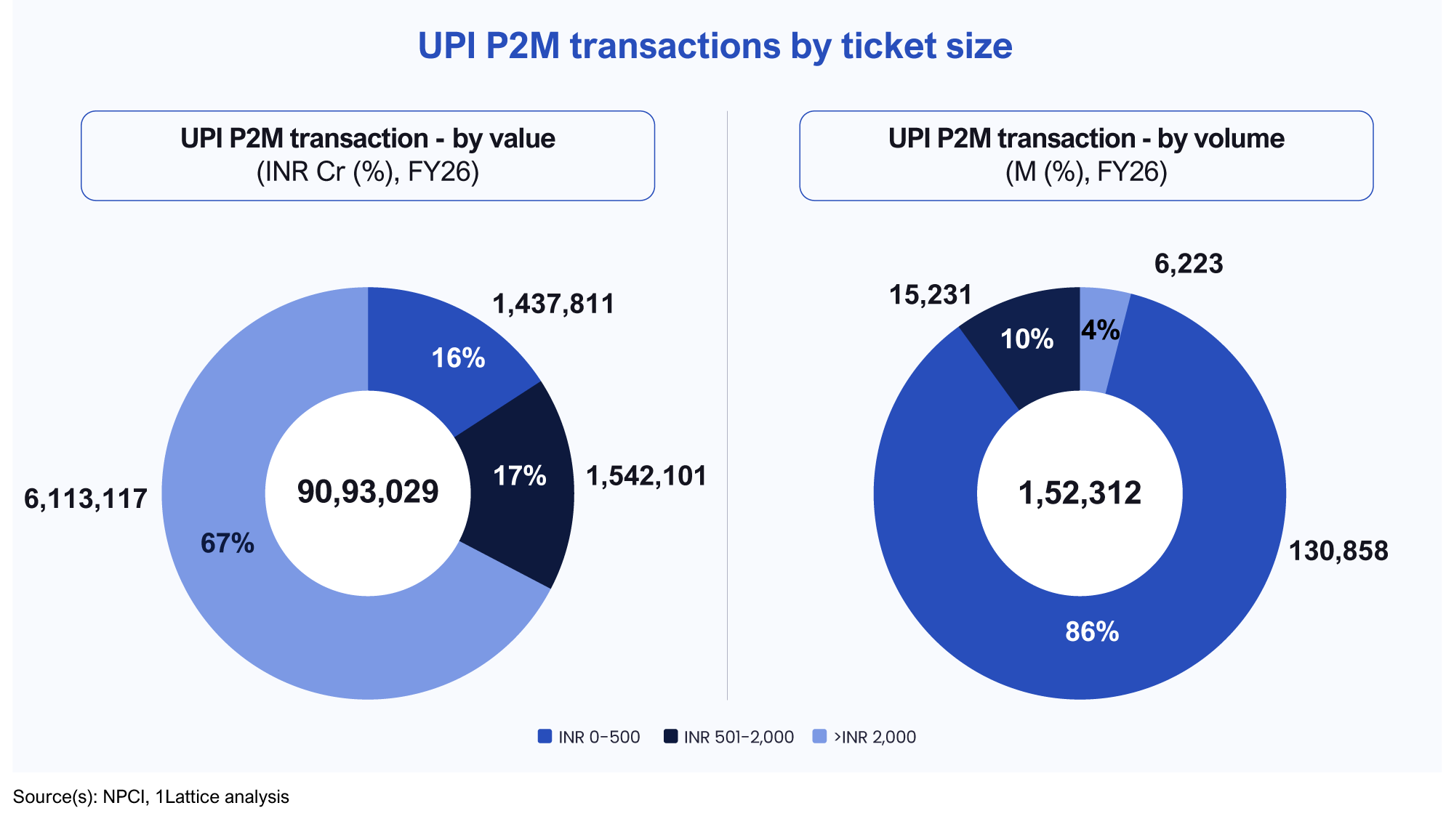
UPI P2M Transactions by ticket size: Value vs. Volume (FY26)
The 1Lattice inference
Observation: Transactions above INR 2,000 make up just 4% of P2M volume but 67% of value. This means a threshold-based MDR would apply to a narrow sliver of UPI's transaction count, roughly 1 in 25 P2M transactions, while drawing from a base worth approximately INR 61.1 L Cr. Layering the INR 50 Cr merchant turnover filter on top narrows the addressable base further still, since a portion of value even within the >INR 2,000 bucket will sit with smaller, sub-INR 50 Cr merchants who would stay exempt. This combination, a small transaction footprint paired with concentrated value, is arguably what makes a nominal MDR structurally viable here: it can generate meaningful revenue while remaining largely invisible to the 86% of P2M transactions sitting below INR 500.
Hypothesis: A threshold and turnover-based MDR is, by design, meant to be narrow in reach. For such a structure to work as a viable revenue mechanism, without unsettling the average UPI user's sense that the service remains free, it must concentrate on a segment that accounts for a small share of overall transaction volume but a meaningfully larger share of transaction value. The ticket size and merchant turnover criteria appear designed with exactly this asymmetry in mind.
Consumer behavior: the real variable
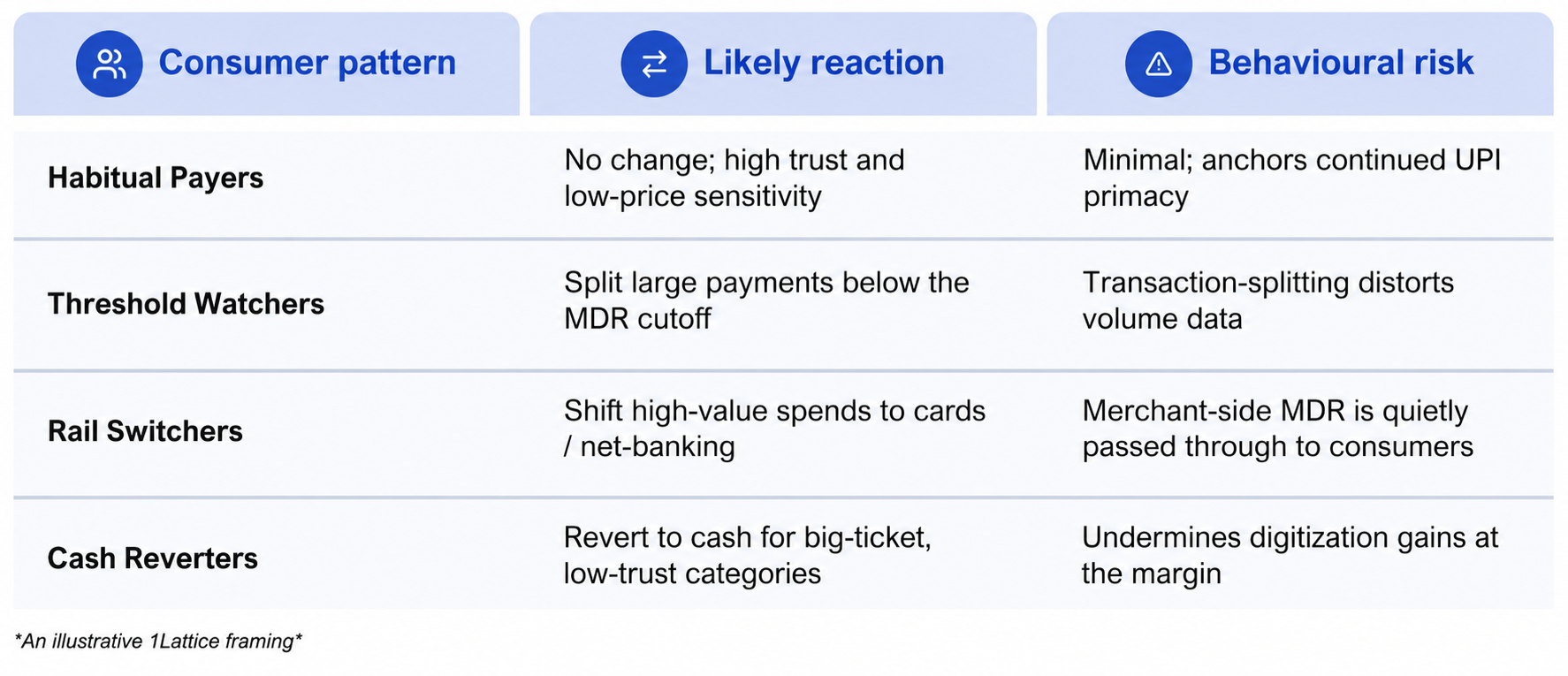
The policy carefully insulates consumers from any direct charge. But payment history suggests behavior rarely waits for a bill to actually arrive; perception moves faster than pricing. Even a merchant-side MDR risks being read by users as "UPI is no longer free", regardless of who technically pays. The last comparable moment, the 2025 GST-on-UPI rumor, showed how quickly speculation alone can dent trust, prompting the ministry to issue a rebuttal before any policy had even been proposed.
The more interesting question is not whether consumers pay, but whether they believe they do, and whether that belief changes where and how they transact.
Four consumer responses to a perceived UPI charge
The questions this opens for BFSI
Which merchant categories and ticket sizes would actually see an MDR, and do consumers even distinguish between paying a merchant's fee versus a personal charge? Whether a nominal MDR changes payment-rail choice at the point of a high-value purchase, whether card, UPI, or net banking, and whether repeated "free vs. not-free" speculation is already eroding trust in UPI as a default, independent of what policy is finally implemented. These are consumer perception questions that transaction data alone cannot answer.
How we look at it
At 1Lattice, we would approach this through primary consumer research: perception and trust tracking on UPI post-clarification, threshold and switching-behaviour studies across ticket sizes, and merchant-side willingness-to-pass-through studies to map how, or whether, any MDR reaches the end consumer in practice.
The bottom line
UPI's zero-cost era was never free; it was subsidised, and the subsidy model is now visibly straining under its own success. Whether a nominal, high-value MDR resolves that tension or simply relocates it into consumer perception will depend less on the rate the steering committee sets than on how households read the change. For BFSI players, the opportunity lies in understanding that reaction before it shows up in the transaction data.