
The Indian banking system has shown remarkable strength, remaining stable even when global markets have been unpredictable. Today, the sector is doing much more than just providing basic capital; it has become a smart, data-powered engine driving the country's real economy forward.
However, beneath this strong growth, banks are facing a new and pressing challenge: a real struggle to collect deposits. A major shift is happening in how people choose to grow their wealth. Instead of keeping their money parked in traditional fixed deposits, households are increasingly moving their savings into alternative investment options like mutual funds (MFs), systematic investment plans (SIPs), direct equity (stocks), and higher yielding small savings schemes like Public Provident Fund (PPF), Sukanya Samriddhi Yojana (SSY), National Savings Certificate (NSC), etc in search of better returns. Because of this change in consumer behaviour, banks are finding it harder to secure the everyday savings they need to fund the rising demand for loans. As India's economy continues to grow, navigating this gap between high lending and slower deposit collection has become the top priority for the banking sector.
The credit-deposit ratio: A measure of systemic pressure
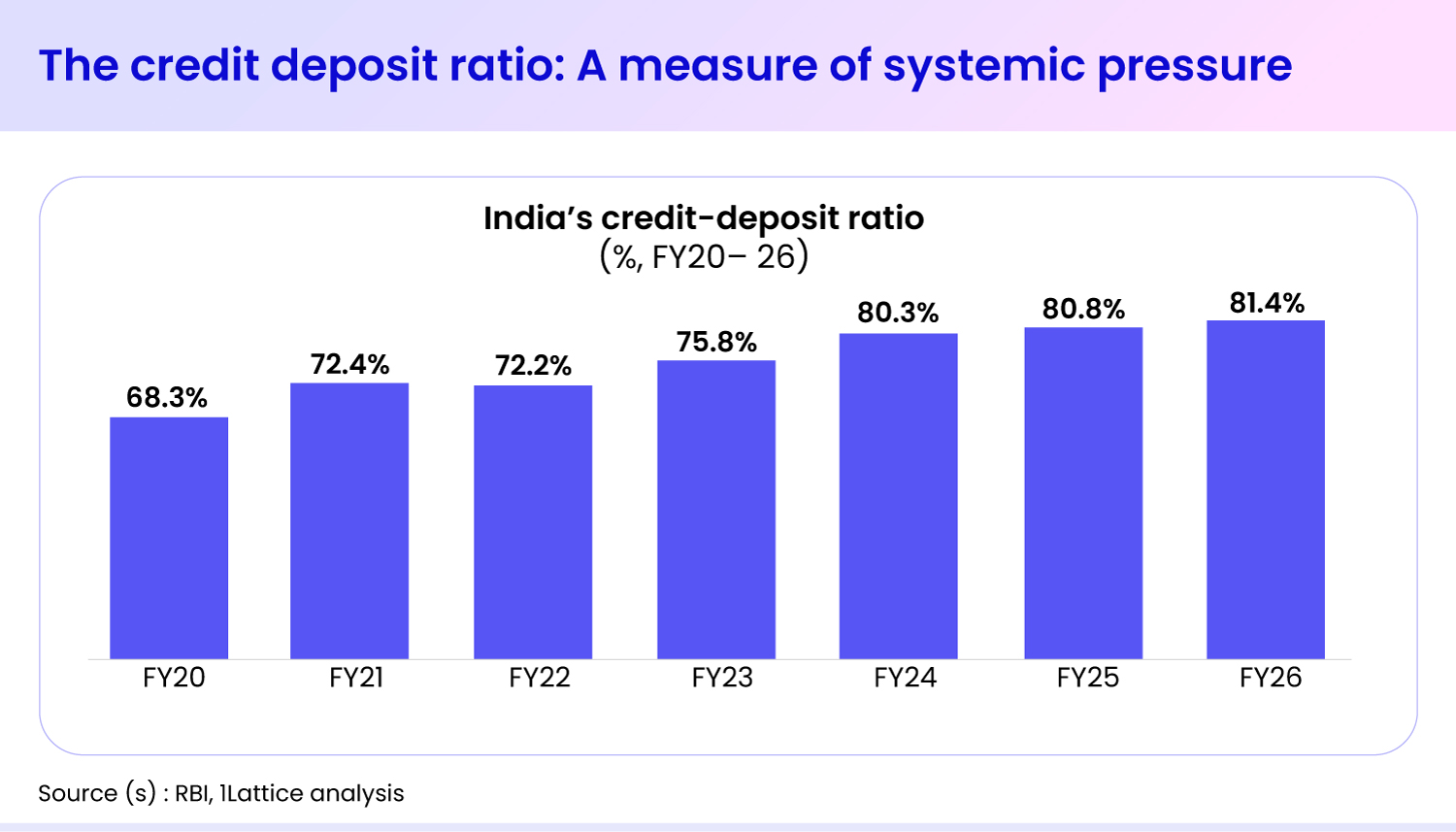
To fully grasp the magnitude of this growing tension between robust loan demand and lagging deposit collection, one must look at the industry's core operating numbers. A critical indicator of this liquidity landscape is the Credit-Deposit (CD) ratio, which measures the proportion of collected deposits that are actively deployed as loans. To put it practically, at an 81.4% ratio, banks are currently lending out more than INR 81 for every INR 100 they mobilize in savings.
This metric has experienced a steady and significant climb, moving from a comfortable 68.3% in FY20 to a highly constrained 81.4% in FY26. Historically, an increasing CD ratio reflects excellent capital efficiency, signalling that funds are being effectively channeled to fuel economic activity. However, sustaining a ratio above the 80% threshold presents a dual narrative. While it underscores a robust appetite for credit across commercial and retail sectors, it also indicates a rapidly narrowing liquidity buffer.
If banks continue to deploy capital at this aggressive pace without accelerating fresh deposit inflows to balance the scales, they will eventually reach a structural ceiling. This rising ratio clearly demonstrates that the current lending momentum is placing immense pressure on the system's available liquidity. To sustain their growth trajectories, fixing the deposit side of the equation has become a non-negotiable priority for lenders.
Analyzing the growth mismatch: Deposits vs. Lending
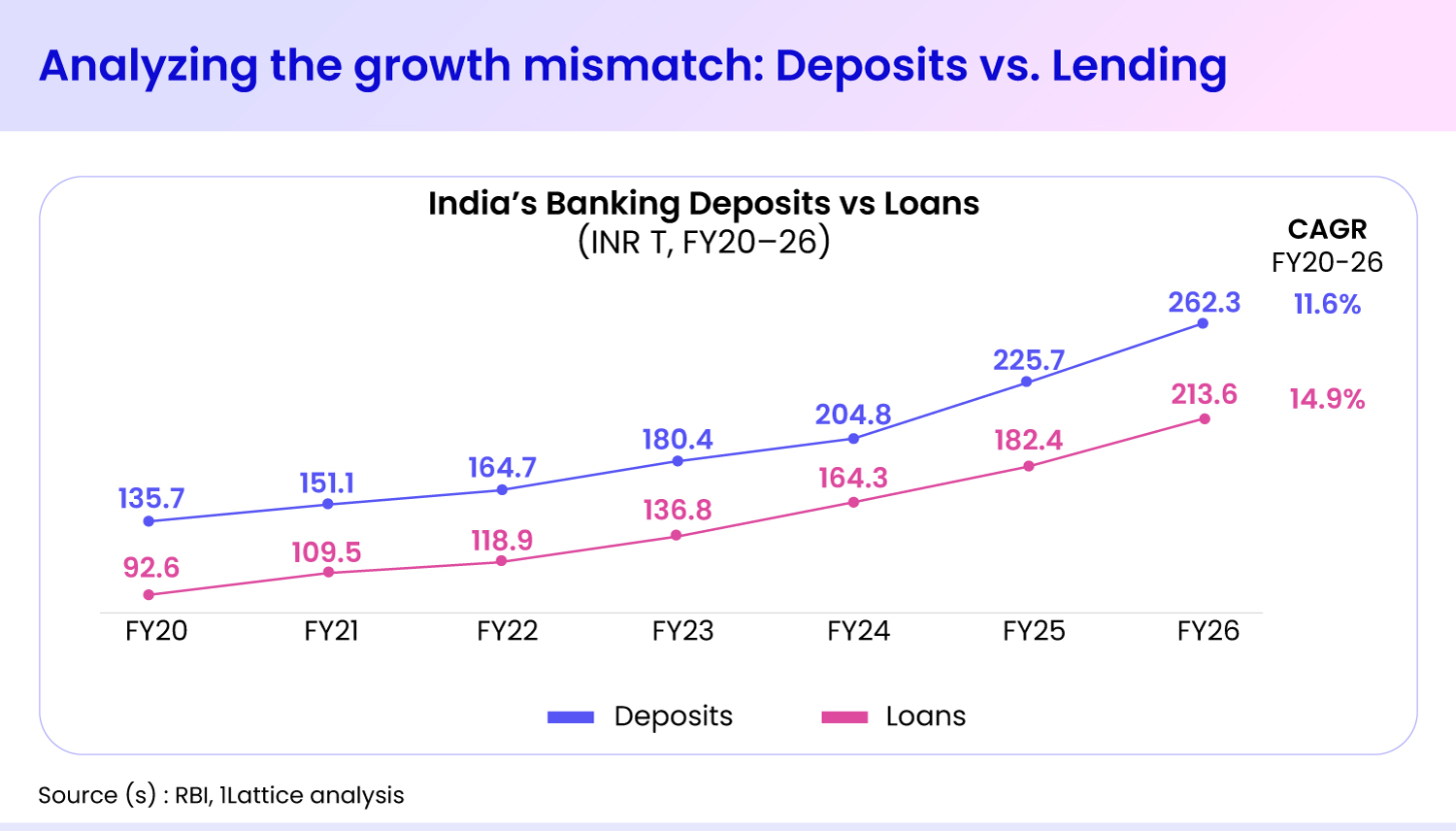
A direct comparison of deposit and loan data reveals a widening structural gap. Over the past six years, total bank loans have surged from INR 92.6T in FY20 to INR 213.6T in FY26 at a CAGR of 14.9%. This robust credit expansion highlights a persistent demand for capital across the Indian economy. In contrast, deposit mobilization has lagged. Total deposits grew from INR 135.7T to INR 262.3T over the same period, recording a notably lower CAGR of 11.6%. This sustained divergence continues to push the CD ratio higher, as banks are forced to fund rapid credit expansion with much slower deposit inflows.
Furthermore, the nature of household savings is shifting. As per the latest Report on Trend and Progress of Banking in India by the RBI, the growth of CASA accounts has moderated. Consumers are increasingly treating surplus cash as investable capital. Consequently, banks are no longer just competing among themselves for deposits; they are competing directly with the broader capital markets.
Bridging the liquidity gap: Strategies for deposit mobilization
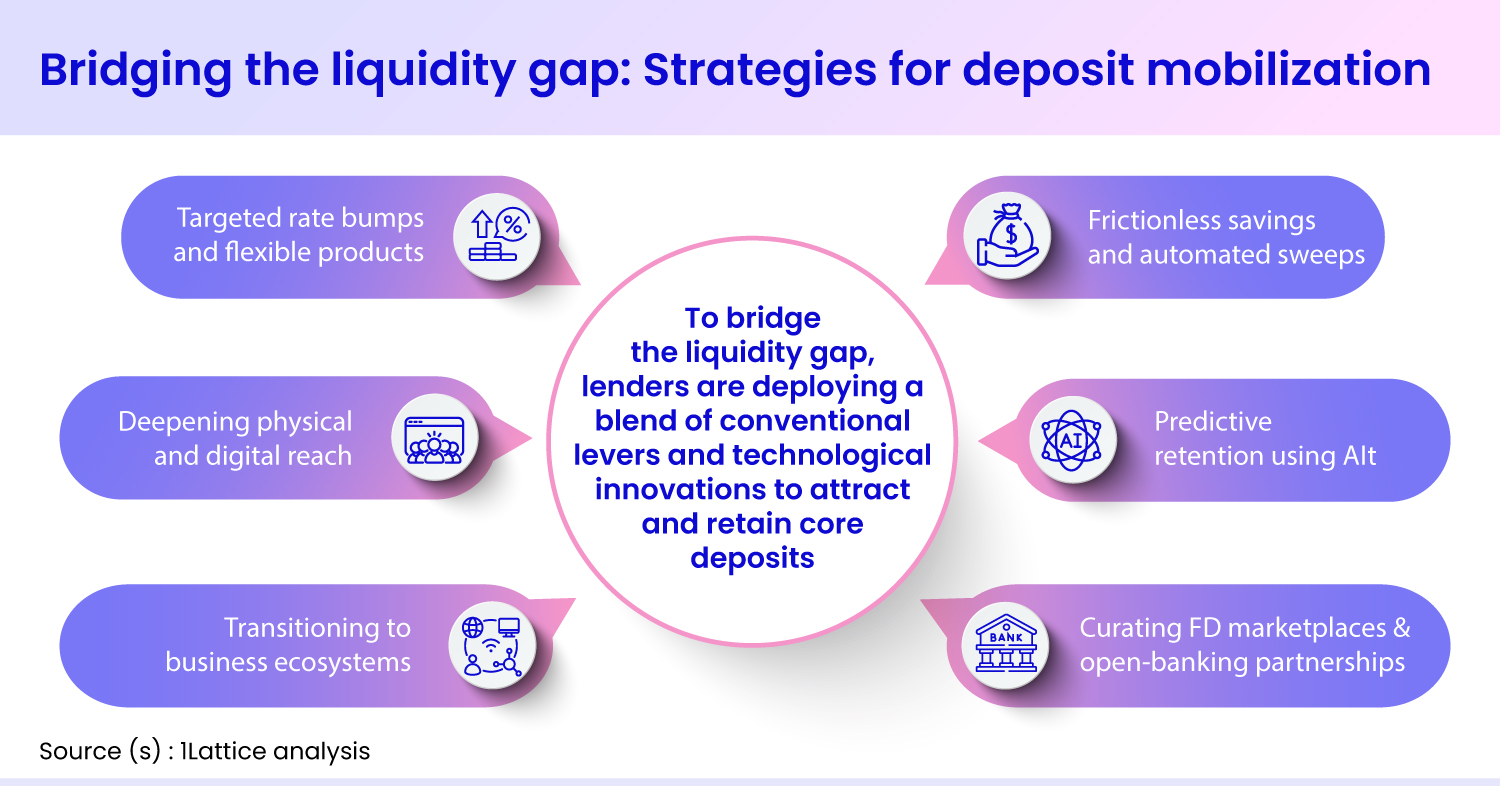
Targeted rate bumps and flexible products: Beyond standard rate hikes, institutions have introduced "special tenure" deposits like SBI’s Amrit Vrishti that offer premium rates for specific windows. Floating-rate deposits are also used by banks; they link returns directly to objective market benchmarks like government securities (G-Sec) yields or the repo rate. This allows depositors to align their returns with prevailing market conditions, effectively automating the repricing process as interest rate cycles shift.
Frictionless savings and automated sweeps: Acknowledging that convenience often outweighs minor rate differences, some banks are utilizing the "auto-sweep" features to. These tools automatically move surplus funds above a threshold into high-yield deposits, providing customers with FD-like returns while maintaining the liquidity of a savings account.
Deepening physical and digital reach: While frictionless digital onboarding via rapid e-KYC is now standard, some lenders are paradoxically doubling down on physical branch expansion. By adding locations in semi-urban and rural areas, they are tapping into "sticky" retail wealth that remains less sensitive to digital-only competition.
Predictive retention using AI: Rather than relying on static pricing, major lenders are increasingly leveraging machine learning to analyse transaction data. By identifying customers with a high propensity to move funds to brokerage accounts, banks can trigger proactive, hyper-personalized retention nudges or loyalty bonuses before a transfer occurs.
Transitioning to business ecosystems: Banks are moving beyond simple lending to become integrated operating partners for SMEs and corporates. By offering customized digital current accounts bundled with merchant acquiring services (POS, QR), payment gateways, and integrated payroll management tools, banks ensure that the daily sales and operational funds of a business flow directly into their ecosystem. This strategy focuses on building low-cost, non-interest-bearing balances by capturing the "float" between revenue collection and salary disbursements, significantly increasing the duration these funds stay within the bank.
Curating FD marketplaces and open-banking partnerships: To tap into a broader investor base, banks are moving beyond their own captive customer lists by listing their deposit products on third-party "FD marketplaces." This allows lenders, particularly smaller ones or those with limited branch networks to access retail liquidity at scale without the heavy overhead of customer acquisition. By integrating with fintech aggregators, banks can offer high-yield deposits to millions of non-account holders, significantly expanding their reach into the digital-first retail segment.
The road ahead: Building a resilient deposit ecosystem
While the structural shift in liquidity presents a significant challenge, it also marks a transformative era for Indian banking. The sector is successfully evolving from being a passive repository of funds to a proactive, tech-driven financial partner. By embracing data-led personalization and building deep operational ecosystems for businesses, banks are not just solving for the current deposit crunch but are laying the groundwork for a more resilient and consumer-centric future. As credit demand continues to soar in a growing economy, the banking system’s ability to innovate on the lending side will ensure it remains the steady, smart engine at the heart of India's financial progress.
Looking further into the future, we anticipate a deeper convergence between banking and commerce. The traditional boundaries between financial services and lifestyle platforms will continue to blur, leading to "invisible banking" where deposit mobilization happens seamlessly within the customer's natural journey. For banks, success will depend on their ability to transition from transaction processing to value creation, turning data insights into actionable financial wellness for the customer.